Switching converters, motor drives, and LED power supplies all generate conducted noise on their DC input and output rails. Two of the most common surface-mount components used to clean up that noise are ferrite beads and common mode chokes. They are not interchangeable. Choosing the wrong one can leave differential-mode noise untouched, saturate a magnetic core, or add u
ecessary DC resistance and voltage drop. This article compares the two and gives practical selection rules.
Ferrite Beads: Differential-Mode Impedance
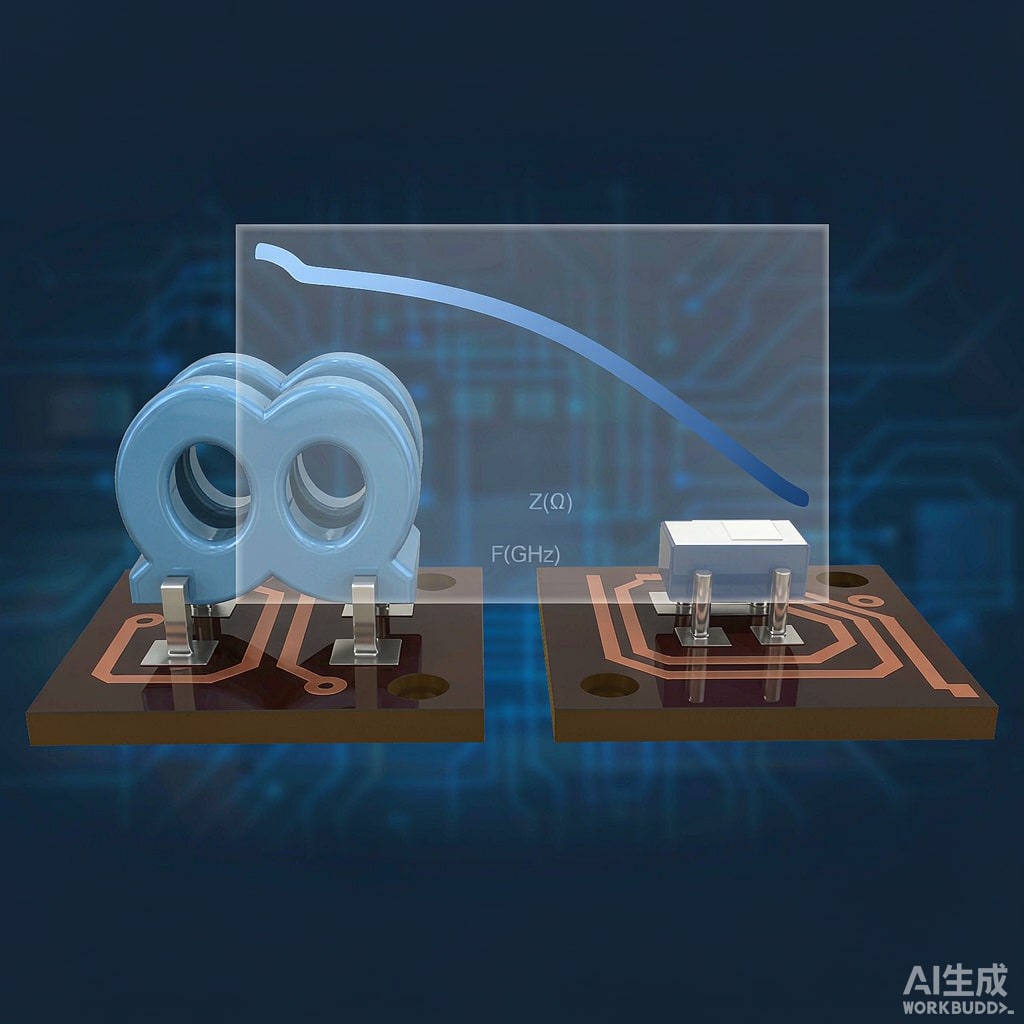
A ferrite bead is a cylindrical or chip-style component that slips over a single trace or conductor. It presents frequency-dependent impedance, appearing mostly resistive at high frequencies and mostly inductive at lower frequencies. This makes it effective at suppressing differential-mode noise—the noise that rides on the positive or negative power rail relative to ground.
Ferrite beads are compact, inexpensive, and easy to place. They are commonly used on the output of DC-DC converters to reduce switching ripple, on analog supply rails to isolate sensitive circuits, and on digital power lines to dampen high-frequency ringing. The key parameters are impedance at 100 MHz, DC resistance (DCR), and rated current. At currents above the rated value, the ferrite saturates and its impedance collapses.
Common Mode Chokes: Suppressing Asymmetric Noise
A common mode choke has two or more windings on a shared toroidal or drum core. When currents flow in opposite directions through the windings, the magnetic fields cancel and the choke presents very low impedance. When currents flow in the same direction—as common mode noise does—the fields add and the choke presents high impedance.
This makes common mode chokes ideal for asymmetric noise picked up on cables, noise coupling between input and output of isolated converters, and emissions caused by ground bounce. They are widely used on AC-DC inputs, DC bus links to motor inverters, and Ethernet or USB power pairs where both lines must remain balanced.
Impedance Curves and Frequency Range
Ferrite beads typically reach peak impedance between 100 MHz and 1 GHz, making them more useful for radiated-emission-related noise. Common mode chokes, depending on core material and winding inductance, are effective from tens of kilohertz up to several hundred megahertz. Ferrite-based chokes target higher frequencies, while iron powder or amorphous metal chokes target lower-frequency conducted noise.
When reviewing datasheets, look at the impedance-versus-frequency curve, not just a single impedance number. A bead rated at 1,000 Ω at 100 MHz may have only 50 Ω at 30 MHz, which could be inadequate for a converter switching at 500 kHz with strong harmonics.
Current, Temperature, and Saturation
Both components must be derated for temperature. Ferrite beads lose impedance as DC bias current increases, and this effect is not always shown clearly on datasheets. Common mode chokes saturate when the net DC flux in the core exceeds the material limit, which typically happens only when the two windings carry unequal DC currents. For asymmetric loads, include a safety margin on the saturation current rating.
DCR is another selection factor. A ferrite bead might add 20–100 mΩ, while a common mode choke can add 10 mΩ to several hundred milliohms. In battery-powered or high-current designs, that resistance translates directly to efficiency loss and heat.
Layout and Placement Rules
Place ferrite beads close to the load or noise source, with short traces to maintain high-frequency effectiveness. Avoid placing ferrite beads on traces that carry large transient currents unless the bead is rated for the peak current. For common mode chokes, keep the two windings symmetrical in length and placement to preserve balance. Place the choke at the cable entry point or converter boundary where common mode currents are most likely to flow.
When to Use Which
- Use a ferrite bead for differential-mode ripple on DC rails, compact filtering near ICs, and high-frequency attenuation above 100 MHz.
- Use a common mode choke for asymmetric cable-borne noise, AC line filtering, motor drive bus links, and interfaces requiring balance.
- Use both in series when both noise modes are present, with the common mode choke at the boundary and the ferrite bead closer to the load.
Conclusion
Ferrite beads and common mode chokes solve different EMI problems. A ferrite bead targets single-ended high-frequency noise on a power rail, while a common mode choke blocks noise that appears equally on two conductors. Match the component to the noise mode, verify current and temperature ratings, and review the full impedance curve before committing to a design. The right filter at the right location is often the difference between a passing EMI scan and a costly redesign.