When an SMT terminal, busbar tab, or spring contact is stamped from copper strip, the material arriving at the press is rarely in its final metallurgical state. It has been cold-rolled to thickness, and that rolling work-hardens the copper. To make the strip formable without cracking—and to give the finished contact the right strength and spring properties—most mills perform a recrystallization a
ealing step. Understanding how that a
eal works helps buyers specify the right temper, diagnose forming failures, and avoid surprises during reflow.
Why Recrystallization A
ealing Matters
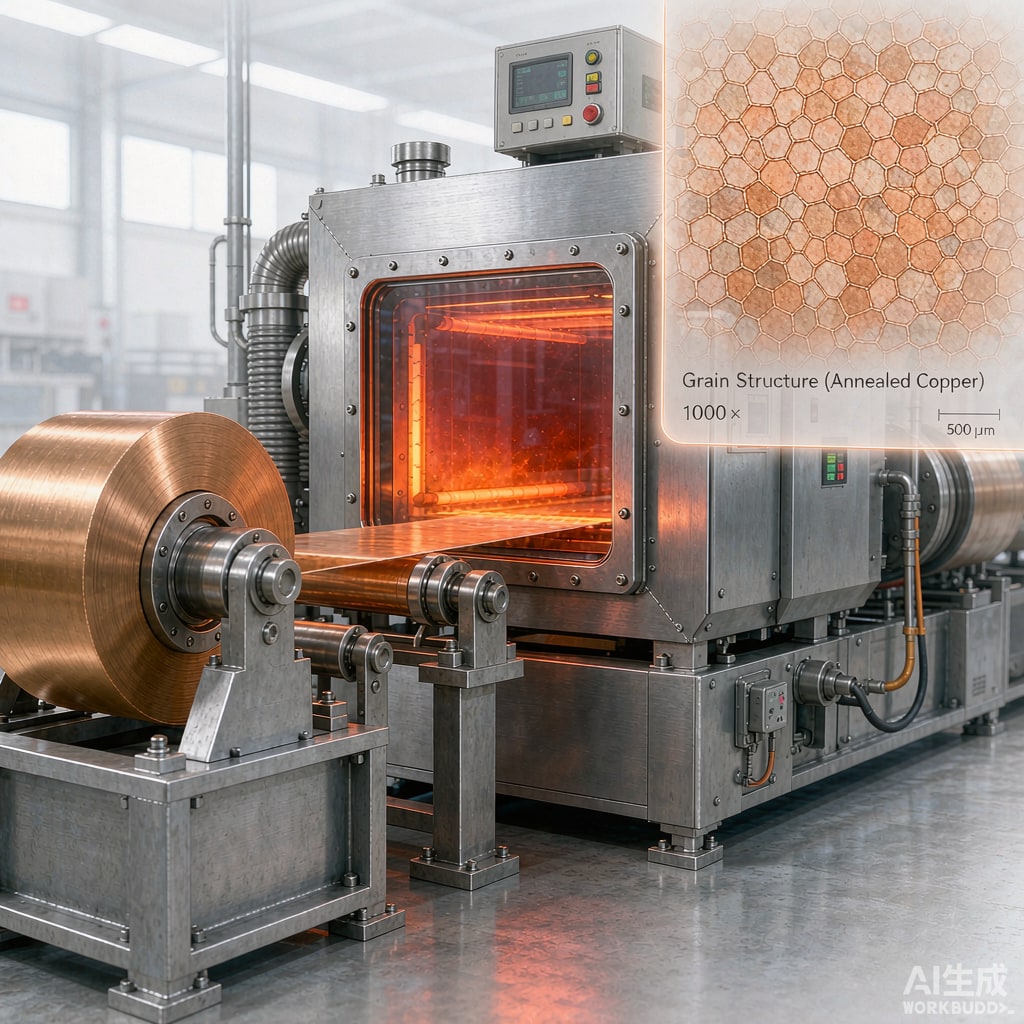
Cold rolling reduces thickness but also introduces dislocations and grain distortion. The strip becomes harder and stronger, yet less ductile. For many SMT terminals, that extra hardness would cause cracks during 90-degree bends, lancing, or coining operations. Recrystallization a
ealing heats the strip above a critical temperature so that new, strain-free grains nucleate and replace the deformed structure. The result is a softer, more uniform microstructure with predictable mechanical properties.
The two most common base alloys for SMT strip are C11000 (ETP copper, 99.9% Cu) and C19400 (Cu-Fe-P, a high-strength alloy). C11000 recrystallizes at roughly 200–280°C depending on prior cold reduction, while C19400 needs higher temperatures, typically 450–550°C, because iron and phosphorus raise recrystallization resistance. Brass and bronze alloys used in co
ector springs can require still higher a
ealing temperatures or controlled atmospheres to prevent surface oxidation.
A
ealing Temperature and Grain Size
The most important control variable is temperature. Below the recrystallization threshold, the strip merely stress-relieves; grains stay small and hardness remains high. Above the threshold, new grains grow rapidly. Higher temperatures and longer soak times produce larger grains, which improve ductility but reduce strength and can create an orange-peel surface appearance during subsequent forming.
For stamped SMT terminals, the target is usually a fine to medium equiaxed grain size—ASTM 7–10 for C11000 and ASTM 6–9 for C19400. Coarse grains below ASTM 5 can cause rough bend surfaces and inconsistent spring back. The exact grain size specification should be agreed with the mill and verified on a certificate of conformance or by metallographic cross-section.
Atmosphere and Surface Quality
Copper oxidizes quickly above 300°C. In a normal air furnace, a dark oxide scale forms and must be removed by acid pickling or abrasive cleaning before plating. That adds cost and can embed contaminants. Most high-quality strip is therefore a
ealed in a protective atmosphere—typically nitrogen-hydrogen mixtures with a dew point below -40°C—or in a vacuum furnace for premium grades.
A reducing atmosphere also brightens the strip surface and preserves solderability. For tin- or nickel-plated strip, the a
ealing step must be carefully controlled because excessive temperature can cause intermetallic growth, dull plating, or partial alloying that changes solder wetting behavior.
From A
ealed Strip to Finished Terminal
After a
ealing, the strip is usually temper-rolled to the final hardness. A light skin pass of 1–3% reduction removes coil set, improves flatness, and sets the temper—commonly soft a
ealed (OS025 for C11000), quarter-hard (H01), half-hard (H02), or hard (H04). The temper selection depends on the forming operation:
- Soft a
ealed strip
for deep draws and tight-radius bends. - Quarter-hard strip for general stamping with moderate spring requirements.
- Half-hard to hard strip for spring contacts and terminals that must retain normal force.
Practical Specification Checklist
When sourcing copper strip for SMT terminals, include the following on the drawing or purchase order:
- Alloy designation (C11000, C19400, C7025, etc.) and temper.
- Grain size range or hardness range (Vickers or Rockwell).
- Surface finish requirement: as-rolled, bright a
ealed, or pre-plated.
- Bend test criteria, especially for tight-radius formed tabs.
- Reflow compatibility if the terminal will see lead-free soldering temperatures.
Conclusion
Recrystallization a
ealing is the invisible step that determines whether a copper strip will form cleanly, solder reliably, and hold its spring force through the life of an SMT assembly. Buyers who specify only thickness and alloy miss half the story. Add grain size, temper, and atmosphere requirements to your procurement documents, and you will avoid the most common causes of cracked terminals and inconsistent contact performance.