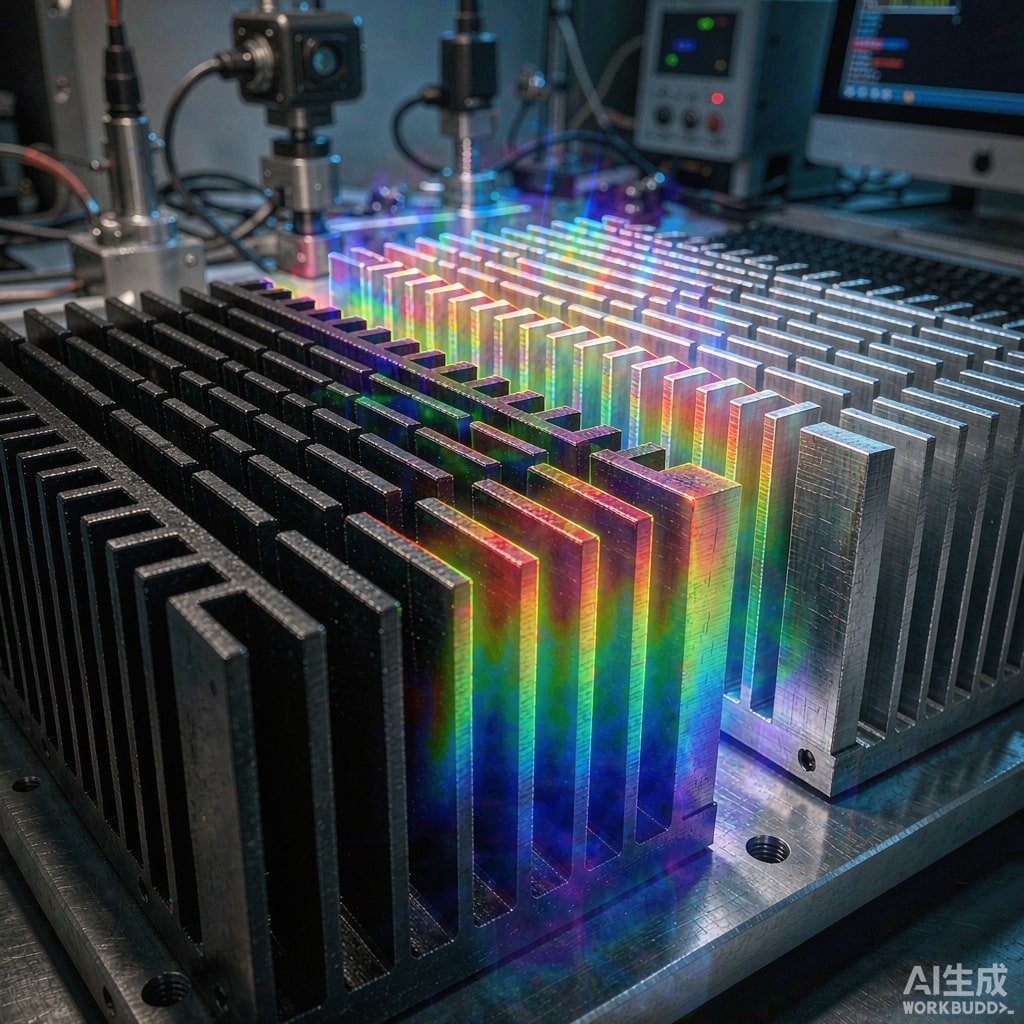
Ask an engineer why heat sinks are black and you will often hear “black absorbs heat better.” The reality is more precise and more useful: at the temperatures electronics operate, radiation is a real but secondary heat path, and anodizing is one of the cheapest levers for exploiting it. This article quantifies the effect so you can decide when the finish matters and when it is just cosmetics.
The Physics: Emissivity, Not Color
Radiated power follows the Stefan-Boltzma
law: q = ε·σ·A·(T⁴ − T_ambient⁴), where ε is emissivity (0 to 1), σ is 5.67 × 10⁻⁸ W/m²K⁴, and A is the radiating surface area. What matters is emissivity, not visible color. In the infrared — where 25–80 °C surfaces radiate — color is nearly irrelevant; texture and chemistry dominate.
Typical emissivity values
| Surface | Emissivity (ε) |
|---|---|
| Polished bare aluminum | 0.03–0.10 |
| Mill-finish (as-extruded) aluminum | 0.05–0.15 |
| Clear anodized aluminum | 0.70–0.85 |
| Black anodized aluminum | 0.85–0.95 |
| Alodine / chem-film (chromate) | 0.20–0.40 |
| Nickel-plated aluminum | 0.08–0.15 |
| Painted (any color, matte) | 0.90–0.95 |
The jump from bare machined aluminum (ε ≈ 0.05) to black anodize (ε ≈ 0.9) is an eighteen-fold increase in radiative coupling. That sounds huge — so why does it rarely halve junction temperatures?
When Radiation Actually Matters
Natural convection: 20–40 percent of total dissipation
In a passively cooled enclosure, a well-designed fi
ed heat sink with ε ≈ 0.9 typically sheds 20 to 40 percent of its heat by radiation, depending on fin spacing and orientation. Going from bare to black anodized on such a sink typically lowers component temperature by 3–8 °C at a 30–40 °C rise. In tight enclosures with hot surrounding walls, the benefit shrinks because T⁴ differences between sink and environment fall.
Forced airflow: usually under 10 percent
At air velocities above 1–2 m/s, convection dominates so thoroughly that radiative share drops below 10 percent. Anodizing a forced-air heat sink buys almost nothing thermally — do it for corrosion protection and appearance instead.
Orientation and view factor
Fins radiate to whatever they “see.” Fins pointing at a hot enclosure lid radiate poorly; fins in open air radiate well. Dense fin packs suffer self-viewing — i
er fins radiate to each other, so the effective radiating area saturates. As a rule, fin gaps below 6–8 mm gain little radiative benefit no matter the finish.
Finish Selection Rules for Practical Designs
- Natural convection, open or vented enclosure: black anodize. Cheap, durable, ε ≈ 0.9, and it doubles as corrosion protection in humid tropical climates — a real concern for equipment deployed across Southeast Asia.
- Natural convection, sealed enclosure: still anodize, but spend your effort on enclosure ventilation design and internal air circulation; radiation to hot enclosure walls gives back less than the datasheet implies.
- Forced-air sink: finish for corrosion and cost. Clear anodize or chromate is fine; black adds nothing thermal.
- Electrical requirements: chromate or bare finishes preserve surface conductivity for grounding. Anodize is an insulator — if the sink must double as a ground plane or EMI shield, mask contact points or use chromate.
- Laser or optical paths nearby: avoid bright anodize scattering; black is better for stray-light control.
Does Color Matter at All?
Practically no, for IR emission: white and black matte paint differ by less than 0.03 in emissivity. The one caveat is solar loading: outdoors, absorptivity in the visible spectrum matters. A light-colored enclosure interior behind a window runs cooler in direct sun than a black one, even though both radiate heat identically indoors.
A Quick Worked Example
Take a 100 × 100 mm fi
ed sink dissipating 15 W at a 40 °C rise above 25 °C ambient, natural convection. Radiating area (fins plus base) ≈ 0.06 m², effective view factor 0.6:
- Bare aluminum (ε = 0.08): q_rad ≈ 0.08 × 5.67e-8 × 0.06 × 0.6 × (338⁴ − 298⁴) ≈ 1.8 W
- Black anodize (ε = 0.9): q_rad ≈ 20 W — but only if every surface sees cold surroundings. With realistic self-viewing (factor 0.6), the sink radiates roughly 5–7 W.
That 4–5 W shift — about a third of total load — is exactly the order of magnitude measured in lab comparisons: black anodized sinks run a few degrees cooler than bare ones, not dramatically cooler, in natural convection.
Conclusion
Anodizing is a thermal optimization worth 3–8 °C in passive designs and roughly nothing in forced-air ones. Specify black anodize for natural-convection sinks — especially in humid climates where corrosion protection is a bonus — and specify clear or chromate finishes when grounding continuity or forced airflow make radiation irrelevant. It costs almost nothing to get right, so there is no excuse for shipping a bare-machined passive sink in 2026.