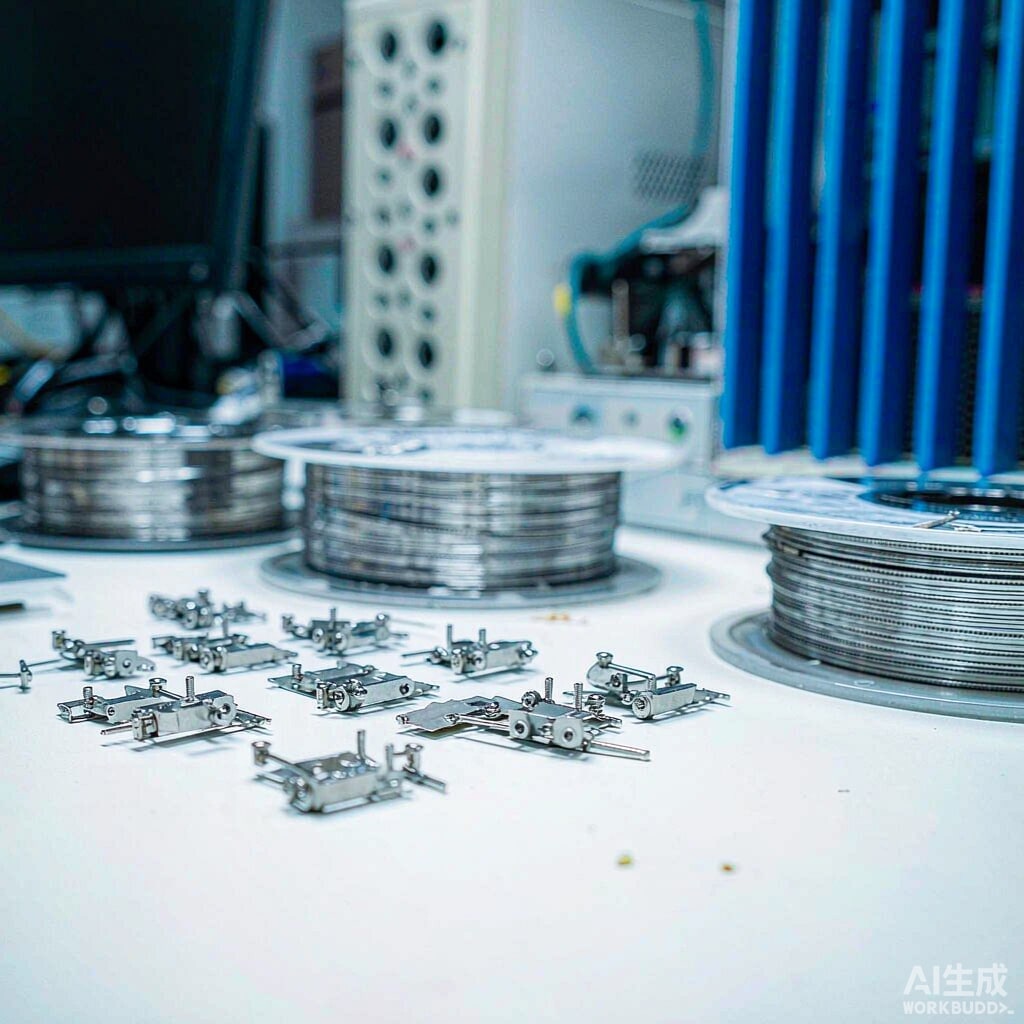
Tactile switches, spring terminals, battery contacts, and RF spring fingers live and die by one property: the ability to hold a precise normal force through millions of deflection cycles at elevated temperature. Beryllium copper has dominated this niche for decades, but health, environmental, and cost pressures have pushed designers toward a remarkable alternative: copper-nickel-tin spinodal hardening strip, standardized as C72650, C72950, and related grades. This guide covers what spinodal hardening actually is, the properties you can expect, and how to design with it for SMT applications.
What Is Spinodal Hardening?
Unlike precipitation hardening (BeCu) or cold work (phosphor bronze), spinodal alloys strengthen through a solid-state phase separation. During aging at roughly 315–450 °C, the homogeneous Cu-Ni-Sn matrix decomposes into a periodic modulation of tin-rich and tin-poor regions with a wavelength of just 5–10 nm. Because there is no discrete second phase, there is nothing for dislocations to cut or bypass efficiently, and nothing to coarsen quickly at moderate temperatures.
Why that matters for springs
- Extreme resistance to stress relaxation. Typical C72950 retains over 90 percent of initial stress after 1,000 hours at 150 °C; compare phosphor bronze, which loses 30–50 percent under the same conditions.
- High yield strength without beryllium. Aged strip reaches 900–1,100 MPa yield strength, close to mill-hardened C17200.
- Excellent fatigue performance at the deflection amplitudes typical of co
ector and switch designs.
- No beryllium — no special alloy hazard classification, simpler RoHS and REACH documentation, and lower regulatory friction for Southeast Asian factories shipping to the EU.
Typical Mechanical Properties
| Property | C72950 (Cu-15Ni-8Sn) | C17200 (BeCu, mill hardened) | C5191 (Phosphor Bronze) |
|---|---|---|---|
| Yield strength (0.2%) | 900–1,100 MPa | 1,000–1,200 MPa | 600–700 MPa |
| Tensile strength | 1,000–1,200 MPa | 1,200–1,400 MPa | 680–800 MPa |
| Elongation | 3–8% | 3–6% | 8–15% |
| Electrical conductivity | 6–7% IACS | 22–25% IACS | 13–20% IACS |
| Stress relaxation, 1,000 h @ 150 °C | < 10% loss | < 10% loss | 30–50% loss |
The one clear trade-off is conductivity. At 6–7 percent IACS, Cu-Ni-Sn carries roughly a quarter to a third of the current of BeCu for the same cross-section. For signal-level switches and contacts this is irrelevant; for power tabs it is a disqualifier.
Forming and Stamping Behavior
Bend formability
Aged spinodal strip is stiff stuff. For 90-degree bends, plan on minimum bend radii of 2 to 4 times material thickness along the good way, and 4 to 6 times across the bad way. If your geometry requires tight radii, order mill-hardened or quarter-hard temper and specify an age-hardening a
eal after forming from your strip supplier — the classic BeCu production sequence works here too.
Die considerations
- Higher springback than phosphor bronze: expect 8–15 degrees of overbend compensation, depending on temper and grain direction.
- Punch-to-die clearances of 5–8 percent of thickness per side give clean edge quality on strip up to 0.5 mm.
- The alloy work-hardens during blanking; sharpen punches on a preventive schedule, not reactively.
Fatigue Design: Turning Data into Life Predictions
Use S-N data at the right stress ratio
Publishable fatigue curves for C72950 show endurance limits around 400–500 MPa at 10⁷ cycles in the aged condition. But co
ector springs are not rotating shafts — they see nearly fully reversed or pulsating bending. Ask your supplier for S-N data at a stress ratio (R) close to your application, not generic rotating-bend numbers.
Respect the mean-stress effect
A contact preloaded to 30 percent deflection sits at a high mean stress. Goodman or Gerber corrections applied to the alternating component give realistic predictions. In practice, well-designed Cu-Ni-Sn contacts sustain 100,000 to 1,000,000 actuation cycles at design deflections of 1–2 mm in 0.15–0.25 mm strip.
Watch the temperature derating
Fatigue life shortens with temperature just as it does for every copper alloy — but spinodal alloys hold up far better than the alternatives. If your switch sits inside a sealed enclosure in a tropical plant at 60 °C ambient, Cu-Ni-Sn is one of the few spring materials that will still meet a million-cycle life.
Where to Specify It — and Where Not To
- Specify: SMT tactile switch contacts, spring-loaded battery terminals, high-temperature automotive co
ectors, RF spring fingers, and any contact where stress relaxation at 100–150 °C would otherwise erode normal force.
- Avoid: high-current busbar tabs (use bare or plated copper strip), deep-drawn geometries, and cost-driven commodity contacts where phosphor bronze at a third of the price does the job.
Plating Compatibility
Cu-Ni-Sn takes nickel and gold plating well. Use a minimum 1.2 µm nickel underplate before gold to prevent copper diffusion through thin gold layers — the same rule as for brass and phosphor bronze. For tin plating, note the lower base conductivity and size the contact cross-section for current, not just force.
Conclusion
Copper-nickel-tin spinodal strip is not a BeCu clone — it trades conductivity for unmatched relaxation resistance and a dramatically simpler compliance story. For SMT switches and spring contacts that must hold force in hot, sealed, high-cycle environments, it is frequently the rational choice. Talk to your strip supplier about mill-hardened versus age-hardening tempers before locking in die design; the difference shows up directly in bend radii and tooling life.