Introduction to Jet Impingement Cooling for SMT Modules
As power densities in surface-mount technology (SMT) modules continue to climb—driven by wide-bandgap semiconductors such as SiC MOSFETs and GaN HEMTs—traditional cooling methods often reach their limits. Jet impingement cooling has emerged as a highly effective thermal management strategy for high-power SMT modules, delivering localized heat transfer coefficients that far exceed those of natural convection or even conventional forced-air cooling. By directing a high-velocity fluid jet directly onto the heat-generating surface, engineers can achieve heat flux removal rates exceeding 100 W/cm² in practical systems.
Fundamentals of Impingement Heat Transfer
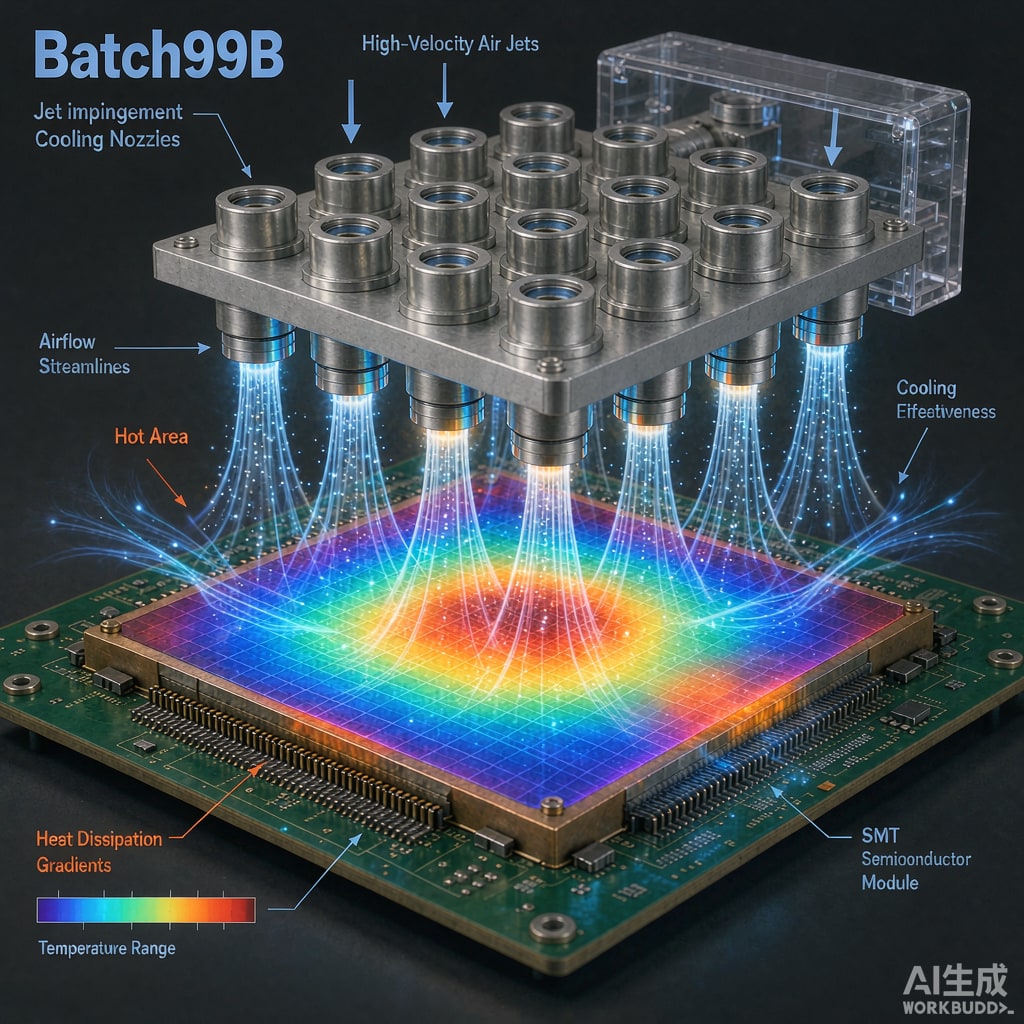
The heat transfer mechanism in jet impingement cooling is governed by the thin boundary layer that forms where the jet strikes the target surface. In the stagnation region directly beneath the nozzle, the boundary layer is extremely thin, resulting in very high local heat transfer coefficients. As the fluid spreads radially outward, the boundary layer thickens and heat transfer efficiency gradually decreases. This spatial variation is a key consideration when designing cooling systems for SMT modules with non-uniform heat generation.
Key Dimensionless Parameters
Several dimensionless groups characterize jet impingement cooling performance:
- Reynolds number (Re): Re = ρVD/μ, where V is jet velocity and D is nozzle diameter. Typical values for electronics cooling range from 2,000 to 50,000.
- Nusselt number (Nu): Nu = hD/k, relating convective to conductive heat transfer. Correlations such as Nu = 0.725 Re^0.5 Pr^0.33 are commonly used for single round jets.
- Nozzle-to-target spacing (H/D): The ratio of nozzle standoff distance to nozzle diameter significantly affects jet development and heat transfer uniformity.
- Prandtl number (Pr): For air (Pr ≈ 0.71) and dielectric fluids such as FC-72 (Pr ≈ 8.5), property differences lead to distinct design optimizations.
Nozzle Design Optimization
Nozzle geometry is the primary lever for controlling jet impingement cooling performance. The main nozzle configurations used in high-power SMT module cooling include:
Round Jets
Single or arrays of round nozzles are the most common configuration. For single round jets, maximum heat transfer occurs at H/D ≈ 6–8, where the jet is fully developed but has not yet begun to dissipate. Arrays of round nozzles require careful spacing (typically S/D = 4–8) to balance coverage area against jet interaction effects, which can create recirculation zones that reduce local heat transfer.
Slot Jets
Slot nozzles produce two-dimensional jets that are well-suited for cooling elongated heat sources such as IGBT modules or linear LED arrays. Slot jets generally provide more uniform cooling across the length of the target but may exhibit lower peak heat transfer coefficients compared to round jets of equivalent hydraulic diameter.
Orifice Plate Arrays
Micro-orifice plates with hundreds of sub-millimeter holes enable very high nozzle density, approaching the performance of showerhead configurations used in semiconductor manufacturing. These designs are particularly effective for cooling large-area SMT modules with multiple hot spots, as the dense jet array minimizes the influence of the wall jet region where heat transfer degrades.
Fluid Selection and Two-Phase Enhancement
While air is the most common working fluid due to its availability and simplicity, liquid coolants offer dramatically higher heat transfer coefficients. Water provides the highest single-phase performance but requires careful electrical isolation when used with powered SMT modules. Dielectric fluids such as perfluorocarbons (FC-72, FC-87) eliminate electrical conductivity concerns but have lower specific heat capacity and higher cost.
Two-phase jet impingement cooling, where the coolant undergoes partial vaporization upon contact with the hot surface, can achieve heat transfer coefficients exceeding 10,000 W/m²·K. Spray cooling, a related technique where liquid is atomized into fine droplets rather than formed into coherent jets, offers even higher performance but introduces complexity in fluid delivery and collection.
Practical Implementation for SMT Modules
Integrating jet impingement cooling with SMT assemblies requires attention to several practical constraints:
- Component height variation: SMT modules often have components of varying heights (passives, co
ectors, heatsinks). The nozzle array must accommodate this topology, or a flat impingement surface must be created through thermal interface materials or direct-bonded copper spreaders.
- Pressure drop and pumping power: Higher jet velocities improve heat transfer but increase pressure drop quadratically. System-level optimization must balance thermal performance against fan or pump power consumption.
- Condensation management: In two-phase systems, condensate must be efficiently removed from the module surface to prevent liquid accumulation that could impede jet development or cause electrical shorts.
- Reliability and maintenance: Nozzle clogging from particulates or mineral deposits (in water systems) can degrade performance over time. Filtration and periodic cleaning protocols should be established.
Case Study: SiC Inverter Module Cooling
A 100 kW automotive SiC inverter module with junction temperatures targeted below 150 °C was cooled using an array of 1.0 mm diameter air jets at H/D = 6 and Re = 15,000. Compared to a conventional aluminum heatsink with forced convection, the jet impingement system reduced thermal resistance from junction to ambient by 42%, enabling a 30% reduction in heatsink volume. The trade-off was a 25% increase in cooling system power consumption, which was deemed acceptable given the packaging space savings.
Conclusion
Jet impingement cooling represents a powerful tool in the thermal management arsenal for high-power SMT modules. Through careful nozzle design, fluid selection, and system integration, engineers can achieve heat removal rates that enable the next generation of power-dense electronics. As wide-bandgap devices become mainstream, expect jet impingement and related advanced cooling techniques to play an increasingly central role in SMT thermal design.