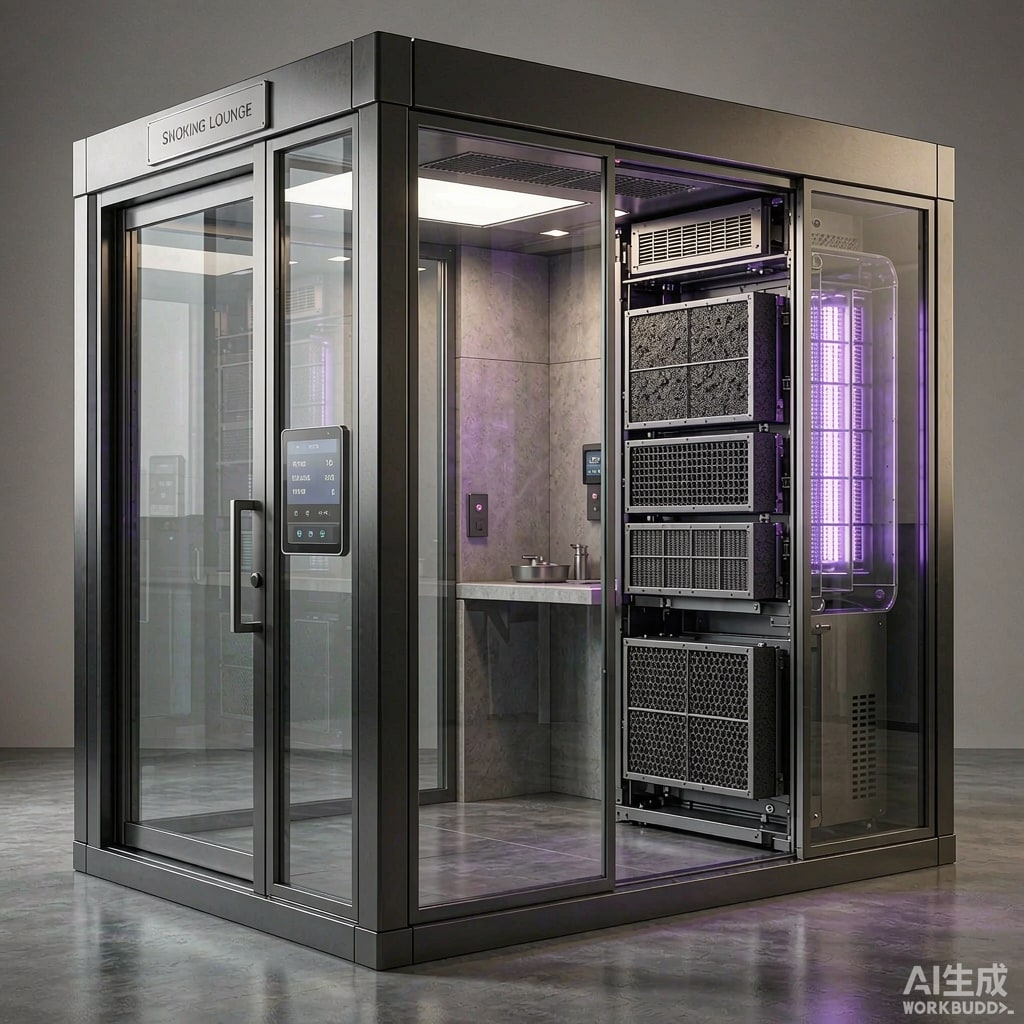
An indoor smoking booth lives or dies by two numbers: whether smoke stays inside, and whether odor stays inside. Ventilation handles the smoke; odor is harder, because the residual smell of tobacco comes from hundreds of semi-volatile organic compounds that linger on surfaces and in air long after the visible haze clears. Two technologies dominate odor control in commercial smoking booths — activated carbon adsorption and photocatalytic oxidation (PCO) — and they work so differently that choosing between them (or combining them) determines long-term user and neighbor satisfaction.
How Activated Carbon Adsorption Works
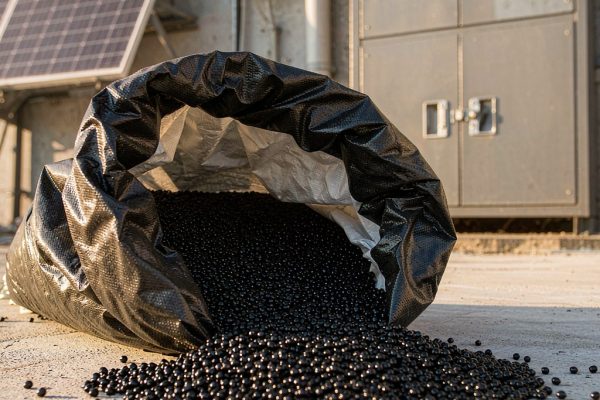
Activated carbon is a sponge at the molecular scale: a gram of properly activated carbon presents over 1000 m² of internal surface. Gas-phase odor molecules diffuse into pores and stick by van der Waals forces (physisorption). Nothing is destroyed — molecules are captured and held — which is both the strength (broad-spectrum, works on almost all tobacco VOCs) and the limitation (finite capacity, and the bed eventually saturates).
Sizing and Maintaining a Carbon Bed
- Use the right form: pelletized or thick-bed carbon gives low pressure drop and high capacity; thin “carbon-impregnated foam” prefilters have trivial capacity and are for polish, not primary control.
- Empty bed contact time (EBCT) of 0.2–0.5 s is the usual design target for odor control — for a booth moving 1000 m³/h, that means roughly 60–140 cm³ of carbon per 1000 m³/h… in practice, cartridge banks sized for 0.5–2 kg of carbon per 100 m³/h of airflow.
- Humidity matters: water vapor competes for adsorption sites above roughly 60% RH, cutting effective capacity for the lighter odor molecules. Well-designed booths dehumidify or at least avoid carrying humid air straight through the bed.
- Change-out discipline: at typical booth duty, expect 3–6 months per bank. Replace on schedule or on VOC-sensor breakthrough, not when someone complains — by then the bed has been bleeding odor for weeks.
How Photocatalytic Oxidation Works
PCO takes the opposite approach: destroy rather than capture. A UV-A lamp (365 nm) illuminates a titanium dioxide-coated surface, generating hydroxyl radicals that oxidize VOCs on contact, ideally down to CO₂ and water. The appeal is obvious — no consumable media, no change-outs, and the lamp lasts 9,000–12,000 hours.
The engineering caveats are just as real:
- Single-pass efficiency is modest. Real-world PCO modules often destroy only 20–50% of VOC mixtures in one pass, far below carbon’s near-total capture at odor-relevant concentrations.
- Incomplete oxidation creates byproducts. Partially oxidized species — notably formaldehyde and acetaldehyde — can form, and some studies show net byproduct production at high VOC loads. Tobacco smoke is a rich, complex feed that challenges PCO chemistry.
- Ozone risk: some “UV PCO” products use UV-C or ozone-producing lamps. For an occupied booth, ozone must stay below strict indoor limits; specify lamps and modules with certified low-ozone output.
- Catalyst fouling: tar and particulate from smoke coat the TiO₂ surface; without good upstream filtration, catalyst activity decays quickly.
Head-to-Head Comparison
| Criteria | Activated Carbon | Photocatalytic Oxidation |
|---|---|---|
| Single-pass odor removal | High (80–95%+ when fresh) | Low–moderate (20–50%) |
| Spectrum of compounds | Broad, non-selective | Selective; weak on some VOCs |
| Byproduct risk | None (capture only) | Formaldehyde, acetaldehyde possible |
| Ongoing cost | Media replacement every 3–6 months | Lamp replacement yearly; low otherwise |
| Performance over time | Saturates predictably | Decays with catalyst fouling |
The Hybrid Design That Actually Works
Field results across commercial installations point to one architecture for smoking booths:
- MERV 8–13 prefilter to strip particulate and tar before any odor stage (protects everything downstream).
- Activated carbon as the primary odor stage, sized per the EBCT rules above — this does 90% of the work.
- Optional low-ozone PCO module as a polishing stage after carbon, targeting the light molecules carbon saturates on first, and extending effective bed life.
- Negative pressure of 5–15 Pa relative to surrounding space, so any leakage flows inward, not outward.
- VOC sensor monitoring at the exhaust with an alert threshold — turning odor control from a calendar guess into a measured process.
This layout keeps consumable costs predictable (carbon is cheap and replaceable in cartridges), eliminates the byproduct risk of leaning on PCO alone, and gives facility managers an objective signal for maintenance.
Validating Odor Control Before Occupants Do
Whatever the technology stack, prove it works with numbers, not impressions:
- Total VOC monitoring: a PID-based TVOC meter at the exhaust and at breathing height inside the booth gives you a continuous trend. A healthy installation shows exhaust readings staying within a small multiple of background lobby air.
- Target compounds: for tobacco odor specifically, acetaldehyde, pyridine, and nicotine are the usual marker species. Quarterly lab sampling (passive badge or sorbent tube) against indoor air guidelines gives you defensible documentation for landlords and regulators.
- Particle counts: PM2.5 inside the booth should drop below roughly 35 µg/m³ within minutes of the last cigarette; if it does not, capture velocity and filtration need review before odor chemistry matters at all.
- Sensory spot checks: a trained panel sniffing at the exhaust during peak load remains the only test that matches what neighbors actually experience. Log it monthly alongside sensor data and you will catch media breakthrough early.
Key Takeaways
For smoking booth odor control, activated carbon remains the primary, proven technology: size the bed for 0.2–0.5 s contact time, watch humidity, and replace on sensor data rather than complaints. Photocatalytic oxidation is a useful polish — not a substitute — provided you specify low-ozone modules and protect the catalyst with prefilters. Combine both with modest negative pressure and you get a booth that keeps its promise to smokers and non-smokers alike.