Why Filled Polypropylene in Electronics
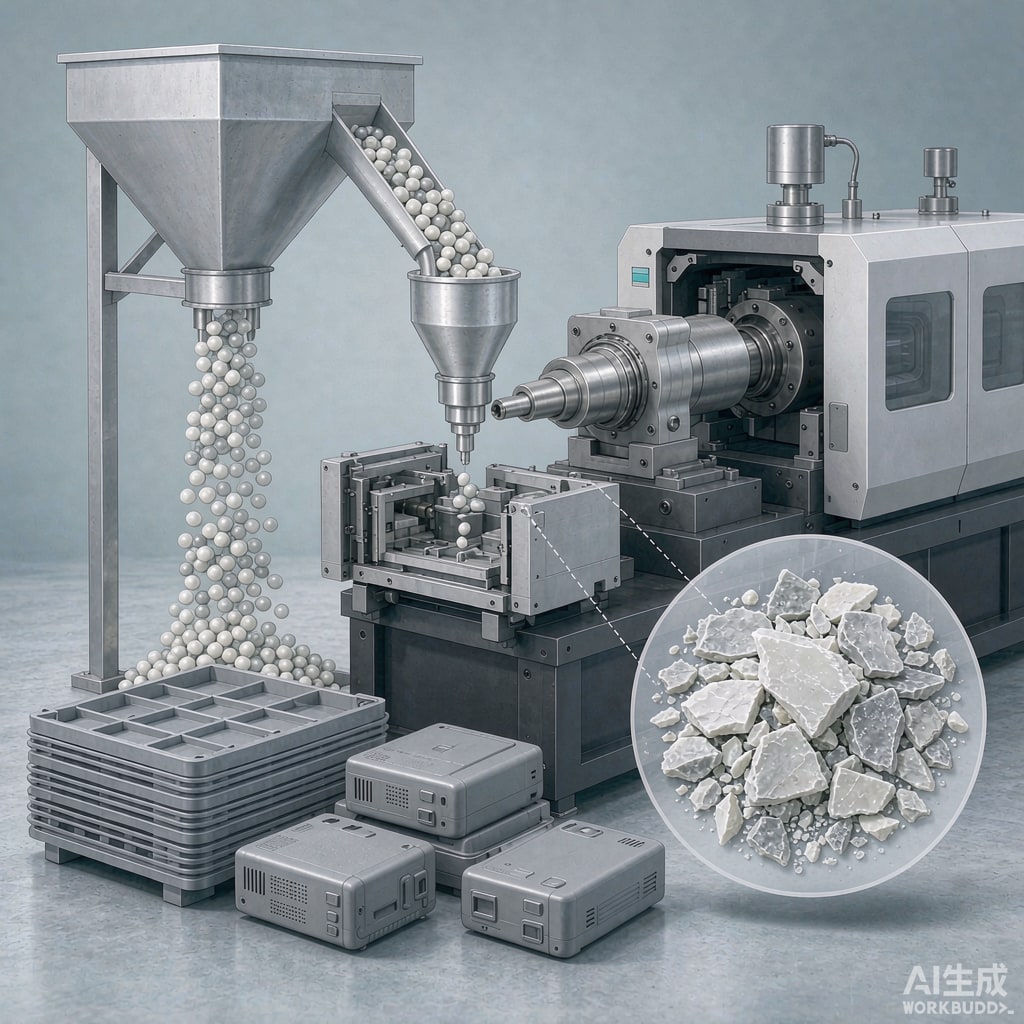
Polypropylene is cheap, chemically inert, and light — but neat PP sags under heat, flexes too much for structural parts, and shrinks unevenly. Adding talc (hydrous magnesium silicate) transforms it into a family of engineering-grade compounds at a fraction of the cost of ABS or glass-filled nylon. For electronics manufacturers, talc-filled PP plastic pellets cover everything from appliance housings and fan blades to SMT carrier trays that must stay flat on a reflow line.
What Talc Actually Does
Talc is a plate-like mineral filler, and its platy geometry is the source of most of its benefits:
- Stiffness: Rigid plates constrain the polymer matrix; 20% talc roughly doubles flexural modulus versus unfilled PP.
- Heat deflection: HDT at 0.45 MPa rises from about 90°C for neat homopolymer to 115–125°C at 30–40% loading — enough for appliance interiors near heat sources.
- Dimensional stability: Mold shrinkage drops from 1.5–2.0% to 1.0–1.3%, and the plates reduce differential shrinkage that warps flat parts.
- Nucleation: Talc surfaces nucleate PP crystallization, speeding cycle times and refining spherulite size for better impact balance.
The trade-offs: density climbs about 0.25 g/cm³ per 10% talc, impact strength falls as loading rises, and the filler is mildly abrasive to screws and barrels.
Loading Levels and Property Effects
10–20% Grades: The Tough Balance
Low loadings keep most of PP’s ductility while adding meaningful stiffness and heat resistance. These grades suit living hinges (still possible with proper design), battery covers, and cosmetic parts where a drop test matters more than absolute rigidity.
30–40% Grades: Structural and Flat
High loadings maximize modulus (3.5–4.5 GPa flexural) and dimensional stability. This is the region for SMT JEDEC and Waffle trays, where a 0.5 mm warp across 300 mm can misalign components, and for appliance structural frames. Expect reduced elongation (3–6%) and the need for EP-copolymer matrices or impact modifiers to avoid brittleness in cold climates.
Selecting a Grade
Compounders offer many variants; four parameters drive the choice:
- Talc fineness: Micronized talc (median 1–5 µm) gives better stiffness and surface than coarse grades (10+ µm), at modestly higher cost. Fine talc also improves weld-line strength.
- Surface treatment: Stearate- or silane-coated talc improves dispersion and impact retention in demanding parts.
- Matrix type: Homopolymer PP maximizes stiffness; block copolymer matrices trade some modulus for low-temperature impact.
- Additive package: Specify UV stabilization for outdoor-adjacent parts, antistatic or carbon-loaded versions for ESD trays, and food-contact or UL 94 ratings where certification matters.
Processing Guidelines
- Drying: PP is non-hygroscopic, but talc-filled pellets carry surface moisture from storage; 1–2 hours at 80–90°C prevents silver streaks on glossy surfaces.
- Melt temperature: 200–240°C. Excessive heat burns stearate surface treatments and dulls surfaces.
- Mold temperature: 30–50°C for most parts; 50–60°C for high-gloss housings.
- Shrinkage pla
ing:
Quote 1.0–1.4% and expect anisotropy — flow direction shrinks less than cross-flow, so gate position determines flatness on trays. - Equipment: Use abrasion-resistant screw and barrel coatings for long campaigns at 30%+ loadings; limit regrind to 15–20% to protect melt flow and surface quality.
Applications Across the SMT and Appliance Chain
In electronics manufacturing, talc-filled PP appears as carrier and du
age trays (ESD grades dissipating 10⁶–10⁹ Ω), fan and blower housings, appliance control panel backs, battery pack enclosures for low-power devices, and cable spools. Its chemical resistance also suits flux-wash environments where ABS would craze.
Conclusion
Talc-filled PP pellets occupy the pragmatic middle of the electronics materials map: stiffer and flatter than neat polypropylene, cheaper and tougher to process than engineering resins. Choose loading level by structural demand, fineness by surface requirement, and the matrix by impact needs — and the compound will usually pay for itself in both part cost and cycle time.