Why Manufacturing Process Shapes Thermal Performance
Given the same alloy and airflow, a heat sink’s thermal resistance is largely determined by fin geometry — fin thickness, gap, and height — and by how well the fins are joined to the base. Each manufacturing process sets hard limits on those variables. Choosing between extruded, skived, and bonded fin heat sinks is therefore not just a sourcing decision; it defines the thermal ceiling of the design.
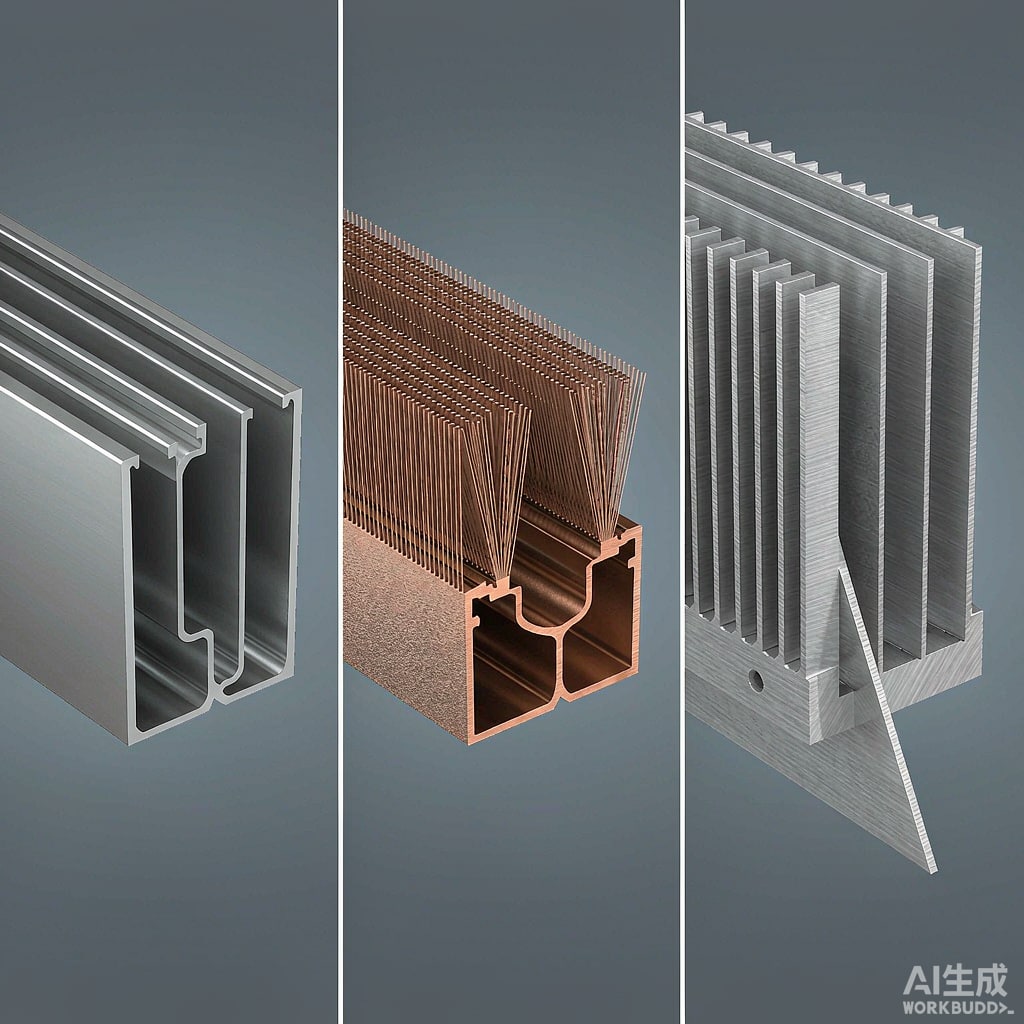
Extruded Heat Sinks: The Volume Workhorse
Extrusion pushes heated aluminum (typically 6063-T5) through a profile die, producing fins and base in one continuous piece:
- Fin thickness: Practically 1.0 mm minimum for standard profiles; thi
er fins distort and tear at the die.
- Aspect ratio: Fin height-to-gap ratios of 8:1 to 12:1 are achievable with fluted die designs and careful die maintenance.
- Tooling cost: Low — a new profile die typically costs a few hundred dollars, amortized quickly in volume production.
- Thermal path: Monolithic; no joint between fins and base, so no interface resistance.
Extrusion dominates cost-sensitive, medium-power cooling: LED drivers, power supplies, and consumer electronics housings. Its weakness is high fin density — thin fins on tight pitch are simply not extrudable.
Skived Fin Heat Sinks: Thin Fins, High Density
Skiving lifts fins directly from a solid copper or aluminum bar with a precision knife, producing extremely thin, tall fins with no joint:
- Fin thickness: 0.15–0.5 mm in production; copper skives finer than aluminum.
- Aspect ratio: Up to 20–25:1, enabling fin pitches below 1.5 mm for high-density forced-air cooling.
- Thermal path: Fins are integral to the base — zero interface resistance.
- Material options: Pure copper skived bases pair naturally with copper heat spreaders and heat pipes in compact, high-flux designs.
Skived sinks excel where board space is scarce and airflow is ducted: 5G small-cell radios, optical modules, server memory cooling, and CPU/GPU reference coolers. Trade-offs are higher per-part cost than extrusion, length limits (typically under 500 mm), and moderately high tooling costs for custom skive patterns.
Bonded Fin Heat Sinks: Tall Fins on Large Bases
Bonded fin construction inserts separate extruded or stamped fins into machined grooves in a base plate, fixed with thermal epoxy or brazing:
- Fin height: 50–150 mm and beyond — far beyond extrusion or skiving practical limits.
- Footprint: Bases of 300×300 mm or larger for passive cooling of telecom power shelves and inverters.
- Mixed materials: Copper base with aluminum fins, or vice versa, is routine — useful for spreading heat into a wide aluminum fin field.
- Joint resistance: The bonded joint adds roughly 0.02–0.08 °C/W per fin interface depending on adhesive quality; brazing reduces this further. In large passive sinks the airflow is so gentle that this penalty is usually acceptable, but verify in simulation.
Bonded fin is the default for large natural-convection designs where a single extrusion would be prohibitively heavy or geometrically impossible.
Thermal Performance Comparison
For a 100×100 mm base in 2 m/s forced air, typical results illustrate the hierarchy:
- Extruded, 1.5 mm fins: Baseline thermal resistance; best cost-per-watt in the 20–60 W range.
- Skived copper, 0.3 mm fins at 2.0 mm pitch: 25–40% lower resistance than the extruded baseline, thanks to doubled surface area in the same footprint.
- Bonded fin, 80 mm tall aluminum fins: Lowest resistance of the three in natural convection; in forced air its joint resistance and thicker fins narrow the advantage.
Real comparisons must hold footprint and airflow constant — a skived sink inherits the airflow, ducting, and bypass losses of the system around it.
Cost, Tooling, and Volume Considerations
- Prototyping: Skived and CNC-machined prototypes need no die, making them fastest for design iterations; extrusion requires a die even for samples.
- Volume pricing: Extrusion wins above roughly 10,000 units for standard profiles; skiving holds an advantage where fin density ca
ot be extruded at any price.
- Lead time: Extrusion dies take 2–3 weeks; skiving setup is days; bonded fin depends on base machining and fin inventory.
How to Choose
Start with the constraint that binds: if airflow and footprint are fixed and surface area is short, choose skived fins. If the part is large and passive, choose bonded fin. If volumes are high, geometry is moderate, and cost rules, extrude. When a design sits between categories, build a skived prototype, measure, then decide whether extrusion can be stretched to meet the thermal budget.
Conclusion
Extrusion, skiving, and bonded fin construction each occupy a distinct region of the design space defined by fin thickness, fin height, footprint, and volume. Matching the process to the constraint — rather than defaulting to the cheapest quote — is what turns a heat sink from a commodity into a thermal solution.