ABS, PC, and PC/ABS enclosures are effectively transparent to radio frequencies. A router housing that passes emissions testing on the engineering bench can fail in production simply because a metal shield was value-engineered away. Conductive coatings, meaning shielding paints sprayed onto the inside of the plastic wall, restore shielding without changing the molding. This guide compares the main chemistries and explains how to apply, ground, and test them.
When Paint Beats the Alternatives
- Sheet-metal shields offer the best attenuation but add weight, tooling, and assembly labor, and they constrain industrial design.
- Conductive plastics filled with carbon or stainless fiber shield moderately but are expensive, usually black, and their conductivity becomes anisotropic after molding.
- Shielding paint adds a few grams, follows any geometry, applies after molding, and costs very little per part at volume, which is why it dominates consumer and medical housings.
Paint is the default choice when attenuation requirements sit between roughly twenty and eighty decibels from 30 MHz to a few gigahertz and the enclosure can provide a ground path.
Shielding Paint Chemistries Compared
Nickel Acrylic Paint
The industry workhorse. Nickel flake suspended in an acrylic binder delivers forty to sixty decibels of attenuation through 1 GHz at fifty micrometers of dry film, with good adhesion to ABS and PC and stable surface resistance below one ohm per square. Nickel’s oxide layer is semiconductive, so performance degrades gracefully rather than catastrophically. It is the default for office and medical equipment.
Silver and Silver-Coated Copper Paint
When attenuation must exceed seventy to ninety decibels, as in defense electronics, test instruments, and high-power RF, silver or silver-plated copper flake paints deliver, at a cost that scales with the silver price. They also hold low contact resistance for gasket interfacing over long dwell times.
Copper Paint
Copper flake offers excellent bare conductivity but oxidizes to a non-conductive oxide within months, so copper paints are formulated with a stabilizing topcoat or used only where constant compression contact keeps oxide from forming. Most commercial programs specify nickel instead for long-term stability.
Carbon and Graphite Paints
Surface resistance in the kilohm range makes these suitable for ESD control and as pretreatment for electrostatic painting, not for meaningful EMI shielding, where they typically provide less than twenty decibels. Do not substitute carbon paint where a nickel specification appears on a drawing.
Application Process
Consistent shielding comes from consistent film build, and that comes from process discipline:
- Surface preparation: mold-release residues destroy adhesion. Wash parts in a mild alkaline solution and, for critical programs, plasma-treat before painting.
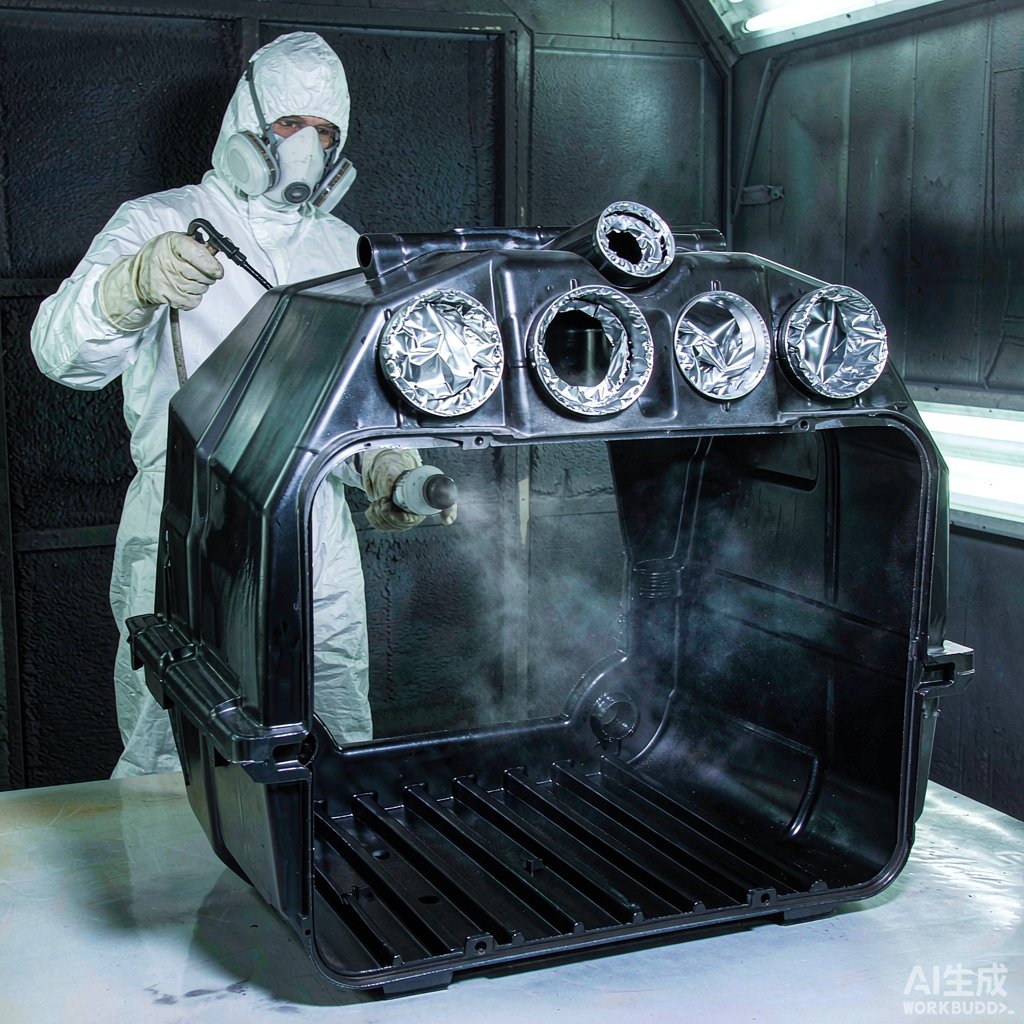
- Masking: mask co
ector openings, vents, and ante
a windows before the first pass. Ante
a areas must remain paint-free, because a coating over a Wi-Fi window detunes the ante
a by several decibels.
- Film thickness: two to three wet passes building fifty to seventy-five micrometers of dry film is typical for nickel paints. Below forty micrometers the flake network has gaps and attenuation falls steeply.
- Drying: air-dry acrylics need twenty to forty minutes between passes; force-drying at fifty to sixty degrees Celsius shortens cycle time. Verify full cure before assembling gaskets.
Grounding the Shield
An ungrounded painted enclosure can perform worse than bare plastic, because the floating conductive layer re-radiates. Effective grounding practice includes:
- Binding the coating to board ground through conductive gaskets compressed against painted boss surfaces or ribs, with at least one contact point per ten centimeters of enclosure perimeter.
- Keeping paint off screw bosses where metal screws must make direct contact, or specifying conductive gaskets that bridge both surfaces.
- Verifying contact resistance below 0.1 ohms between coating and board ground in sample builds, then again after environmental conditioning.
Testing and Acceptance
Shielding effectiveness is measured per ASTM D4935, a plane-wave fixture convenient for coupon screening, or IEEE 299 for full enclosure measurement. Production control relies on surface resistance: a four-point probe reading below one ohm per square for nickel paints correlates with on-spec film build. Sample the first article of every shift and re-qualify after any mold or paint batch change.
Environmental durability deserves equal attention: cross-hatch adhesion testing after damp-heat exposure, for example 85 degrees Celsius and 85 percent relative humidity for 168 hours, confirms the coating survives humidity cycling, and abrasion at gasket contact points should be checked against the mating gasket specification.
Cost Notes and Design Tips
At volume, nickel paint adds a modest cost per enclosure, a fraction of a metal shield’s total cost once sheet-metal tooling and fastening labor are counted. Design tips that keep it that way: provide flat painted lands for gaskets instead of forcing paint around tight corners; keep ante
a windows outside the painted zone from the first industrial design sketch; and select flame-retardant paint grades early if the plastic itself must meet UL 94 V-0, so the finished assembly passes as a system.
Handled as a specified process with defined chemistry, thickness, grounding, and test methods, conductive coatings turn a commodity plastic box into a competent RF enclosure at consumer prices.