The Thermal Stability Challenge in EV Battery Packs
Electric vehicle battery packs must operate within a narrow temperature window, typically 15 to 35 degrees Celsius, to maximize cycle life, safety, and range. When cells fast-charge or accelerate hard, internal heat generation can push local temperatures well above this window, triggering thermal derating or accelerated degradation. Phase change materials (PCMs) offer a passive, latent-heat buffering approach that absorbs excess energy at constant temperature and releases it when the pack cools.
Unlike active liquid cooling, PCM systems require no pumps, hoses, or coolant maintenance. They act as a thermal flywheel, smoothing temperature swings during transient events. This article explains how PCMs work, what materials are available, and how to integrate them into EV battery packs.
How Phase Change Materials Work
Latent Heat Absorption
A PCM absorbs or releases large amounts of energy as it transitions between solid and liquid states at a fixed melting point. During heating, the PCM remains at its melt temperature while storing energy equivalent to its latent heat of fusion. For battery cooling, this means cell temperatures plateau near the PCM melt point instead of rising continuously.
Reversibility and Cycling
Paraffin-based PCMs can undergo thousands of freeze-thaw cycles with minimal degradation if properly encapsulated. Salt hydrates offer higher energy density but can suffer from phase segregation and supercooling over repeated cycles. Material selection therefore depends on expected cycle count, allowable volume change, and packaging constraints.
Common PCM Types for Battery Thermal Management
Paraffin Waxes
Paraffin blends dominate EV applications because their melt points can be tuned from roughly 30 to 80 degrees Celsius by adjusting carbon chain length. A typical battery-grade paraffin might melt at 40 to 45 degrees Celsius, matching lithium-ion ideal operating temperatures. Paraffins are chemically stable, non-corrosive, and electrically insulating, simplifying integration. Their main drawback is low thermal conductivity, often below 0.3 W/m·K.
Salt Hydrates
Salt hydrates such as sodium sulfate decahydrate and calcium chloride hexahydrate offer latent heat values two to three times higher than paraffin per unit volume. However, they are corrosive to metals, require nucleating agents to prevent supercooling, and may exhibit incongruent melting that reduces long-term capacity. They are best suited to stationary energy storage rather than automotive packs.
Bio-Based and Eutectic Blends
Fatty acids and bio-derived esters provide moderate latent heat with better environmental credentials. Some engineered eutectic blends combine organic and inorganic phases to achieve specific melting windows and higher conductivity. These materials are gaining interest for sustainability-focused vehicle programs.
Improving Effective Thermal Conductivity
Raw PCMs conduct heat poorly, so engineers add conductive fillers or embed PCM within metal foams, expanded graphite matrices, or aluminum honeycomb. Expanded graphite composites can raise effective thermal conductivity above 5 W/m·K while retaining most of the latent heat capacity. Aluminum foam-PCM composites are popular in pouch-cell modules because they provide both structural support and heat spreading.
Integration Strategies
Intercell Pads and Pouches
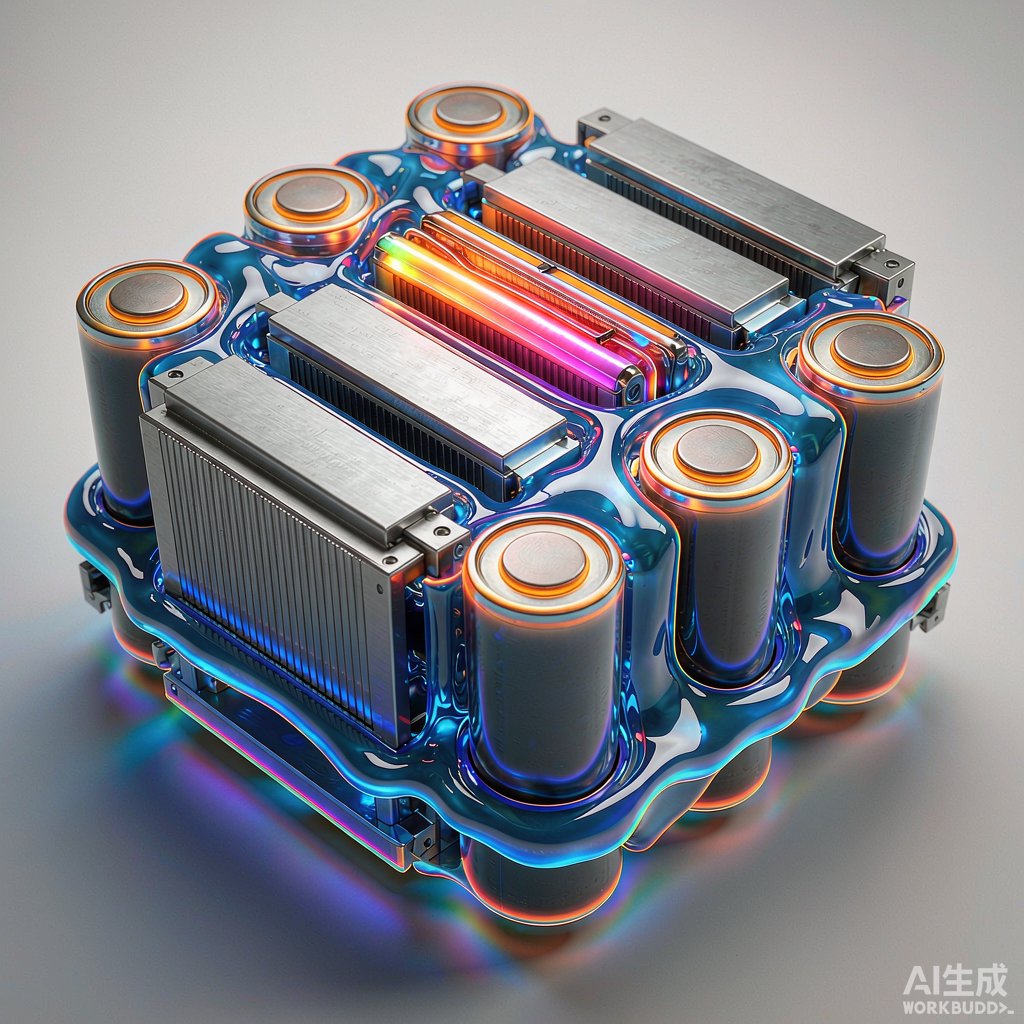
Thin PCM sheets placed between cylindrical or pouch cells absorb localized hotspots. Encapsulated PCM pouches prevent leakage during the liquid phase and simplify assembly. Designers must leave expansion volume, typically 10 to 15%, to accommodate density changes during melting.
Module- and Pack-Level Reservoirs
For larger packs, PCM can fill cavities within the module housing or a dedicated cooling plate. Combining PCM with a small liquid cooling loop handles both transient absorption and steady-state rejection. In this hybrid approach, PCM delays peak temperatures until the cooling system can catch up.
Performance Metrics and Validation
Key PCM metrics include melt temperature, latent heat of fusion, thermal conductivity, cycling stability, flammability rating, and cost per kilowatt-hour of thermal capacity. Validation typically involves calorimetry, accelerated thermal cycling, and full pack abuse testing to confirm that PCM containment survives vibration, crash loads, and thermal runaway propagation scenarios.
Conclusion
Phase change materials provide a simple, maintenance-free way to stabilize EV battery temperatures during fast charge and aggressive drive cycles. While they are not a replacement for liquid cooling in high-performance applications, PCMs excel at buffering transient loads and keeping cell temperatures uniform. With the right material choice and conductive enhancement, PCM integration can extend battery life and improve vehicle safety.