## Why Fire Suppression is Critical in Smoking Booths
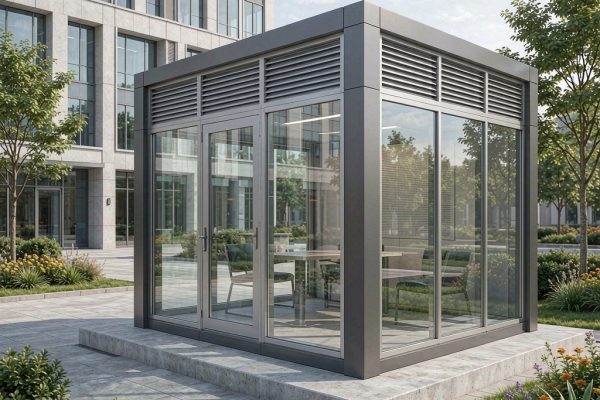
Smoking booths are enclosed spaces designed to contain tobacco smoke and protect non-smoking areas from secondhand exposure. By their very purpose, they concentrate an ignition source (lit cigarettes, matches, lighters) in a confined space with combustible materials (paper towels, upholstered seating, filter media). Without adequate fire suppression, a discarded cigarette or careless disposal can rapidly escalate into a structural fire.
This article covers the fire suppression system design, detection technologies, and regulatory compliance requirements specific to smoking booths and enclosed smoking rooms.
## Fire Risk Assessment for Smoking Enclosures
### Ignition Sources
The primary ignition source in a smoking booth is, by definition, an open flame — whether from a lighter, match, or burning cigarette tip reaching 600–900°C at the combustion zone. Secondary ignition sources include:
– Discarded cigarette butts in waste receptacles
– Electrical equipment (lighting, ventilation fans, air purifiers)
– Heating elements in cold-weather booths
### Fuel Load Analysis
The combustible materials typically present in a smoking booth include:
– Seating: Upholstered cushions, fabric covers (fire-retardant treated but not fireproof)
– Waste: Cigarette butts, paper packaging, food wrappers
– Wall panels: Decorative laminate or wood-finish panels
– Filter media: HEPA and activated carbon filters in the smoke extraction system
– Ceiling tiles: Acoustic ceiling materials
The total fuel load in a standard 4-person smoking booth (approximately 4 m² floor area) can reach 20–40 MJ/m², which qualifies as a moderate fire load under most building codes.
### Fire Growth Scenario
A fire originating from a discarded cigarette in a waste bin can grow to flashover conditions in 2–4 minutes if the booth’s ventilation system feeds oxygen to the fire. The confined space accelerates fire development compared to open environments, making rapid detection and suppression essential.
## Fire Detection Technologies
### Smoke Detectors
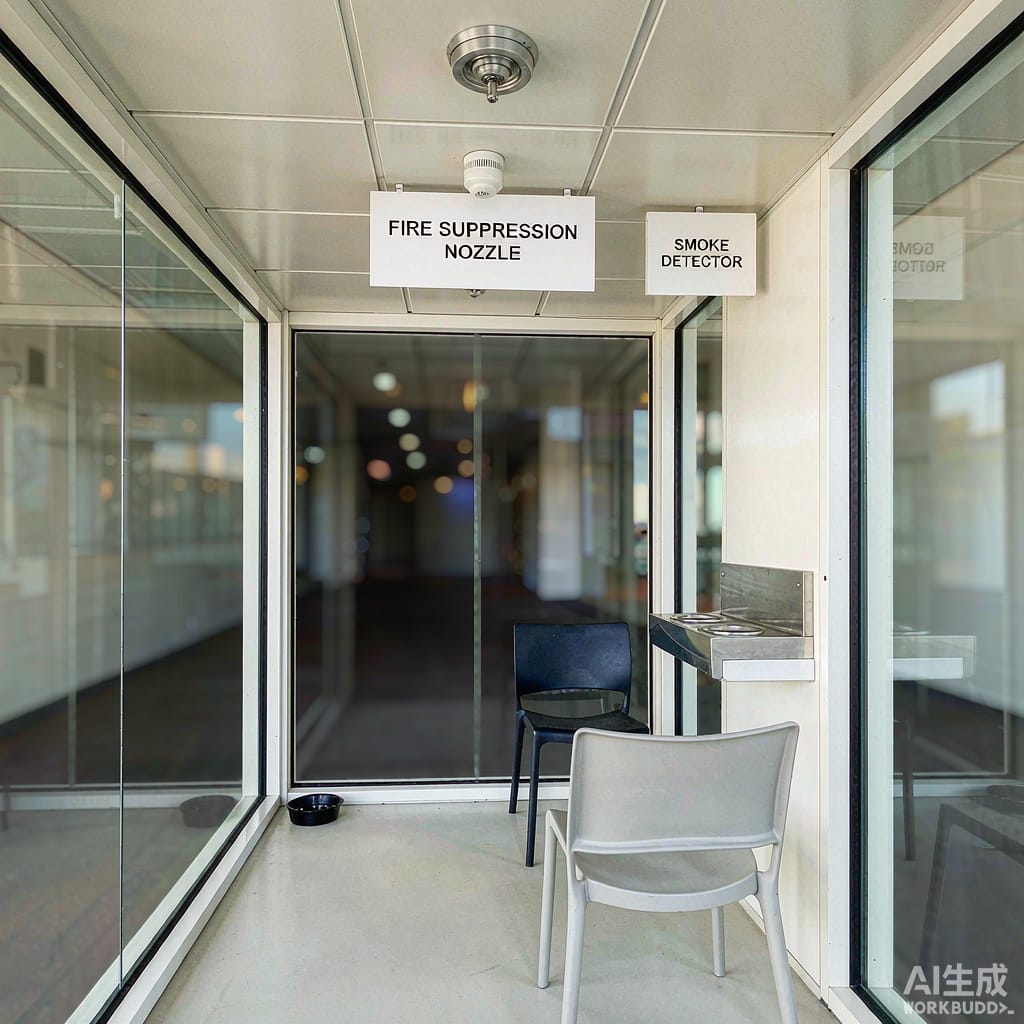
Smoke detectors are the first line of defense in smoking booth fire protection. However, the normal smoking activity in the booth generates continuous smoke that can trigger conventional detectors, creating a false-alarm problem.
Solutions for false-alarm mitigation:
– Photoelectric detectors with drift compensation: These detectors adjust their sensitivity baseline to account for gradual smoke accumulation from normal use, only alarming when smoke density exceeds the baseline threshold significantly.
– Multi-criteria detectors: Combining photoelectric smoke detection with heat rate-of-rise sensing reduces false alarms while maintaining rapid response to actual fire conditions.
– Air sampling smoke detection (ASD): High-sensitivity systems that sample booth air through pipework and analyze it in a centralized laser detector. ASD can detect pre-combustion smoldering before visible flame appears.
### Heat Detectors
Heat detectors provide a backup detection method that is immune to false alarms from normal smoking activity. Two types are commonly deployed:
– Fixed-temperature detectors: Activated when ambient temperature exceeds a set threshold (typically 57°C/135°F for booth applications)
– Rate-of-rise detectors: Activated when temperature increases faster than a set rate (typically 8°C per minute), detecting rapid fire growth
For smoking booths, the recommended approach is a multi-criteria detector combining photoelectric smoke sensing with rate-of-rise heat sensing, with drift compensation to manage false alarms.
### Flame Detectors
UV/IR flame detectors provide very rapid response to open flames (within 50–100 milliseconds) and are immune to smoke from cigarettes. However, they require direct line-of-sight to the flame and may miss smoldering fires. Flame detectors are recommended as a supplementary detection layer in larger smoking rooms.
## Suppression Agent Selection
### Water Mist Systems
Water mist systems use fine water droplets (80–200 µm droplet size) delivered through specialized nozzles at high pressure (35–200 bar). Water mist is highly effective for smoking booth applications because:
– Rapid cooling of fire gases prevents flashover
– Small water volume (2–5 liters for a 4 m² booth) limits water damage
– Droplets penetrate smoke-filled spaces effectively
– No environmental concerns (clean agent)
Design parameters for smoking booth water mist:
– Design density: 0.3–0.5 L/min/m²
– Nozzle spacing: 1.5–2.0 m (single nozzle may suffice for booths < 4 m²)
– Discharge time: 10 minutes minimum
– Water supply: Pressurized cylinder or municipal supply with booster pump
### Clean Agent Systems
Clean agent suppression systems use gases such as Novec 1230, FM-200, or inert gas blends (IG-541) to extinguish fires without residue. These are preferred for booths containing electronic equipment (air purifiers, lighting systems, sensors) where water damage must be avoided.
Design considerations:
– Agent quantity calculated based on booth volume and hazard class
– Discharge time: 10 seconds for clean agents, 60 seconds for inert gases
– Pre-discharge alarm: 10–30 seconds for occupant evacuation
– Post-discharge hold time: 10 minutes minimum to prevent re-ignition
### Dry Chemical Systems
Dry chemical suppression (using monoammonium phosphate or sodium bicarbonate powder) is effective for rapid fire knockdown but creates significant residue that requires cleanup. Dry chemical systems are typically used only in industrial smoking booths where cleanup resources are readily available.
### Automatic Sprinkler Protection
When the building is already sprinklered, extending sprinkler coverage to the smoking booth is the most straightforward fire protection approach. A single upright or pendent sprinkler head provides adequate coverage for booths up to 9 m² floor area.
Design parameters:
– Sprinkler temperature rating: 68°C (155°F) standard response or 74°C (165°F) for booths with elevated ambient temperature
– Coverage area per head: up to 9 m² (per NFPA 13 standard)
– Design density: 0.10 gpm/ft² (4.1 L/min/m²) for light hazard occupancy
## Ventilation System Interlock
### Shutdown on Fire Alarm
The booth’s smoke extraction ventilation system must interlock with the fire suppression system. On fire alarm activation:
1. Ventilation shuts down (supply and exhaust fans stop) to prevent oxygen feeding the fire and to avoid spreading smoke/fire to other building areas
2. Fire dampers close in the supply and exhaust ductwork
3. Suppression system discharges after a pre-set delay (if the booth is occupied, allow 10–30 seconds for evacuation before discharge)
4. Building fire alarm system activates to initiate building-wide evacuation
### Post-Fire Smoke Purge
After the fire is suppressed and the area is verified safe, the ventilation system can be activated in purge mode to remove combustion products. This should be a manual operation, not automatic, to ensure the fire is truly extinguished before ventilation resumes.
## Regulatory Standards and Codes
### NFPA 101 (Life Safety Code)
NFPA 101 classifies designated smoking areas as requiring fire protection consistent with the building’s occupancy classification. For most commercial and institutional buildings, this means the booth must have:
– Fire detection integrated with the building fire alarm system
– Suppression coverage (sprinkler or equivalent)
– Fire-rated construction separating the booth from adjacent spaces (minimum 1-hour fire rating)
– Self-closing doors
### International Building Code (IBC)
The IBC requires designated smoking areas to comply with Section 308 (Ambulatory Care Facilities) or Section 708 (Group I occupancies) requirements for fire-rated separation and suppression, depending on the building occupancy.
### Local Fire Marshal Requirements
Many jurisdictions have specific requirements for smoking booth fire protection that exceed national codes. Always consult the local fire marshal or authority having jurisdiction (AHJ) during the design phase.
### ASHRAE 62.1 Ventilation Requirements
ASHRAE 62.1 specifies ventilation rates for smoking lounges at 70 cfm per person (approximately 33 L/s per person) under the smoking-permitted calculation. This high ventilation rate affects fire detection placement and suppression design because it creates significant air movement that can influence smoke detector response.
## Maintenance and Testing
### Weekly Visual Inspections
– Verify suppression agent cylinder pressure gauge is in the green range
– Confirm nozzles are unobstructed
– Check that detector indicator lights are normal
– Ensure waste receptacle lids close properly
### Semi-A
ual Functional Testing
– Test each detector for alarm response
– Verify ventilation shutdown interlock
– Test fire damper closure
– Verify suppression system control panel a
unciator function
### A
ual Full System Test
– Full flow test of suppression system (simulated or actual discharge)
– Verify design density at all nozzles
– Full functional test of all interlocks and alarms
– Inspection and certification by a licensed fire protection engineer
## Design Checklist for Smoking Booth Fire Suppression
– [ ] Multi-criteria smoke/heat detectors with drift compensation installed
– [ ] Suppression agent appropriate for booth contents (water mist for general, clean agent for electronics)
– [ ] Ventilation system interlocked for automatic shutdown on alarm
– [ ] Fire dampers in supply and exhaust ducts
– [ ] 10–30 second pre-discharge alarm for occupant evacuation
– [ ] Fire-rated separation from adjacent spaces (minimum 1-hour)
– [ ] Self-closing door with automatic latch
– [ ] Waste receptacle with self-closing metal lid
– [ ] Integration with building fire alarm system
– [ ] A
ual testing and certification program established
## Conclusion
Fire suppression in smoking booths requires careful consideration of the unique fire risks associated with an enclosed space where ignition sources are continuously present. Multi-criteria detection, appropriate suppression agent selection, and robust ventilation interlocks form the foundation of a compliant fire protection system. By following the design standards and maintenance protocols outlined above, building owners and facility managers can provide a safe environment for designated smoking areas while protecting the broader building from fire propagation. TechMartSE designs and supplies smoking booths with integrated fire suppression and ventilation systems, certified to international fire safety standards.