## Introduction
Smoking booths and smoking rooms have proliferated across airports, office lobbies, casinos, and industrial break rooms in Southeast Asia. Unlike open smoking areas, an enclosed booth can reduce secondhand smoke exposure for non-smokers while still providing a designated space for smokers. The effectiveness of a smoking booth depends on three engineering factors: ventilation rate, smoke capture velocity, and the leakage rate of the enclosure. Combined, these factors determine whether the booth meets the local indoor air quality (IAQ) and fire safety regulations.
This article provides a practical compliance roadmap for smoking booth installations, covering the design parameters that inspectors look for and the documentation owners should retain.
## Ventilation Rate Targets
### Air Changes Per Hour (ACH)
Most international guidelines recommend a minimum of 10–20 air changes per hour for a smoking booth or smoking room. The exact rate depends on the number of simultaneous smokers, the volume of the booth, and the local code. ASHRAE 62.1 lists smoking lounges as a special occupancy with an outdoor air rate of 60 cfm per person plus 0.06 cfm per square foot.
For a small two-person booth of roughly 4 m² floor area and 2.4 m ceiling, that translates to about 115 cfm (54 L/s) of outdoor air. For a larger four-person booth, the requirement can climb above 250 cfm.
### Exhaust vs Recirculation
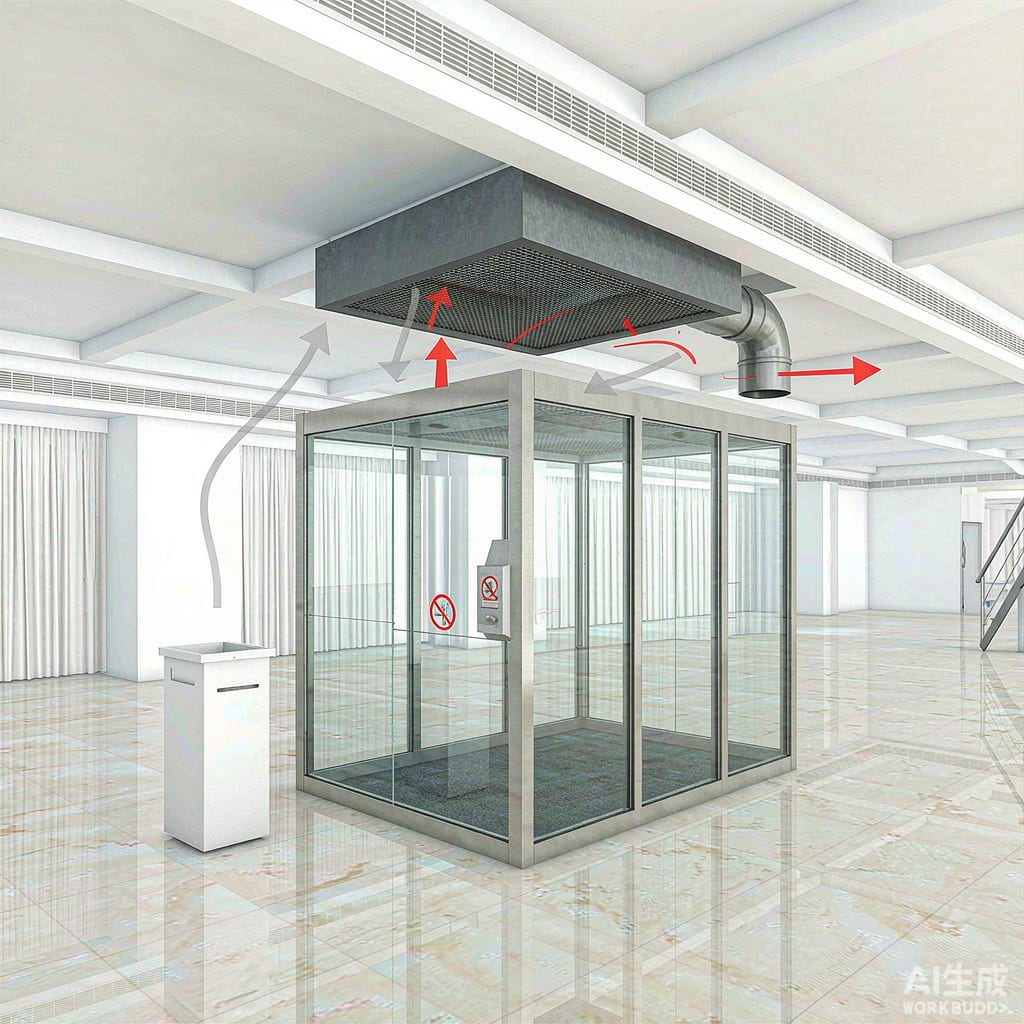
The cleanest compliance strategy is to exhaust 100% of the booth air to the outside through a dedicated duct. Recirculating air through a fine filter is technically possible but rarely accepted by local inspectors because filter breakthrough is hard to verify in the field. When recirculation is permitted, the system must use a HEPA filter followed by an activated carbon stage with sufficient contact time, and it must include a manometer or pressure switch that alarms when filter loading exceeds the design point.
## Smoke Capture Velocity
### Why Capture Velocity Is the Critical Number
Air changes per hour describe the volume flow but not whether the system actually captures smoke at the source before it spreads. Smoke capture velocity is the air velocity at the opening of a hood or booth that reliably entrains the contaminated air. The recommended capture velocity for hot tobacco smoke with strong thermal buoyancy is 0.5–1.0 m/s at the booth opening.
Designers must distinguish between capture velocity and face velocity. Face velocity is the air speed through the filter or hood face, which is often much higher than capture velocity because the hood is recessed or partially enclosed.
### Heat and Buoyancy Effects
Hot exhaled smoke rises rapidly because of buoyancy. A booth designed only for horizontal capture may let smoke escape upward through the door opening during the first second of exhalation. Adding a ceiling-level capture hood with downward-facing inlet slots helps pull the smoke plume down into the exhaust stream before it can escape.
## Enclosure Leakage
### Why Sealed Construction Matters
A booth with poor seals around doors, glass panels, and service penetrations leaks smoke back into the surrounding space. Negative pressure inside the booth, typically 12–25 Pa relative to the occupied zone, prevents leakage. To achieve that pressure, the exhaust fan must overcome the leakage path resistance.
A common field test is the door decay test: close all doors, measure the pressure inside, and verify that the pressure decays slowly when the fan is turned off. A leakage area of more than 1–2% of the booth floor area makes compliance with IAQ thresholds unlikely.
### Self-Closing Doors
Booth doors should be self-closing to prevent occupants from propping them open. Magnetic catches or spring hinges are typical. Signage reminding occupants to keep the door closed is helpful but rarely sufficient on its own.
## Indoor Air Quality Thresholds
### Particulate Matter (PM2.5)
The most common compliance metric for smoking booths is the PM2.5 concentration in the occupied zone adjacent to the booth. WHO indoor air guidelines recommend an a
ual average below 15 µg/m³ and a 24-hour average below 45 µg/m³. Many local regulations use 35 µg/m³ as the 24-hour limit.
After installation, a qualified IAQ professional should measure PM2.5 at the booth door during a worst-case smoking scenario to verify that the booth does not raise the surrounding area above the threshold.
### Nicotine and VOCs as Tracers
PM2.5 alone can be confounded by outdoor pollution, cooking, or other indoor sources. Nicotine is a specific tracer for tobacco smoke. Air sampling for nicotine and 3-ethenyl pyridine using sorbent tubes and GC-MS analysis provides unambiguous evidence of whether smoke is escaping the booth. Many compliance audits now require both PM2.5 and nicotine sampling.
## Regional Regulations in Southeast Asia
### Singapore
Singapore’s National Environment Agency treats designated smoking rooms in public buildings as enclosed areas that must exhaust directly outside. Smoking booths are not generally permitted in indoor public spaces except in very specific venues such as certain airport zones. Where smoking areas are allowed, the ventilation rate and pressure isolation requirements are strict.
### Malaysia and Thailand
Malaysia and Thailand permit smoking rooms in airports and large entertainment venues but prohibit them in most indoor public areas. Where allowed, the rooms must be fully enclosed, negatively pressurized, and exhausted outdoors. Inspection focuses on door seals and exhaust duct routing.
### Vietnam, Indonesia, Philippines
Regulations vary by city and venue. Major hotels and airports in Ho Chi Minh City, Jakarta, and Manila have introduced smoking rooms in recent years as a service to international travelers, but smaller venues face stricter rules. The trend across the region is moving toward broader indoor smoking bans, with smoking booths reserved for specific high-traffic or hospitality settings.
## Commissioning and Documentation
A compliant installation package should include:
– As-built mechanical drawing showing duct routing, fan location, and exhaust termination
– Airflow balance report with measured CFM at each booth
– Capture velocity measurements at the booth opening
– Negative pressure test results
– Filter cut sheets with rated efficiency and recommended change interval
– Commissioning report signed by a qualified engineer
– Ongoing maintenance log for filter changes and fan service
## Conclusion
Smoking booth compliance is achieved by combining adequate ventilation, reliable smoke capture, low enclosure leakage, and traceable documentation. Specifiers should design to the strictest applicable regional standard, verify performance with on-site measurements, and retain commissioning records for the life of the installation.