As power densities rise in 5G handsets, EV power modules, and edge AI hardware, PCB heat dissipation has become a limiting factor in product design. Two advanced materials dominate the conversation: carbon fiber thermal pads and synthetic graphite sheets. Both leverage carbon’s exceptional in-plane thermal conductivity, but they solve different problems. This article compares their properties, best-use scenarios, and assembly considerations to help engineers choose the right thermal management path.
Material Structure and Thermal Conductivity
Carbon fiber thermal pads are typically made from chopped or aligned carbon fibers embedded in a silicone or acrylic matrix. The fibers create conductive pathways through the thickness of the pad, allowing heat to travel from a hot component to a heat sink or metal chassis. Through-plane thermal conductivity commonly ranges from 5 W/m·K to 20 W/m·K for fiber-loaded grades, with premium aligned-fiber products reaching 30 W/m·K or more. The matrix provides electrical isolation and mechanical compliance.
Synthetic graphite sheets, also called graphite film or pyrolytic graphite, are produced by polymer carbonization and graphitization. Their defining feature is extreme anisotropy: in-plane thermal conductivity can reach 1,000–1,900 W/m·K, comparable to copper, while through-plane conductivity is only 5–20 W/m·K. Graphite sheets spread heat laterally across a large area, making them ideal when the heat source is small and the available cooling surface is far larger.
When to Choose Carbon Fiber Thermal Pads
Carbon fiber pads excel where the thermal path is primarily vertical and where gap tolerance, surface roughness, or mechanical vibration are concerns. Typical applications include:
- CPU/GPU interfaces to heat spreaders in laptops and servers
- IGBT or MOSFET modules in motor drives
- LED drivers and power supplies with uneven component heights
The compressibility of a pad compensates for warped PCBs and non-flat metalwork, maintaining low thermal resistance without excessive mounting force. Most carbon fiber pads are electrically insulating because the fibers are surrounded by dielectric binder, but always verify the dielectric strength rating because some grades use conductive resins.
When to Choose Synthetic Graphite Sheets
Graphite sheets are the better choice when the challenge is lateral heat spreading rather than vertical conduction. Use cases include:
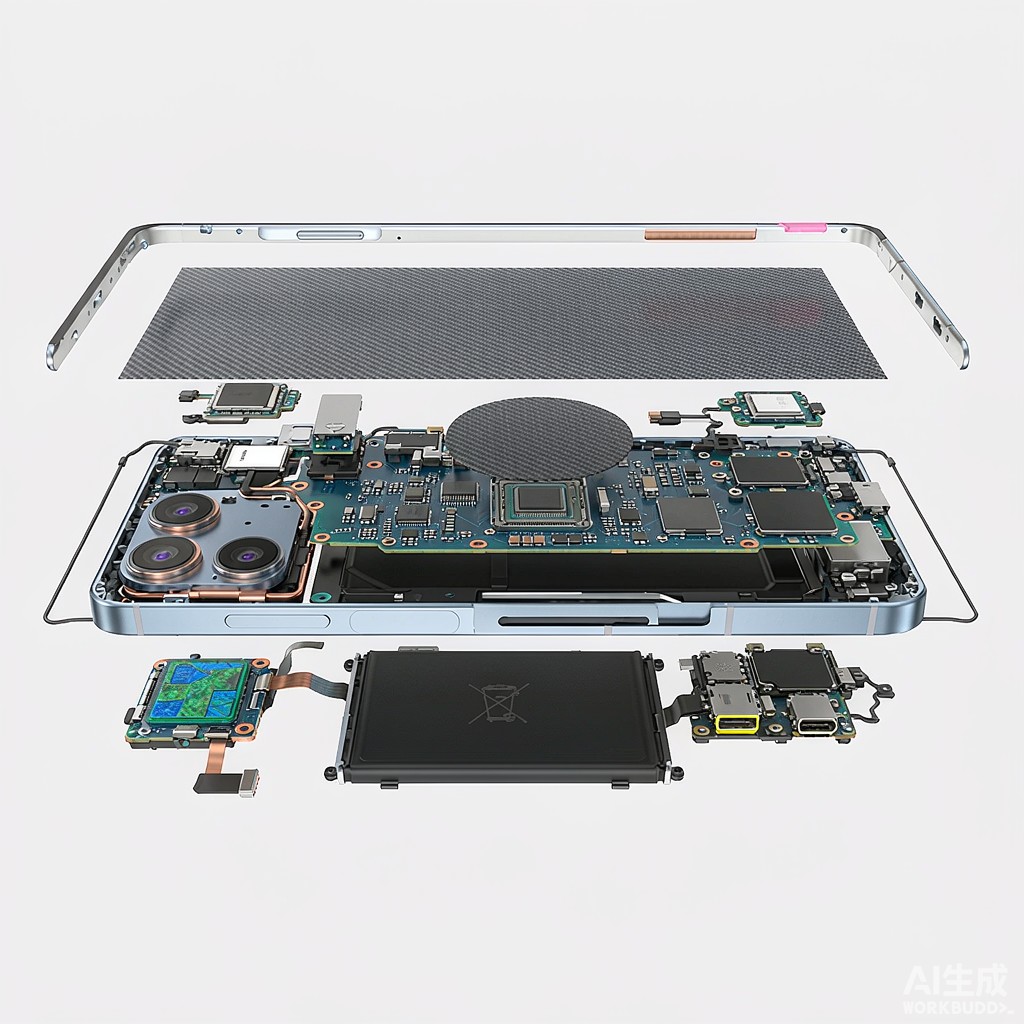
- Smartphones where a small processor must heat a large rear case
- Thin LED backlights with hot spots
- EV battery management systems requiring uniform temperature distribution
Because graphite is electrically conductive, designers must prevent contact with exposed traces or component leads. A thin polyimide or PET overlay is often laminated to the graphite for insulation. Graphite is also brittle and can flake if bent sharply; it works best in flat or gently curved assemblies.
Compression, Thickness, and Thermal Resistance
The real-world performance of a thermal interface material depends on bulk thermal conductivity, thickness, and contact resistance. Carbon fiber pads are supplied in thicknesses from 0.5 mm to 5 mm. Under 20–30% compression, they conform well and reduce air gaps. Thermal resistance is roughly thickness divided by conductivity plus contact terms; a 1 mm pad at 10 W/m·K gives about 0.1 K·cm²/W before contact resistance.
Graphite sheets are usually 0.07–0.5 mm thick. Their through-plane resistance is higher because the path is short but conductivity through the thickness is low. However, once heat enters the sheet, it spreads rapidly. In many designs, graphite is paired with a thin thermal pad or phase-change material on the heat source to overcome the through-plane bottleneck.
EMI and Electrical Considerations
Both carbon fiber pads and graphite sheets can alter electromagnetic behavior. Conductive graphite, if grounded, can act as a heat-spreading EMI shield; if floating, it can couple noise between circuits. Carbon fiber pads vary: some are intentionally formulated with electrically insulating binders, while others offer controlled conductivity for grounding. Always review the datasheet and, if possible, run near-field sca
ing on a prototype.
Cost and Supply Chain
Carbon fiber pads are generally more expensive per square millimeter than generic silicone gap pads but less costly than high-performance phase-change materials. Synthetic graphite is price-sensitive to thickness and grade; ultra-thin 0.07 mm consumer-grade film is inexpensive in volume, while thick high-conductivity industrial grades can cost several dollars per square centimeter.
Conclusion
There is no universal wi
er between carbon fiber thermal pads and synthetic graphite sheets. If your PCB needs vertical heat conduction across a gap, choose a carbon fiber thermal pad. If the challenge is spreading heat laterally from a concentrated source, choose synthetic graphite. Many high-performance products combine both: a graphite spreader on the chassis and a carbon fiber pad between the chip and the spreader. Matching the material to the heat flow path is the key to effective PCB heat dissipation.