Why Glow-in-the-Dark Is Moving Into Mainstream Electronics
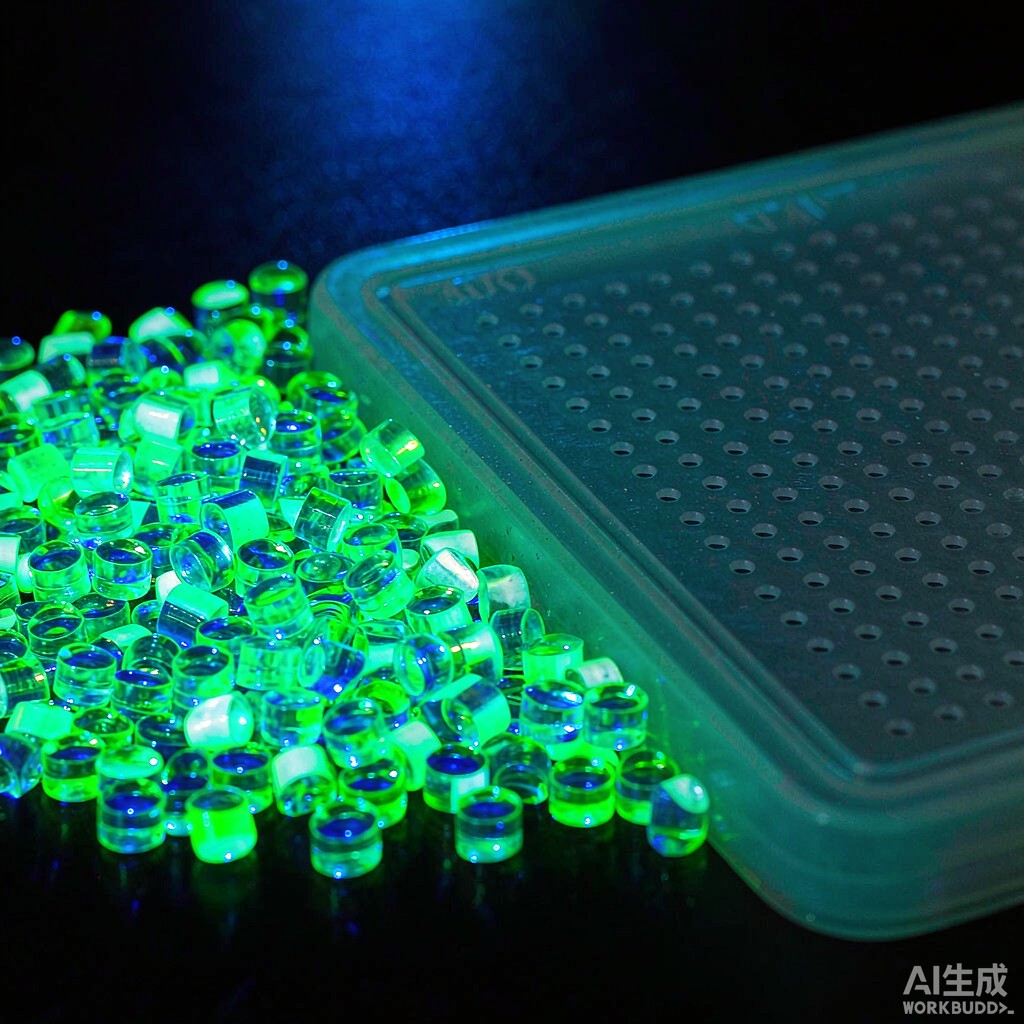
Photoluminescent pigments, the chemistry that makes a building exit sign glow after the power fails, are now being compounded into engineering plastics for SMT indicator light diffusers, light guides, and emergency-locator bezels. At TechMart SE we supply strontium-aluminate and zinc-sulfide masterbatches in PC, ABS, and PMMA carrier resins, optimized for the 200 to 320 degrees Celsius injection-molding window and the 1.4 to 1.7 refractive index required for an even light pipe.
Strontium Aluminate vs Zinc Sulfide: The Two Pigment Families
Strontium aluminate doped with europium and dysprosium, formula SrAl2O4:Eu,Dy, is the modern high-performance pigment. The afterglow is 8 to 12 hours, the emission peak sits at 520 nm, and the luminance decay follows a bi-exponential curve with half-lives of 5 minutes and 80 minutes. The pigment is chemically stable to 600 degrees Celsius and is the right choice for safety signage and high-end indicators. Zinc sulfide doped with copper, formula ZnS:Cu, is the older technology with a 30 to 60 minute afterglow, an emission peak at 530 nm, and a ceiling temperature of 350 degrees Celsius. Zinc sulfide costs 30 to 50 percent less than strontium aluminate and is the typical choice for low-cost consumer electronics where 30 minutes of afterglow is enough.
Loading Level and the Transparency Trade-Off
Photoluminescent pigments are opaque at the wavelengths they emit, so a 1.0 to 2.0 percent loading in a 1.5 mm thick diffuser gives a clearly visible green or aqua glow with about 60 to 75 percent of the LED’s original lumen output reaching the observer. A 4.0 to 6.0 percent loading produces a more saturated glow but blocks 40 to 55 percent of the active light and is typically reserved for emergency-locator applications where the LED is only a status beacon rather than the primary user interface. The light-pipe thickness is matched to the pigment loading through a 4:1 thickness-to-loading rule of thumb.
Carrier Resin Selection for SMT Processing
Polycarbonate and PC/ABS are the preferred carrier for SMT indicator housings because the heat-deflection temperature of 130 to 140 degrees Celsius at 1.8 MPa handles the lead-free reflow profile at 250 to 260 degrees Celsius peak. PMMA is a better optical choice with 92 percent light transmission and excellent UV stability, but its 105 degrees Celsius heat-deflection temperature rules it out for parts that are surface-mount reflowed. We typically use a PMMA cap layer over a PC body for high-end light guides that need both optical clarity and reflow compatibility.
Injection Molding Process Window
Strontium aluminate is abrasive and shortens the life of an untreated tool-steel screw by 30 to 50 percent. The standard fix is a bimetallic barrel with a CPM-9V or CPM-10V screw and a nitrogen-nitride-coated cavity. The melt temperature is 280 to 310 degrees Celsius for PC, the mold temperature 80 to 110 degrees Celsius, and the injection speed 40 to 80 mm per second. To preserve the afterglow lifetime, the pigment supplier recommends holding the melt below 320 degrees Celsius and the residence time below 8 minutes; higher temperatures or longer residence times hydrolyze the strontium aluminate and shorten the afterglow by 15 to 25 percent.
Light-Pipe and Diffuser Geometry
A 1.0 to 1.5 mm wall thickness is the typical minimum for even light distribution in a 20 to 50 mm long light pipe. The light-entry surface is polished to a 0.2 to 0.5 micrometre Ra finish, and the light-output surface is micro-textured at 1.5 to 3.0 micrometre Ra to scatter the light evenly. The radius at the entry and exit corners is held above 0.5 mm to avoid total-internal-reflection losses at the corners. Adding a 5 to 10 percent loading of a near-IR absorbing dye in the cap layer shifts the daylight color of the part to a subtle gray or aqua while preserving the green afterglow.
UV Activation and Daylight Performance
Strontium aluminate pigments charge under UV-A and high-blue light, so a diffuser that sits near a window or under an LED with a 450 nm peak will saturate within 5 to 10 minutes. The DIN 67510-1 photometric test for emergency exit signs uses 1 000 lux of a D65 xenon arc for 5 minutes, then measures the luminance at 10 minutes and 60 minutes; quality strontium aluminate masterbatches deliver 200 to 350 mcd per square metre at 10 minutes and 35 to 60 mcd per square metre at 60 minutes. The DIN 67510-4 solid-state test uses 30 minutes of indoor fluorescent lighting as the charging source and is the more realistic target for indoor electronics.
Specification Skeleton for a Photoluminescent Masterbatch
A robust specification lists the pigment chemistry and grain size, the afterglow luminance at 10 and 60 minutes per DIN 67510-1, the carrier resin and the recommended loading, the maximum melt temperature and residence time, the light transmission at 1 mm thickness, and the abrasive-wear note for the tool. At TechMart SE the default bill of materials is 4 percent strontium aluminate in PC carrier, with a 1.5 mm wall thickness, a 0.3 micrometre Ra entry finish, and a 2.0 micrometre Ra output texture, qualified to DIN 67510-1 Class C and lead-free reflow at 260 degrees Celsius peak. The full specification covers both the optical and the SMT-process requirements, eliminating the most common field complaints of dim afterglow and uneven daylit appearance.