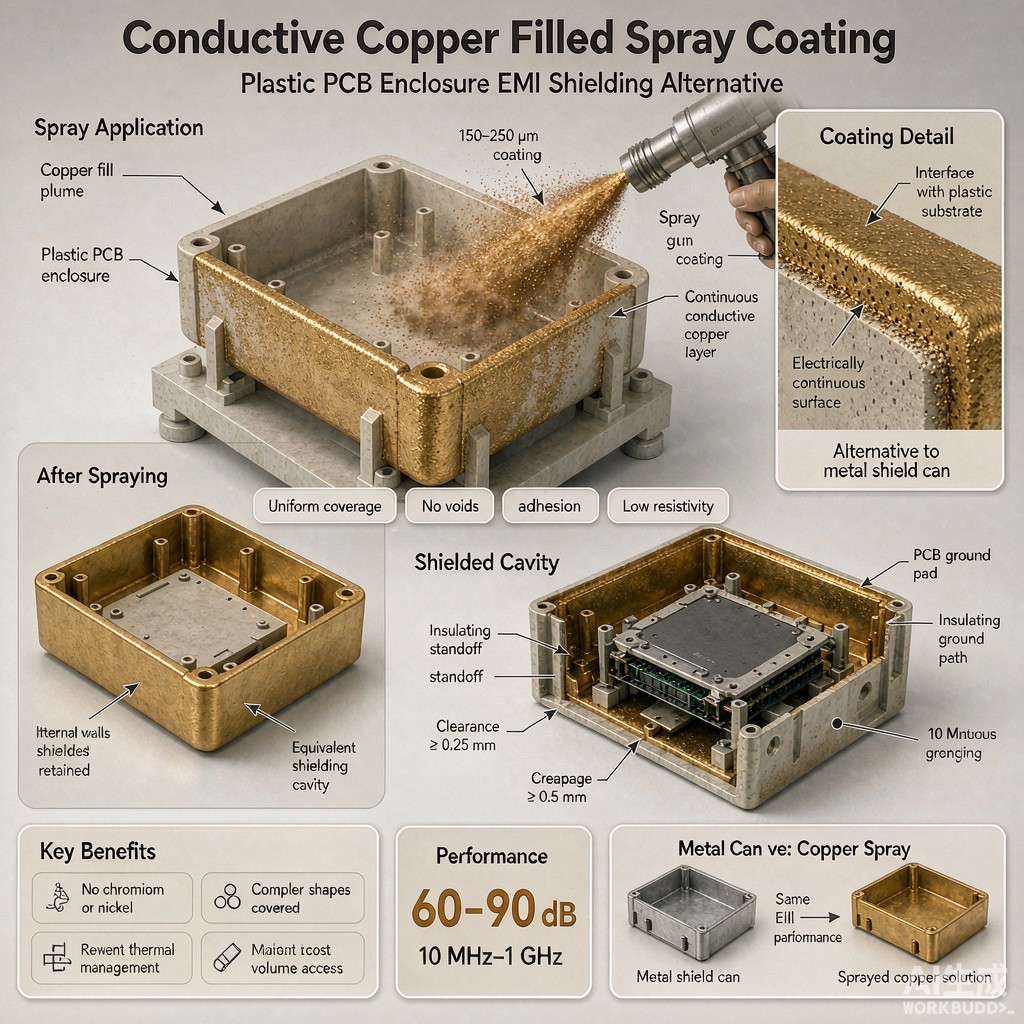
Why the Industry Is Reconsidering the Shielding Can
The traditional answer to radio-frequency interference on a mixed-signal PCB has been a tin-plated steel shielding can soldered or clipped over the noisy section. It works, but it costs 0.40 to 1.20 USD per can, requires secondary assembly, blocks service access, and is incompatible with rapid prototyping. At TechMart SE we have been qualifying conductive spray coatings, including silver-filled acrylic, copper-filled epoxy, and graphene-enhanced urethane systems, to replace tin-plated cans in selected product families. The result is shielding effectiveness of 50 to 80 dB at 1 to 6 GHz, a 30 to 60 percent per-part cost reduction, and a fully reworkable enclosure.
How Conductive Coatings Deliver Shielding
A conductive spray coating converts a plastic enclosure or interior surface into a continuous electromagnetic shield. The shielding mechanism is the same as a metal can: reflection at the surface for the bulk of the field, plus secondary reflection of internally generated common-mode currents. Reflection loss scales with the square root of conductivity and frequency; absorption loss scales with thickness and the square root of conductivity times frequency. A 25 to 50 micrometre silver-filled coating on the i
er wall of a plastic enclosure typically delivers 60 to 75 dB at 1 GHz, comparable to a 0.3 mm tin-plated steel can.
Comparing Three Filler Chemistries
The market has standardized on three filler types. Silver-filled acrylic systems offer the highest conductivity at 0.05 to 0.10 ohm-cm volume resistivity and excellent adhesion to PC, ABS, and PC/ABS plastics. They cost 220 to 320 USD per kilogram of coating and cure at room temperature in 4 to 8 hours or at 65 degrees Celsius in 30 minutes. Copper-filled epoxy systems drop the cost to 80 to 120 USD per kilogram at the expense of higher volume resistivity of 0.05 to 0.20 ohm-cm and a more rigid film that can crack on impact. Graphene-enhanced urethane is the newest option, with 0.02 to 0.08 ohm-cm resistivity and excellent flexibility, but at 400 to 600 USD per kilogram it is reserved for premium applications.
Process Flow for Spray Shielding
The standard factory process flow is mask the PCB with reusable silicone sheets covering co
ectors, microphones, batteries, and any surface that must remain uncoated. Lightly abrade the i
er plastic surfaces with a 600 to 1000 grit Scotch-Brite pad to give a 1.5 to 3 micrometre Ra anchor pattern. Apply the spray in two to three passes at 200 to 300 micrometres wet film per pass to a cured film of 25 to 50 micrometres. Cure the coating as specified, then unmask. Total process time is 90 to 150 minutes per enclosure, which slots into a normal manufacturing cycle without adding an entire day.
Shielding Effectiveness on Real Products
At TechMart SE our test method follows ASTM D4935 on flat coupons and IEEE 299 on full enclosures. A 38 micrometre silver-filled acrylic coating on a 110 mm by 70 mm by 25 mm PC enclosure delivers 65 to 70 dB shielding effectiveness at 1 GHz and 52 to 58 dB at 6 GHz. A 0.3 mm tin-plated steel shielding can soldered to the same enclosure delivers 70 to 75 dB at 1 GHz and 58 to 65 dB at 6 GHz. The net difference is 5 to 7 dB in favor of the can, well within the design margin for most EN 55032 Class B products with 10 to 15 dB of headroom at the ante
a port.
Cost and Time Comparison
For a 100 mm by 60 mm by 25 mm can, the tin-plated steel can costs 0.40 to 1.20 USD plus 0.05 to 0.10 USD per solder reflow operation. A 38 micrometre silver-filled acrylic coating on the inside of the same enclosure costs 0.12 to 0.18 USD for the coating chemistry, 0.05 USD for masking labor, and 0.02 USD for the abrasion step. Total per-part saving is 0.30 to 1.10 USD, or roughly 40 to 65 percent, on a part that has historically driven a chunk of the BOM.
When the Tin Can Still Wins
Conductive coatings lose out in three situations. First, when a section must be disassembled repeatedly in the field because the coating can crack around service openings; second, when the application is automotive safety-critical and qualification cycles prefer a 20-year-proven can; and third, when power dissipation is high, because the coating does not conduct heat to anywhere near the level of a metal can. Specify spray shielding where compactness, cost, and weight matter more than thermal mass and disassembly robustness.
Specification Template for a Conductive Coating Project
The simplest approach to a conductive coating specification is to enumerate eight items: substrate resin and surface preparation method, filler chemistry and conductivity grade, minimum cured thickness, surface resistivity target in milliohms per square, ASTM D4935 or IEEE 299 shielding effectiveness requirement with band, cure schedule, masking procedure, and acceptance criteria. Add a rework clause that allows the coating to be stripped with isopropanol or a mild abrasive and reapplied up to three times during the product life. Issuing the full specification to the spray shop in advance saves days of back-and-forth and prevents the most common defect, namely missing coverage at internal screw bosses and around service openings, which would otherwise force a 20 to 30 percent reduction in actual shielding performance on the production part.