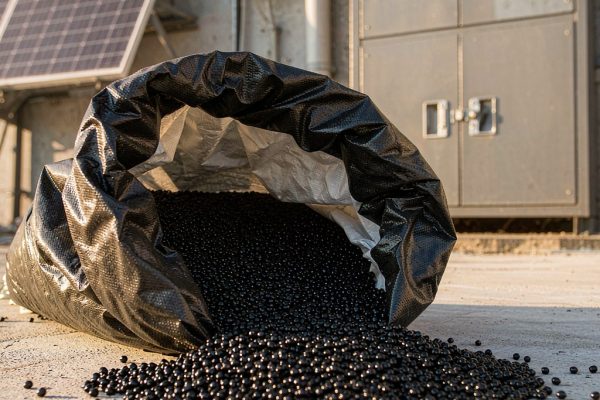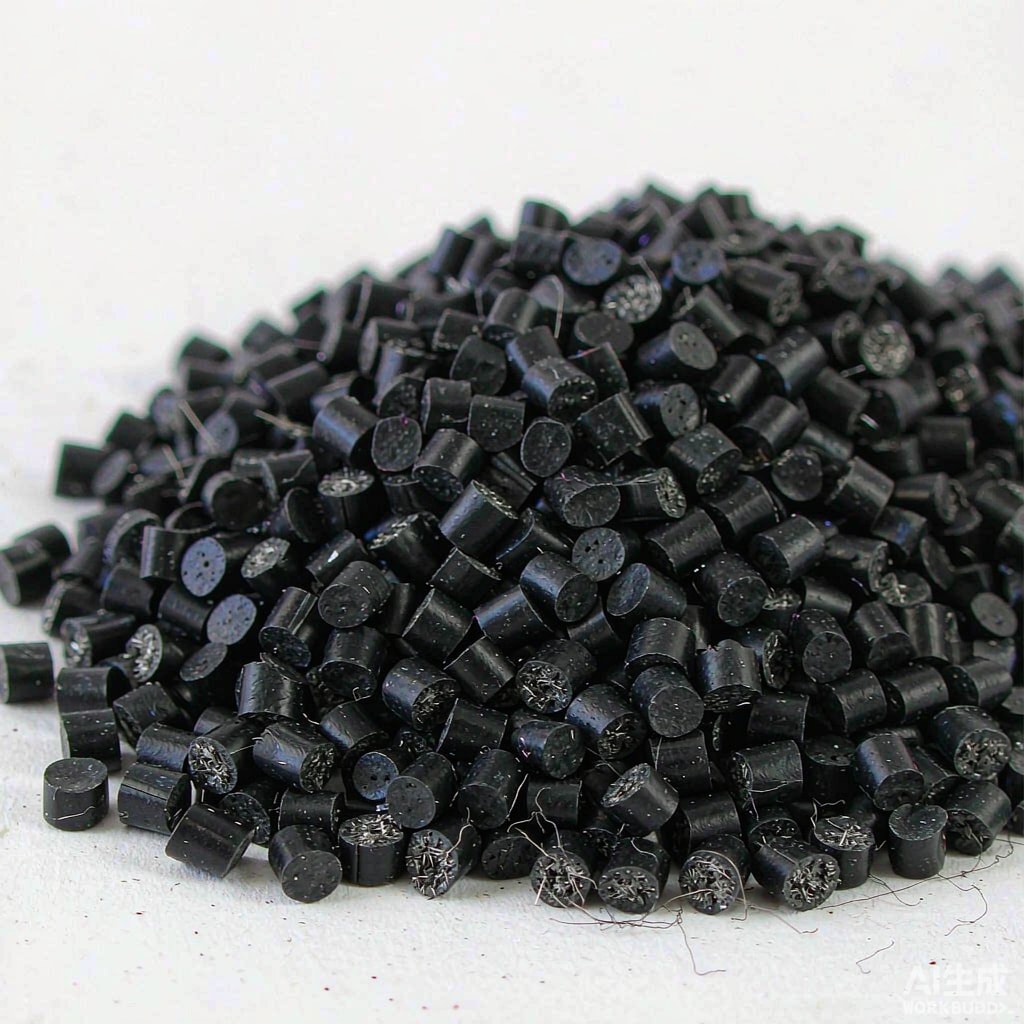
Automotive SMT sensors — including pressure sensors, position sensors, temperature sensors, and current sensors — operate under severe underhood conditions: continuous temperatures from 125°C to 175°C, transient peaks above 200°C during engine bay heat soak, exposure to engine oil, transmission fluid, coolant, brake fluid, and road salt, plus vibration and thermal cycling over a 15-year service life. The housing material must survive lead-free reflow assembly at 245-260°C peak without warping or outgassing, then maintain mechanical integrity and sealing performance in the vehicle environment. Polyphenylene sulfide with 40% glass fiber reinforcement (PPS-GF40) has emerged as a leading material for these applications because of its exceptional chemical resistance, high heat deflection temperature, low moisture absorption, and excellent dimensional stability. This article examines the engineering properties, processing, and application of PPS-GF40 plastic pellets for automotive SMT sensor housings.
PPS-GF40 Material Properties
Thermal and Mechanical Performance
PPS is a semi-crystalline high-performance thermoplastic with an aromatic thioether backbone that provides inherent flame retardancy and chemical resistance. The addition of 40% short glass fibers raises stiffness, strength, and heat deflection temperature:
| Property | PPS-GF40 | PBT-GF30 | PA66-GF30 |
|---|---|---|---|
| Density (g/cm³) | 1.65-1.70 | 1.50-1.55 | 1.35-1.40 |
| Tensile Strength (MPa) | 180-220 | 130-160 | 170-210 |
| Flexural Modulus (GPa) | 13-16 | 8-10 | 9-11 |
| Heat Deflection Temp. (°C, 1.8 MPa) | 250-270 | 205-220 | 250-260 |
| Continuous Service Temperature (°C) | 200-220 | 140-160 | 150-170 |
| Moisture Absorption (%) | 0.02-0.05 | 0.07-0.20 | 0.8-2.5 |
| Flammability (UL94) | V-0 @ 0.4 mm | V-0 @ 0.4 mm | V-0 @ 0.75 mm |
| Chemical Resistance | Excellent | Good | Fair to Good |
The near-zero moisture absorption of PPS-GF40 is particularly important for SMT sensor housings. PA66-GF30 must be dried immediately before molding and can dimensionally change during reflow or in humid service environments, affecting lid sealing and co
ector fit.
Reflow Compatibility
Lead-Free Solder Process Window
Automotive SMT sensor housings are often assembled on the same PCB as other components and must survive infrared or vapor-phase reflow. PPS-GF40 is compatible with standard lead-free profiles:
- Pre-heat: 150-180°C for 60-120 seconds; no degradation or discoloration.
- Soak: 180-220°C for 60-90 seconds; allows uniform temperature distribution.
- Reflow peak: 245-260°C for 5-10 seconds; well below PPS melting point of 285°C.
- Cooling: Controlled cooling at 2-4°C/s to minimize warpage.
Because PPS-GF40 has a melt temperature around 285°C and HDT above 250°C, the housing retains rigidity during reflow and resists the deformation common with lower-temperature plastics. Parts should still be designed with uniform wall thickness (1.5-3.0 mm) and adequate draft angles to minimize internal stress and warpage.
Chemical Resistance in Automotive Fluids
Fluid Aging Performance
PPS-GF40 demonstrates outstanding resistance to automotive chemicals, enabling sensor housings to be mounted directly on engines, transmissions, and brake systems without additional protective coatings:
| Fluid | Test Temperature | Typical Property Retention |
|---|---|---|
| Engine oil (5W-30) | 150°C, 1,000 h | 90-95% tensile strength |
| Transmission fluid (ATF) | 150°C, 1,000 h | 88-93% tensile strength |
| Coolant (50/50 EG/water) | 135°C, 1,000 h | 85-92% tensile strength |
| Brake fluid (DOT 4) | 120°C, 500 h | 80-88% tensile strength |
| Road salt (CaCl₂ solution) | 85°C, 500 h | 95-98% tensile strength |
| Gasoline (E10) | 60°C, 500 h | 85-90% tensile strength |
The sulfur-aromatic backbone of PPS resists hydrolysis, oxidation, and hydrocarbon swelling far better than ester-based PBT or amide-based PA66. This chemical stability translates directly to longer service life and reduced warranty claims for sensors exposed to underhood fluids.
Dimensional Stability and Sealing
Tight-Tolerance Housing Design
Automotive sensor housings must maintain tight sealing surfaces and co
ector pin alignment over temperature extremes:
- Mold shrinkage: PPS-GF40 shrinks 0.1-0.3% in flow direction and 0.4-0.7% in cross-flow direction; anisotropy must be managed through gate location and wall thickness uniformity.
- Coefficient of thermal expansion (CTE): 15-25 ppm/°C in-plane; close to aluminum inserts and PCB substrates, reducing thermal stress on soldered leads.
- Creep resistance: Low creep under bolt preload and O-ring compression at 150°C; critical for long-term seal retention.
- Surface finish: As-molded surfaces Ra 0.4-1.0 µm support O-ring sealing without secondary machining.
Insert molding of metal terminals, lead frames, and threaded brass inserts is common with PPS-GF40. The material bonds well to plated copper and brass through mechanical interlocking and chemical adhesion, provided inserts are preheated and proper venting is used.
Processing Guidelines for Pellets
Drying, Melt, and Mold Temperature
PPS-GF40 plastic pellets require precise processing conditions to achieve full mechanical properties and surface quality:
- Drying: 130-150°C for 3-5 hours to <0.02% moisture; PPS is hygroscopic enough to cause hydrolytic degradation if not dried.
- Melt temperature: 300-340°C; avoid prolonged residence above 350°C to prevent polymer oxidation and color shift.
- Mold temperature: 130-160°C; higher mold temperatures improve crystallinity, surface gloss, and weld-line strength.
- Injection pressure: 80-140 MPa; high viscosity requires adequate clamp to
age and fast injection.
- Screw design: General-purpose compression screw with L/D 18-22; avoid excessive shear that breaks glass fibers.
Properly molded PPS-GF40 parts exhibit light tan to dark brown color depending on grade and heat history. Color consistency is less critical for underhood sensor housings than for visible interior components.
Comparison Summary
For automotive SMT sensor housings operating above 150°C or exposed to aggressive fluids, PPS-GF40 outperforms PBT-GF30 and PA66-GF30 in heat resistance, chemical resistance, moisture stability, and long-term creep. The higher material cost (typically 2-3x PBT and 1.5-2x PA66) is justified by the elimination of protective coatings, reduced warranty claims, and the ability to use a single material across multiple sensor platforms. As automotive electrification increases sensor density in high-temperature zones near motors, inverters, and battery packs, demand for PPS-GF40 plastic pellets in SMT sensor housings continues to grow.