Filtration Requirements in Enclosed Smoking Booths
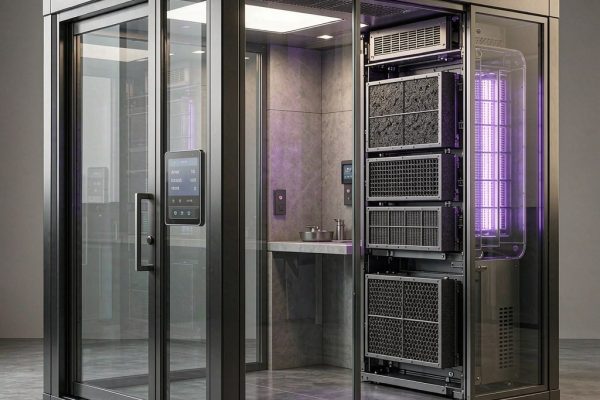
Modern smoking booths are designed as negative-pressure enclosures that protect non-smoking building occupants from secondhand smoke. The core of this protection is a multi-stage filtration system that removes particulate matter, volatile organic compounds, and odor gases from the recirculated and exhausted air. At the heart of this system is the HEPA (High-Efficiency Particulate Air) filter, which captures fine and ultrafine particles that carry the most harmful constituents of tobacco smoke.
Selecting the right filter grade, understanding its behavior under tropical humidity, and scheduling timely replacement are critical decisions that determine both air quality compliance and long-term operating cost.
HEPA vs MERV: Understanding Filter Efficiency Grades
Tobacco smoke particles range from 0.01 to 1.0 micrometers in diameter, with a peak number concentration between 0.1 and 0.4 micrometers. Capturing these particles requires a filter rated for sub-micron efficiency. Two rating systems are commonly referenced:
HEPA (EN 1822 / IEC 60335-2-65)
True HEPA filters are classified by their efficiency at the MPPS (Most Penetrating Particle Size), which is typically 0.1-0.3 micrometers. The standard classes relevant to smoking booths are:
- E10 (HEPA): 85% efficiency at MPPS. Adequate for general ventilation but insufficient for tobacco smoke capture.
- E11: 95% efficiency. Removes most visible smoke but allows significant ultrafine penetration.
- E12: 99.5% efficiency. The recommended minimum for smoking booth primary filtration.
- H13: 99.95% efficiency at MPPS. Used in high-performance booths and cleanroom-adjacent applications. Adds 30-50% to filter cost and doubles pressure drop compared to E12.
MERV (ASHRAE 52.2)
The MERV scale ranges from 1 to 20 and reports composite efficiency across particle size ranges. For smoking booths, MERV ratings are used for the pre-filters that protect the HEPA stage:
- MERV 8: Captures particles above 3.0 micrometers (dust, lint, pollen). Used as a washable pre-filter.
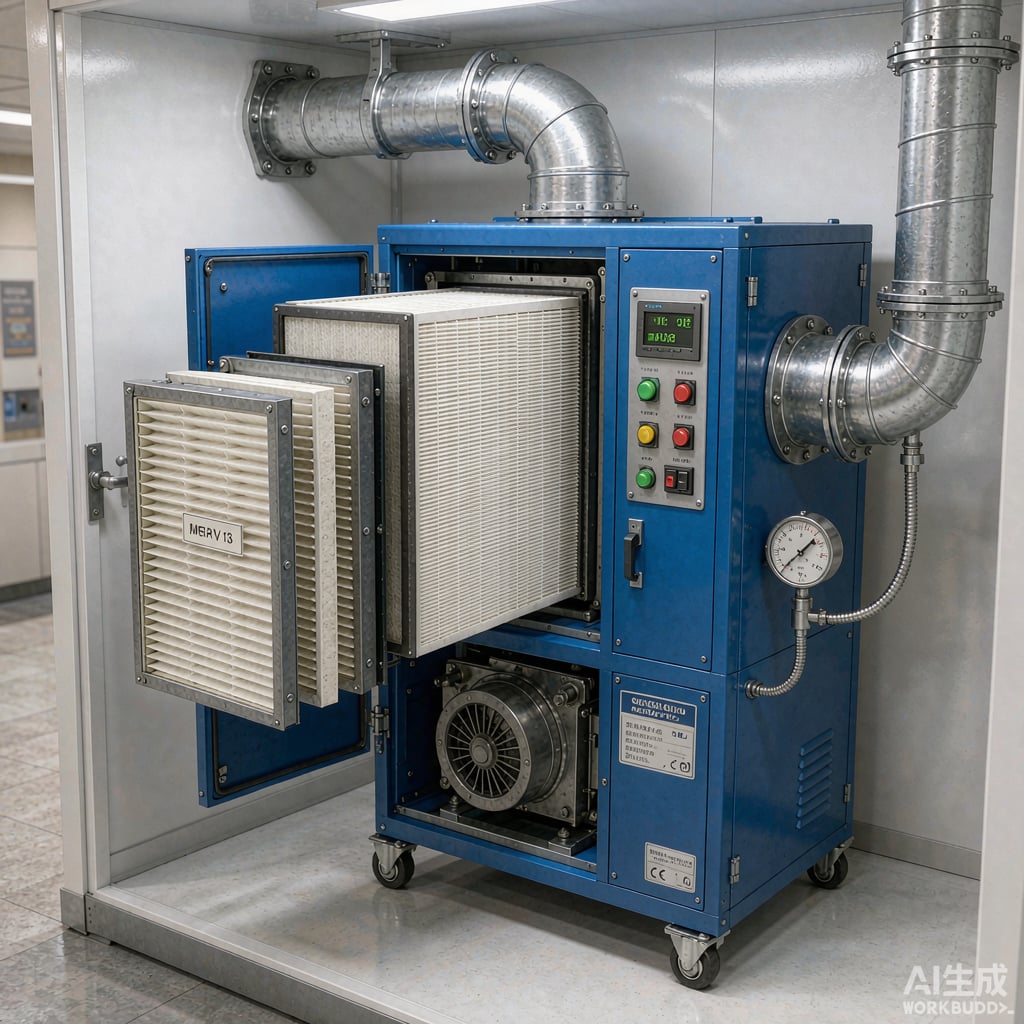
- MERV 13: Captures particles above 0.3 micrometers with 75-85% efficiency. Can serve as a mid-stage filter to extend HEPA life.
- MERV 16: 95% efficiency above 0.3 micrometers. Sometimes used as a standalone filter in lower-spec booths.
A typical smoking booth uses a two or three stage configuration: a MERV 8 washable pre-filter, an optional MERV 13 mid-stage, and an E12 or H13 HEPA final filter.
Pressure Drop and Energy Consumption
Filter pressure drop directly impacts blower power consumption and noise. Clean HEPA filters have an initial pressure drop of 120-250 Pa at rated face velocity (0.05-0.10 m/s). As the filter loads with particulate, pressure drop rises. The replacement trigger is typically 2 to 2.5 times the initial pressure drop, or about 400-500 Pa for an E12 filter.
| Filter Stage | Clean Pressure Drop | Replacement Trigger | Typical Cost |
|---|---|---|---|
| MERV 8 pre-filter | 15-30 Pa | Visual inspection / 3 months | Low |
| MERV 13 mid-stage | 40-80 Pa | 200 Pa or 6 months | Medium |
| E12 HEPA final | 120-200 Pa | 400-500 Pa or 12 months | High |
| H13 HEPA final | 200-300 Pa | 500-600 Pa or 12 months | Premium |
A booth with an E12 filter at 300 Pa clean pressure drop ru
ing at 250 m3/h airflow requires approximately 25-35 W of blower power. If the filter loads to 600 Pa, power consumption rises to 50-70 W, and airflow may drop by 20-30% if the fan is not constant-volume rated. This is why filter loading must be monitored and replacement scheduled proactively.
Tropical Humidity Effects on Filter Media
In Southeast Asia, ambient relative humidity routinely exceeds 80% for extended periods. High humidity affects HEPA filter performance in several ways:
- Media swelling: Glass fiber and cellulose media absorb moisture, increasing structural weight and slightly expanding the fiber matrix. This can actually improve initial efficiency but accelerates pressure drop rise.
- Microbial growth: At sustained humidity above 70%, mold and bacteria can colonize the filter media, producing musty odors and potentially releasing spores downstream. Antimicrobial-treated media (silver-ion or zinc pyrithione coatings) mitigate this risk.
- Hygroscopic particle loading: Tobacco smoke particles are hygroscopic and grow in size when exposed to high humidity. This shifts the particle size distribution and can change the effective MPPS slightly, but the net effect on HEPA efficiency is small because larger particles are captured more easily by impaction and interception.
- Frame and seal degradation: Wooden frame filters (common in low-cost units) warp and delaminate in tropical humidity. Aluminum or galvanized steel frames with polyurethane gasket seals are the preferred choice for tropical installations.
Replacement Scheduling and Monitoring
Filter life in a smoking booth depends on occupancy rate, ventilation rate, and ambient air quality. A booth serving 50 smokers per day in a relatively clean indoor environment will load filters faster than one serving 20 smokers per day. Recommended replacement intervals for tropical deployments:
- Pre-filter (MERV 8): Wash or replace every 2-3 months. Washable aluminum mesh pre-filters reduce cost but require disciplined maintenance.
- Mid-stage (MERV 13): Replace every 4-6 months or when pressure drop reaches 200 Pa above clean.
- HEPA (E12): Replace every 8-12 months. High-occupancy booths may require replacement every 6 months.
- Carbon stage: The activated carbon stage for VOC and odor removal typically exhausts its adsorption capacity before the HEPA loads. Replace every 3-4 months in high-occupancy booths.
Modern booths include a differential pressure sensor that triggers an indicator when the HEPA reaches its replacement threshold. In tropical deployments, it is advisable to also log booth occupancy and correlate it with pressure-drop trends to optimize the replacement schedule and avoid premature filter changes.
Compliance and Air Quality Standards
Smoking booth filtration performance is evaluated against standards such as ASHRAE 62.1 (ventilation for acceptable indoor air quality), which requires that enclosed smoking areas maintain negative pressure of at least 5 Pa relative to adjacent spaces and achieve a particulate removal efficiency sufficient to limit PM2.5 exposure. A properly specified E12 HEPA filter with adequate pre-filtration can reduce recirculated PM2.5 by 99% or more, meeting or exceeding ASHRAE 62.1 requirements for smoking enclosure ventilation.
By selecting the appropriate filter grade, monitoring pressure drop, accounting for tropical humidity effects, and scheduling proactive replacement, facility managers can ensure that smoking booths deliver clean, compliant air quality over their service life while controlling energy and maintenance costs.