Introduction: Why Copper Strip Temper Matters in SMT Battery Contacts
In surface-mount technology (SMT) manufacturing, battery contact springs fabricated from precision copper strip must maintain consistent normal force throughout the product lifecycle. The temper designation of the copper strip directly determines its mechanical properties, spring-back behavior, and fatigue endurance. Engineers designing battery-powered IoT devices, wearables, and portable electronics must select the correct temper to ensure contact reliability under thermal cycling, mechanical shock, and long-term stress relaxation.
Copper Strip Temper Classification per ASTM B152
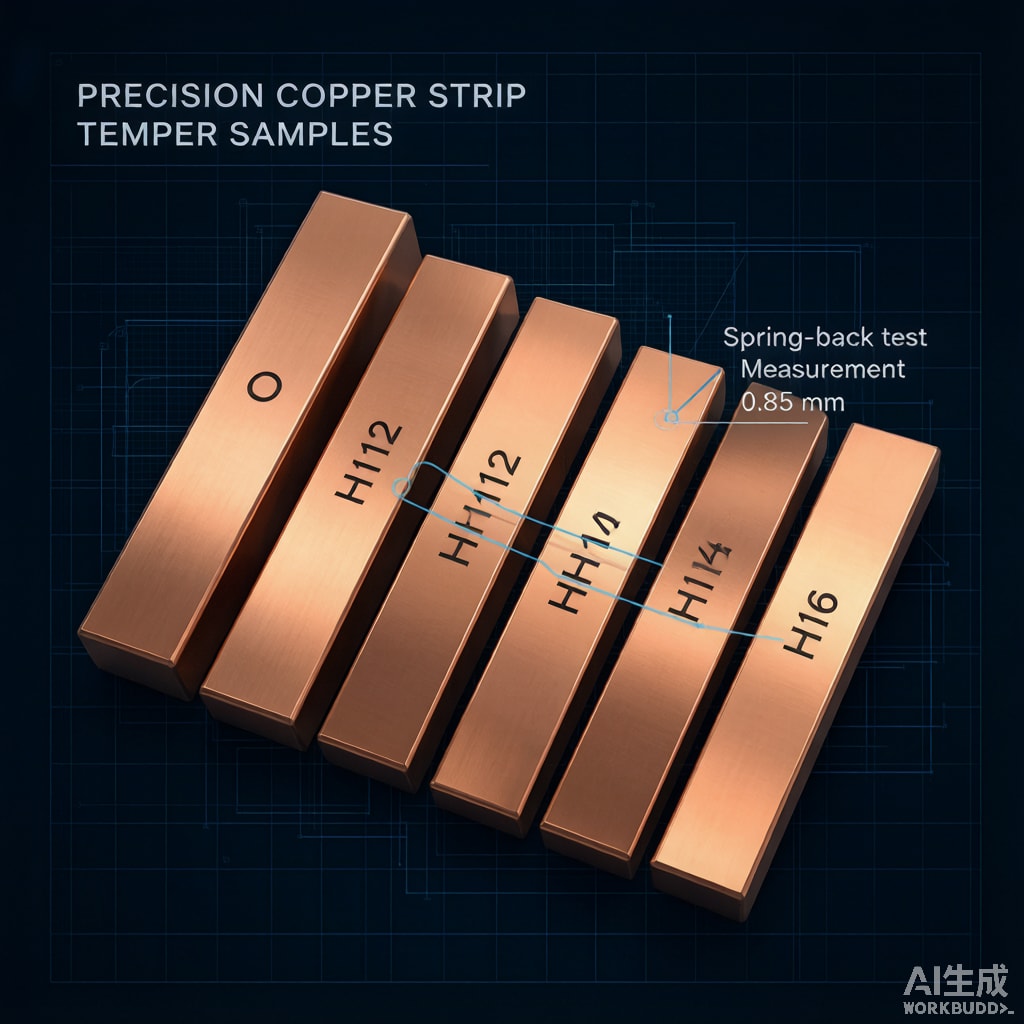
The ASTM B152 standard defines six primary temper grades for copper strip, each produced through controlled cold-rolling reduction:
Temper Grades and Mechanical Properties
- 1/4 Hard (H01): Tensile strength 290-360 MPa, yield strength 220-290 MPa, elongation 25-36%. Used for lightly loaded contacts requiring formability.
- 1/2 Hard (H02): Tensile strength 340-410 MPa, yield strength 280-340 MPa, elongation 18-28%. The most common temper for standard battery spring contacts.
- 3/4 Hard (H04): Tensile strength 400-470 MPa, yield strength 360-420 MPa, elongation 10-20%. Preferred for high-force contacts in automotive and industrial applications.
- Hard (H06): Tensile strength 450-520 MPa, yield strength 410-470 MPa, elongation 7-15%. Used where space constraints require smaller contact geometry with higher force.
- Extra Hard (H08): Tensile strength 480-550 MPa, yield strength 450-510 MPa, elongation 5-12%. Maximum strength for ultra-miniature contacts but limited formability.
- Spring (H10): Tensile strength 510-580 MPa, yield strength 490-560 MPa, elongation 3-8%. Highest spring temper, suitable for high-cycle precision contacts.
For SMT battery contacts, the H02 and H04 temper grades dominate due to their balance of formability (needed for stamping complex contact geometries) and spring performance (required for maintaining normal force).
Spring-Back Ratio: Measurement and Control
Spring-back is the elastic recovery of copper strip after stamping or forming. It directly affects the dimensional accuracy and final contact force of battery springs. The spring-back ratio (K) is calculated as:
K = (A – B) / A × 100%
Where A is the die angle and B is the formed part angle after spring-back. Typical spring-back ratios for common SMT contact alloys:
| Alloy | Temper | Spring-Back Ratio | Formability Index |
|---|---|---|---|
| C26000 Cartridge Brass | H02 | 8-12% | Excellent |
| C51000 Phosphor Bronze | H02 | 12-18% | Good |
| C17200 Beryllium Copper | H04 (TH04) | 15-22% | Fair |
| C19400 Cu-Fe-P | H04 | 10-14% | Good |
| C70250 Cu-Ni-Si | TM04 | 14-20% | Fair |
Compensation Strategies
Tooling engineers compensate for spring-back through overbending (die angle 2-5 degrees beyond target), coining (localized compression at bend radius to set the material), and progressive die station adjustments. For high-precision contacts in 0.3-0.5mm pitch co
ectors, coining at the bend root reduces spring-back variation to under 2 degrees.
Battery Contact Force Requirements
The normal force at the battery contact interface determines contact resistance, insertion/extraction feel, and long-term reliability. SMT battery contacts must satisfy these force targets:
- Consumer electronics (coin cell): 50-100g per contact, 1,000-5,000 cycles
- Smartphone Li-ion pouch: 80-150g per contact, 500-1,000 cycles
- Automotive battery module: 150-300g per contact, 500-2,000 cycles with vibration
- Industrial sensor pack: 100-200g per contact, 10,000+ cycles
The required strip thickness and temper can be estimated using cantilever beam theory: F = (3EIδ) / L³, where E is the elastic modulus, I is the moment of inertia (proportional to strip thickness cubed), δ is the deflection, and L is the beam length. A 0.15mm thick C51000 H02 strip at 3mm length deflecting 0.3mm produces approximately 85g of normal force.
Stress Relaxation at Elevated Temperature
One critical failure mode for battery contacts is stress relaxation at operating temperature. The contact force decreases over time as the copper strip relaxes under sustained deflection. At 85°C (common for sealed battery packs), stress remaining after 1,000 hours varies significantly by alloy:
- C26000 H02: 65-75% stress remaining
- C51000 H02: 75-85% stress remaining
- C17200 TH04 (age-hardened): 85-92% stress remaining
- C70250 TM04: 88-95% stress remaining
For automotive battery contacts operating at 105-125°C, only C17200 (after age hardening at 315°C for 2-3 hours) and C70250 provide sufficient stress relaxation resistance. The precipitation hardening mechanism in these alloys creates nanometer-scale precipitates that pin dislocation movement, maintaining spring force at elevated temperatures.
Stamping Process Considerations
Tool Clearance
Progressive die clearance (c) relative to strip thickness (t) affects burr formation, edge quality, and fatigue life. The recommended c/t ratios for battery contact copper strips range from 3-5% for brass and phosphor bronze to 5-8% for beryllium copper. Excessive clearance produces a shear-break zone exceeding 30% of thickness, creating stress concentration sites for fatigue crack initiation.
Bend Radius
The minimum internal bend radius (R) relative to strip thickness (t) must satisfy R/t ratios to prevent cracking during stamping and forming. For SMT battery contacts: C26000 H02 allows R/t ≥ 1.0, C51000 H02 requires R/t ≥ 1.5, and C17200 TH04 demands R/t ≥ 2.0. Violating these ratios causes micro-cracks at the bend root that propagate under cyclic loading, reducing contact life by 50-80%.
Surface Finish and Contact Resistance
The contact interface resistance depends on both the bulk conductivity of the copper alloy and the surface finish. For battery contacts operating at low voltage (1.5-3.7V), contact resistance below 30 mΩ is typically required:
- Bare copper: 5-15 mΩ (corrodes rapidly in humid environments)
- Tin plating (2-5 μm): 10-25 mΩ (excellent solderability, moderate corrosion resistance)
- Gold flash (0.05-0.1 μm over Ni): 3-8 mΩ (best for low-force, low-voltage contacts)
- ENEPIG (Ni-P/Pd-P/Au): 5-12 mΩ (balanced cost and performance)
Conclusion
Selecting the correct copper strip temper for SMT battery contacts requires balancing formability, spring-back compensation, normal force targets, and stress relaxation resistance. For consumer applications, C51000 phosphor bronze at H02 temper provides the best overall balance. For elevated-temperature automotive and industrial applications, C17200 beryllium copper (TH04) or C70250 Cu-Ni-Si (TM04) deliver superior performance. Engineers must verify spring-back ratios during tooling development and validate stress relaxation through accelerated life testing at maximum operating temperature.