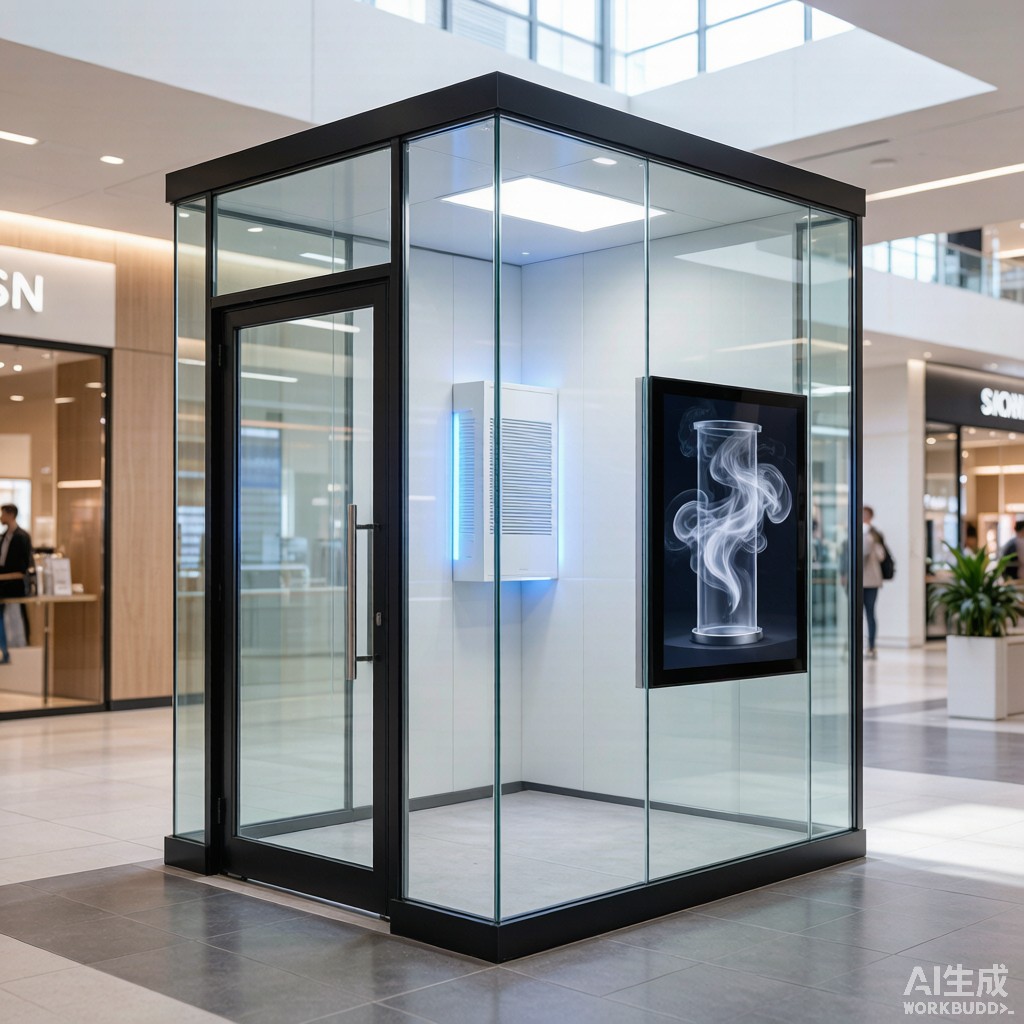
The global e-cigarette and vape market size has surpassed USD 25 billion in 2025 with projected continued growth through 2030, leading to a parallel demand for indoor vaping accommodation in commercial facilities — airports, hotels, casinos, and shopping malls. Unlike tobacco cigarette smoke that produces a polydisperse solid-and-liquid aerosol of 0.1-1.0 µm particle size dominated by combustion byproducts, vaping aerosol is a relatively homogeneous liquid droplet aerosol of 0.2-1.5 µm dominated by propylene glycol (PG), vegetable glycerin (VG), nicotine in salt or freebase form, and flavoring compounds. The fundamentally different aerosol physics of vaping requires purpose-engineered filtration in modern smoking booths if they are to serve both traditional and vape users. This article examines the engineering principles, filter design, and ventilation strategies for vape aerosol capture in commercial smoking booth applications.
Vape Aerosol Physical Characteristics
Droplet Size Distribution and Composition
Vape aerosol generation differs fundamentally from tobacco combustion. The e-cigarette atomizer heats a liquid formulation of PG and VG (typically 50/50, 40/60, or 30/70 ratio) to 200-280°C, producing a supersaturated vapor that condenses into fine droplets upon inhalation and exhalation. The exhalation aerosol has a number-weighted median diameter of 0.3-0.5 µm and a mass-weighted median diameter of 0.6-1.5 µm — substantially smaller than tobacco smoke particles which have a mass median diameter of 0.4-0.6 µm but with a much wider size distribution from combustion sub-products.
| Property | Tobacco Smoke | Vape Aerosol |
|---|---|---|
| Particle median diameter (mass) | 0.4-0.6 µm | 0.6-1.5 µm |
| Particle concentration (per cm³ exhaled) | 1-5 × 10⁹ | 5-20 × 10⁷ |
| Liquid content | Tar (200-500 compounds) | PG/VG 80-95% + nicotine + flavoring |
| Gaseous phase | CO 10-20 mg/cig, NO, HCN | Negligible CO, trace aldehydes |
| Settling velocity | Slow (suspended 30-60 min) | Fast (settles 5-10 min as liquid) |
| Visible persistence in still air | Persistent (puffs visible 1-5 min) | Disappears in 30-90 sec |
| Odor intensity (panel rating) | Strong, persistent | Sweet, dissipating rapidly |
Nicotine Salt and Freebase Difference
Modern vape devices predominantly use nicotine salts (nicotine + benzoic acid or lactic acid) rather than freebase nicotine, achieving higher nicotine concentration at lower pH (5.5-6.5 vs 8-9 for freebase) with reduced harshness. This chemistry difference has implications for filter design:
- Freebase nicotine: Volatile at room temperature, primarily removed by activated carbon adsorption
- Nicotine salts (benzoate): Higher molecular weight, lower vapor pressure, predominantly in liquid droplet phase — captured by HEPA filtration of the condensed aerosol
- Flavoring compounds: Diacetyl, vanillin, menthol, benzaldehyde — semi-volatile with partition coefficient varying widely; require combined HEPA + activated carbon (KI-impregnated) for complete removal
Vape Filtration Filter Stack Design
Pre-Filter Stage (G4)
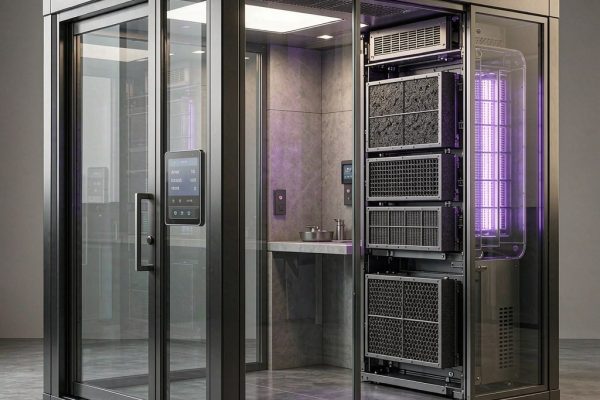
Capture the larger 2-10 µm liquid droplets that condense first as the warm exhaled vapor cools. G4 class pleated media filters (MERV 8 equivalent) with electrostatic enhancement achieve 90-95% capture at this size range with minimal pressure drop (20-40 Pa initial). Pre-filter service life in vape-dominant booth operation is typically 2-4 weeks versus 1-2 weeks in tobacco-smoking-dominant operation due to the lower fine-particle loading.
HEPA Stage (H13 or H14)
Capture 0.2-0.5 µm vape droplets that pass the pre-filter. HEPA H13 (≥99.95% at MPPS 0.3 µm) is the workhorse grade, removing 90-95% of the vape droplets in single-pass operation. H14 (≥99.995%) achieves 95-99% removal at marginally higher pressure drop (250-350 Pa vs 200-280 Pa initial). For pure-vape booths where aldehyde gas removal is less critical than tobacco, H13 HEPA alone may be the principal filter element.
Gas-Phase Stage (Activated Carbon)
Capture residual gaseous compounds including:
- Propylene glycol vapor: Vapor pressure 0.13 mmHg at 25°C; partly in gas phase at sub-saturated condition
- Aldehydes (formaldehyde, acetaldehyde, acrolein): Thermal decomposition byproducts from PG/VG at 280°C atomizer temperature, 0.5-5 µg per puff depending on device power
- Flavoring volatiles: Particularly diacetyl (2,3-butanedione) with buttery flavor profile; chronic inhalation linked to bronchiolitis obliterans. KI-impregnated carbon achieves 95-99% diacetyl capture
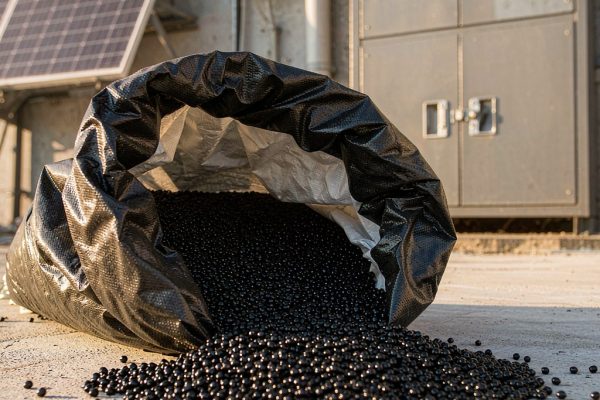
- Nicotine residue gas: Captured by standard coconut-shell carbon without specialized impregnation
For vape-dominant booths, a 25-35 kg activated carbon bed operating at 200-400 m³/h airflow achieves 90-95% gas-phase removal efficiency over an 8-12 month service interval.
Ventilation Volume Calculation
Air Change Rate Scaling
Vape aerosol dissipates faster than tobacco smoke due to liquid droplet settling, but commercial booth design must apply conservative air change rates to ensure user-comfort and odor-free adjacent areas. The recommended ACH (air changes per hour) for vape and mixed-use booths:
| Booth Type | Volume (m³) | Recommended ACH | Exhaust Rate (m³/h) | PM2.5 Target (µg/m³) |
|---|---|---|---|---|
| Single-user vape | 2.5-3.5 | 40-60 | 100-210 | <25 |
| 2-person vape | 4.0-6.0 | 35-50 | 140-300 | <25 |
| Mixed tobacco + vape | 5.0-7.0 | 50-70 | 250-490 | <10 |
| Heavy-traffic transport hub vape | 8.0-15.0 | 30-45 | 240-675 | <25 |
CO₂-Based Demand-Controlled Ventilation
Vape aerosol generation does not produce CO₂ directly, so occupancy sensing ca
ot rely on CO₂ as a surrogate. Alternative occupancy sensors suitable for vape booth demand-controlled ventilation:
- PIR (passive infrared) motion sensor: Detects occupant movement but fails in stationary holding posture typical of vape users
- Ultrasonic occupancy sensor: Detects minor chest expansion and exhale vapor plume; 90-95% accuracy in stationary posture
- PM2.5 optical particle counter: Real-time aerosol density measurement triggers high-mode ventilation when PM2.5 exceeds 80 µg/m³ trigger threshold; provides direct feedback control with 6-12 second response time
- TVOC metal-oxide sensor: Detects the broad VOC profile of vape aerosol; 70-85% correlation with PM2.5 density in mixed-use booths
Mixed-Use Tobacco + Vape Design Considerations
Aerosol Aging and Settling
Vape droplets act as nuclei for the otherwise gaseous tobacco smoke compounds, accelerating the visible aging of mixed aerosol. In a 6 m³ booth with two simultaneous users (one cigarette, one vape), the suspended aerosol mass peaks at 30-90 seconds after both exhale, then decreases exponentially with a time constant of 3-8 minutes. Effective particle capture requires the booth ventilation to clear 95% of the peak mass within 90-180 seconds, corresponding to an ACH of 50-70 in the mixed-use configuration.
Filter Selection for Mixed-Use Operation
Mixed-use booths require the full filter cascade — G4 + H13 HEPA + activated carbon — sized for the higher tobacco-smoke loading rather than vape-only loading. The HEPA service interval for mixed-use is typically 4-6 months versus 8-12 months for vape-only booths. Activated carbon service interval is 6-8 months versus 10-14 months for vape-only, since tobacco aldehydes and tars load the carbon more rapidly than vape flavoring compounds alone.
Conclusion
Vape aerosol filtration in commercial smoking booths requires purpose-engineered filter cascades due to the distinct physical and chemical properties of PG/VG-based aerosols relative to tobacco combustion products. Pre-filter + HEPA H13/H14 + KI-impregnated activated carbon provides 90-99% capture of droplets, nicotine residues, and flavoring aldehydes. Ventilation rates of 35-60 ACH in single-user and mixed-use booths achieve PM2.5 target <25 µg/m³ within 90-180 seconds of dual simultaneous exhalation. For Southeast Asian transport hub deployments, demand-controlled ventilation via PM2.5 or TVOC sensor feedback reduces energy consumption by 40-55% versus fixed high-rate ventilation. Integrated multi-stage filtration scaled to the expected user mixture (vape-only, tobacco-only, or mixed) achieves sustainable indoor air quality compliance with WHO guideline values for PM2.5 and a wide range of aldehyde and flavoring exposure limits.