Introduction: Cantilever Umbrellas in Tropical Hospitality
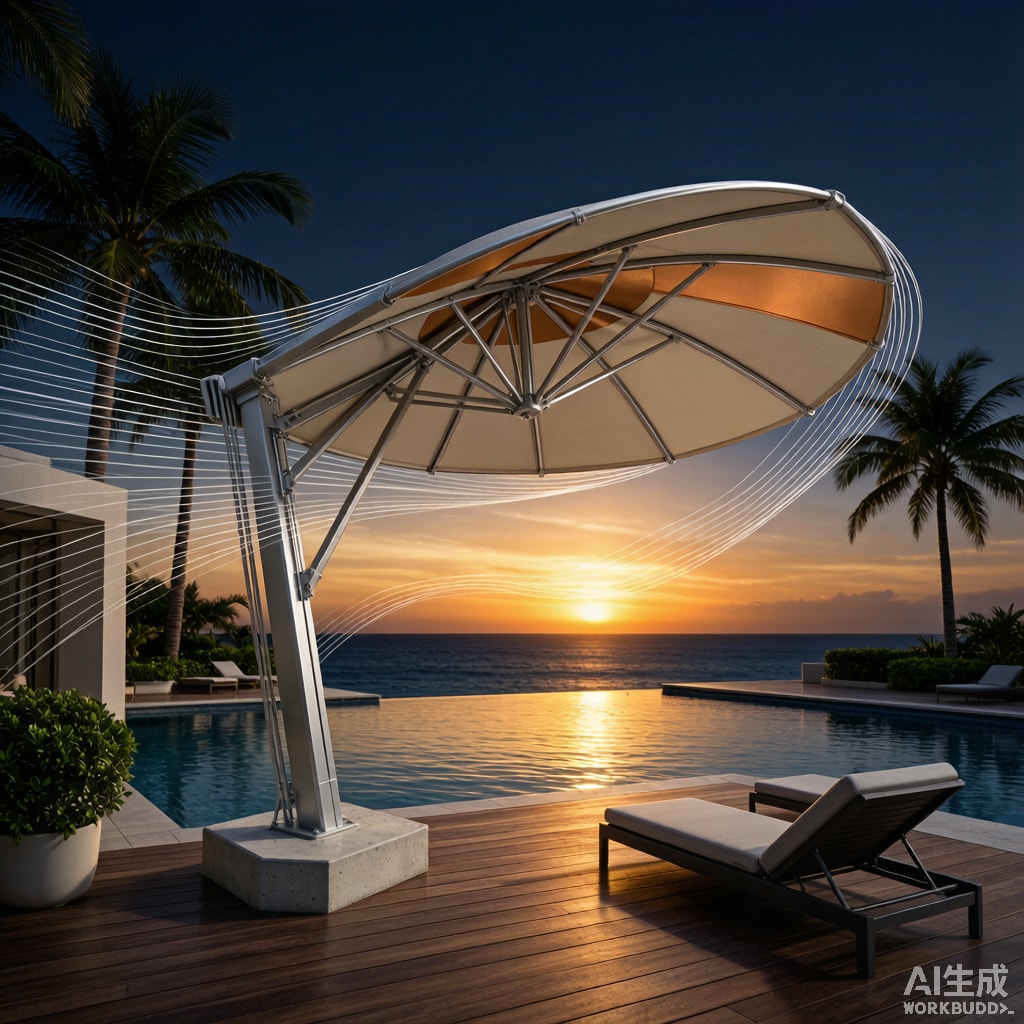
Large cantilever umbrellas have transformed tropical resort and outdoor lounge design. Unlike center-post umbrellas, their offset mast frees the entire shaded area from obstructions, allowing loungers, dining tables and pools to be arranged without pole interference. A typical high-end resort might deploy 30 to 100 such umbrellas around pool decks, beach clubs, restaurant terraces and bar lounges — each one an exposed structure subject to tropical sun, monsoon rain and cyclone-force winds.
The same design that makes the umbrella so desirable — large unsupported canopy area above guests — also makes it vulnerable to wind. Failed cantilever umbrellas have caused injuries and even deaths at resorts worldwide, typically during sudden squalls or cyclones when the umbrella catches wind like a sail and lifts or topples. The economic cost of replacement and the risk to guests and property make proper wind-rated design not optional but essential. This article explains the engineering approach for tropical resort deployment.
Wind Load Fundamentals for Cantilever Structures
Wind Speed and Site Classification
Wind load specification begins with the design wind speed for the site. ASCE 7 (US) and AS/NZS 1170 (Australia/NZ) are two commonly referenced standards. For Southeast Asian resort sites, basic wind speeds are typically:
| Location | 3-sec gust @ 10 m (m/s) | Equivalent 1-min sustained |
|---|---|---|
| Bangkok inland | 32 | 22 |
| Singapore coastal | 30 | 21 |
| Phuket / Penang coastal | 38 | 27 |
| Manila typhoon-prone | 55 | 39 |
| Da Nang typhoon-prone | 50 | 36 |
Cantilever umbrellas should be rated for at least the local 50-year return basic wind speed with no risk factor reduction. Premium products rated for 25–30 m/s sustained (with appropriate safety factor) cover most tropical resort sites excluding the most typhoon-exposed.
Wind Pressure on Canopy
The wind pressure on a curved or flat canopy is given by:
P = 0.5 × ρ × V² × Cp
where ρ is air density (1.225 kg/m³ at sea level), V is wind speed at canopy height, and Cp is the pressure coefficient. For a flat canopy normal to wind, Cp ≈ 1.2; for a tilted canopy, Cp depends strongly on the lift-to-drag ratio of the canopy shape. CFD simulation has shown that a well-shaped canopy with a gentle 12–18° upward tilt and a smooth curved profile has a peak CL ≈ 1.5–1.8 at certain angles of attack — this lift force is what tends to lift the umbrella from its base.
For a 4 m × 4 m canopy in 25 m/s wind with CL = 1.6, the lift force is roughly 2,400 N — equivalent to 245 kg of upward force on the umbrella frame, sufficient to overturn an inadequately weighted base.
Frame Materials and Geometry
Aluminum vs Fiberglass Ribs
Two material systems dominate commercial cantilever umbrellas:
| Material | Tensile Strength | Stiffness (E/GPa) | Density | Best Use |
|---|---|---|---|---|
| Anodized 6061 aluminum | 240 MPa | 70 | 2.7 g/cm³ | Standard resort, cost-effective |
| Fiberglass pultrusion | 300 MPa (longitudinal) | 40 | 1.9 g/cm³ | Coastal, cyclone-prone |
| Carbon fiber composite | 600 MPa | 130 | 1.6 g/cm³ | Premium, lightweight |
Aluminum is the most common, with ribs typically 30×15 mm or 40×20 mm oval cross-sections. Fiberglass has better fatigue life under cyclic wind loading — important for umbrellas that are deployed year-round in tropical sun. The lower stiffness of fiberglass (40 vs 70 GPa) requires slightly larger rib cross-sections to maintain deflection limits.
Mast and Frame Sizing
For a 4 m × 4 m canopy, the central mast is typically 50–75 mm diameter aluminum tube with 3–4 mm wall thickness. The cantilever arm projecting out from the mast top requires moment-resisting co
ection at the hub — a fail-point for many low-quality umbrellas. Premium designs use cast aluminum or stainless steel hubs with sealed bearings to allow the canopy to rotate and (in some models) telescope up and down without weakening.
Base Design and Anchoring
Portable Base Plates
For deck or slab installation, a steel base plate with four bolt-down holes is the standard. Plate dimensions of 300 mm × 300 mm × 10 mm allow ground anchoring with four M12 stainless steel wedge anchors. The base plate must provide moment resistance to overturn the umbrella under the full wind lift + horizontal load combination.
In-Ground Concrete Foundations
For permanent resort installation, an in-ground concrete foundation is preferred. Standard detail:
- 300 mm × 300 mm × 600 mm deep concrete footing (C25/30 strength, reinforced)
- Four M16 × 200 mm embedded anchor studs in stainless steel 316
- Embedded steel plate (250 mm × 250 mm × 10 mm) flush with concrete top
- Threaded engagement length ≥ 150 mm into concrete
This footing resists an uplift force of roughly 30 kN, sufficient to anchor even a 5 m × 5 m umbrella in 30 m/s winds.
Soft Soil and High Water Table Considerations
In tropical coastal sites, sand and high water tables complicate foundation design. Helical screw anchors (4-helix, 100 mm diameter) extending 2.5–3.5 m below grade achieve equivalent uplift resistance without excavation. Their installation also avoids the dewatering required for traditional cast-in-place footings. Allowable capacity per anchor is typically verified by pull-out testing on site.
Canopy Fabric Selection
Solution-Dyed Acrylic vs Polyester vs PVC
Three fabric families dominate commercial umbrellas:
| Fabric | Tensile Strength | UV Life | Water Head | Cost | Use |
|---|---|---|---|---|---|
| Solution-dyed acrylic (Sunbrella) | ~300 N/5cm | 8-12 years | 300-450 mm | High | Premium hospitality |
| Polyester with PU coating | ~200 N/5cm | 3-5 years | 1000+ mm | Medium | Mid-tier resort |
| PVC-coated polyester | ~400 N/5cm | 8-10 years | 2000+ mm | Medium | Wet / heavy rain climates |
| PTFE (Teflon) coated fiberglass | ~500 N/5cm | 20+ years | Infinite | Very high | Permanent architecture |
For tropical resort use, solution-dyed acrylic remains the gold standard — its UV resistance, breathability, and elegant drape keep umbrellas looking new for years. Polyester with PU coating is the cost-effective alternative for budget operations.
Fabric Wind Survival
The fabric is the weakest part of the umbrella under wind. Most commercial products specify a maximum in-use wind speed of 30–50 km/h (8–14 m/s) with the canopy open. Above this, the canopy must be closed, removed, or the umbrella taken down. Quality manufacturers supply a wind-rated maximum clearly marked on each umbrella and a quick-release strap system so staff can close the canopy in under 30 seconds when wind picks up.
Operational Wind Management
Daily Closing Protocol
Resort operations should adopt a daily wind-management protocol:
- Forecast review each morning by engineering staff
- Wind threshold: 35 km/h (10 m/s) sustained — close all umbrellas at pool deck
- Cyclone warning: dismantle umbrellas or strap down with engineered tie-down system
- Off-season storm protection: store umbrella canopies in the equipment room
Sensor-Based Automatic Closure
Premium resort deployments now use anemometer-triggered automatic closure systems. A small anemometer on each umbrella mast (or at the pool deck edge) detects sustained wind above a threshold and signals the umbrella’s motorized drive to retract and lower the canopy. This eliminates reliance on staff and reduces the risk of human error during sudden squalls.
CFD Optimization and Advanced Design
High-end custom umbrellas often use CFD simulation to optimize canopy shape:
- Concave underside: Traps a controlled pocket of air that smoothes airflow, reducing peak CL by 25–40% compared to flat canopies.
- Asymmetric sweep: Tilts the canopy so wind flows off the trailing edge, reducing uplift when wind comes from the prevailing direction.
- Vented top: A 100–200 mm opening at the canopy apex allows some pressure equalization, reducing lift by 10–20% in gusty conditions.
- Leading-edge reinforcement: Carbon fiber rods in the front ribs prevent tip flutter that initiates fatigue failures.
Cost-Benefit Considerations
A wind-rated 4 m × 4 m cantilever umbrella with engineered foundation costs approximately $3,000–$6,000 installed. A non-rated commodity umbrella costs $800–$1,500, but carries significant risk:
- Injury liability if the umbrella blows over onto a guest
- Replacement cost after the first major storm
- Brand damage from incidents
- Insurance premium implications
For a resort deploying 20 to 100 umbrellas, the lifetime cost of premium wind-rated products with 10–15 year lifespans is comparable to commodity products replaced every 3–5 years — while delivering dramatically safer performance.
Conclusion
Cantilever umbrellas are an iconic feature of tropical resort design, but their exposed area demands serious structural engineering. Wind-rated products with proper foundation anchoring, fabric selection and operational wind protocols deliver safe, low-maintenance service for a decade or more. For Southeast Asian resorts where typhoons and tropical cyclones are an a
ual concern, specifying to local or international wind load standards is not optional — it is essential to protecting guests, property and brand reputation.