Introduction: Why Noise Control Matters in Smoking Booths
When smoking booths are installed near noise-sensitive locations — hospitals, schools, residential towers, libraries and office buildings — acoustic design becomes as important as ventilation and smoke containment. A noisy booth disturbs patients trying to rest, students trying to learn and office workers trying to focus. Even at locations without specific noise ordinances, complaints arise quickly once a booth becomes an audible presence in the neighborhood. Therefore, modern commercial smoking booth specifications should always include a maximum sound emission target, typically 55–65 dB(A) at 1 m from the booth exterior during peak ventilation operation.
Smoking booth acoustics is more challenging than standard architectural acoustics because the booth has large openings (the entry doorway and the exhaust vent), a powerful fan ru
ing continuously and the need to maintain airflow without compromising noise performance. The solution combines sound-absorbing interior surfaces, silenced ventilation paths, vibration isolation of mechanical equipment, and a tightly sealed structure.
Sound Behavior and Acoustic Targets
Key Acoustic Quantities
Acoustic design for indoor-outdoor noise uses A-weighted decibels (dB(A)), which approximate human hearing response. Common targets for smoking booths near various receivers:
| Adjacent Space | Day Limit dB(A) at façade | Night Limit dB(A) at façade |
|---|---|---|
| Hospital ward | 40 | 30 |
| Classroom | 45 | — |
| Office interior | 50 | 40 |
| Residential bedroom | 55 | 40 |
| 50 | 45 |
Booth exterior emission minus façade attenuation must remain below these limits. For a booth 5 m from a residential façade with 10 dB façade attenuation, target 1 m emission is 50–60 dB(A) day and 40–50 dB(A) night.
Source Noise Inside the Booth
Three primary sources dominate booth interior noise:
- Forced ventilation fan: 55–70 dB(A) at 1 m for typical EC/AC centrifugal fans. Variable-speed drives modulate to maintain CFM at low load, reducing noise when fewer smokers are present.
- Smoker conversation and movement: 50–60 dB(A) with 2–4 occupants.
- Airflow turbulence in ducts and terminals: 60–75 dB(A) in un-silenced ductwork.
Total interior level is typically 70–78 dB(A). The acoustic treatment must reduce this to whatever exterior target the application requires, typically 20–35 dB of total attenuation through walls, ceiling, floor and openings.
Sound-Absorbing Materials and Wall Construction
Material Comparison
| Material | NRC @ 50 mm | Density | Fire Rating | Cost |
|---|---|---|---|---|
| Mineral wool (32 kg/m³) | 0.95 | 32 kg/m³ | A1 non-combustible | Low |
| Glass wool (24 kg/m³) | 0.85 | 24 kg/m³ | A2-s1,d0 | Low |
| Open-cell acoustic foam | 0.70 | 30 kg/m³ | B-s2,d0 | Mid |
| Polyester fiber (PET) | 0.65 | 40 kg/m³ | B-s1,t0 | Mid |
| Micro-perforated panel (MPP, 25 mm cavity) | 0.60 | panel only | A2-s1,d0 | High |
| Closed-cell foam | 0.10 | 40 kg/m³ | B-s2,d0 | Low |
Mineral wool and glass wool are the workhorses — high absorption across 250 Hz to 4 kHz (the dominant human voice and HVAC noise band) at low cost and with excellent fire ratings. Closed-cell foam is unsuitable for booth interiors because its rigid skin and closed cells reflect rather than absorb sound.
Wall Construction
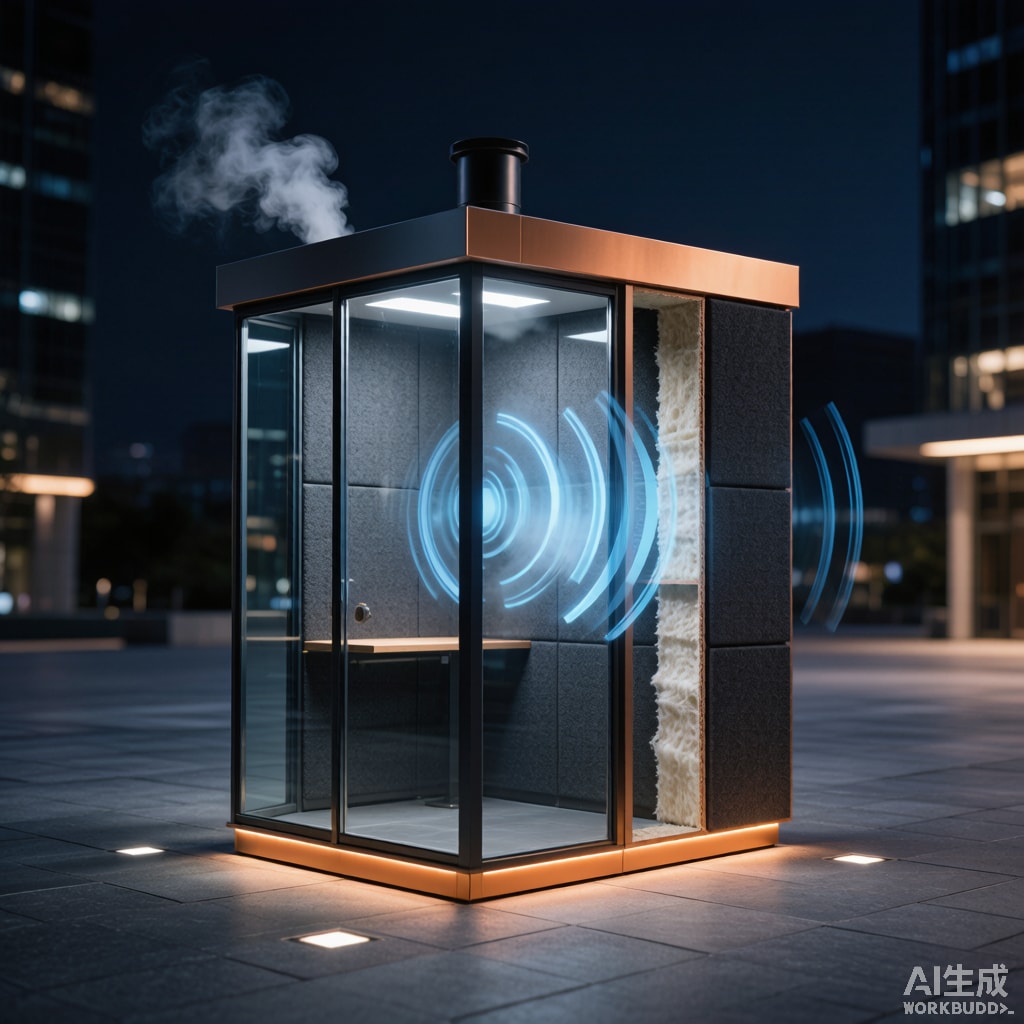
A typical high-performance booth wall consists of:
- Outer skin: 1.0–1.5 mm powder-coated steel or 4 mm tempered glass
- Cavity: 50–80 mm mineral wool at 32 kg/m³ density
- I
er perforated panel:
1.0 mm galvanized steel with 25% open area, hole diameter 2.5 mm staggered pitch 5 mm
This sandwich delivers 35–45 dB(A) insertion loss when properly sealed at the perimeter, with most low-frequency attenuation coming from the cavity’s mass-air-mass resonance (around 200–400 Hz) and broadband absorption from the perforated facing.
Micro-Perforated Panel (MPP) for Hygiene
When regular cleaning with disinfectants is required (hospitals, transit hubs), open-faced mineral wool is impractical. Micro-perforated transparent or painted panels solve this: 0.5–1.0 mm acrylic or aluminum panel with 0.5 mm holes at 4 mm pitch forms a Helmholtz resonator at frequencies from 250 Hz to 2 kHz. Two layers of MPP tuned to different bands can absorb across the speech range while remaining wipe-clean.
Ventilation Noise Control
Fan Selection and Variable Speed
The single loudest component in a smoking booth is the ventilation fan. EC (electronically commutated) motors are 8–12 dB(A) quieter than equivalent AC induction motors due to smoother commutation and reduced magnetic noise. For a 1,500 m³/h system, an EC fan at full speed reaches 65 dB(A) at 1 m, while an AC fan produces 75 dB(A). Over an 8-hour day, this 10 dB difference is perceived as half the loudness.
Variable-speed drives modulate fan output to maintain a target CO or PM2.5 level. During low-occupancy periods, the fan slows to 30–50% speed, dropping noise levels by 6–10 dB compared to full-speed operation.
Duct Silencers
Inline duct silencers are inserted in the supply and exhaust ducts of every well-designed booth. A typical silencer is a 600 mm long rectangular section with internal splitter pods of mineral wool. Insertion loss ratings by octave band:
| Octave Band (Hz) | Insertion Loss (dB) |
|---|---|
| 63 | 4–6 |
| 125 | 8–12 |
| 250 | 15–20 |
| 500 | 22–28 |
| 1,000 | 25–30 |
| 2,000 | 22–28 |
| 4,000 | 14–18 |
A pair of supply+exhaust silencers typically drops 25–30 dB at the dominant 500–2000 Hz HVAC band. Lining the inside of ducts with 25 mm mineral wool adds another 4–6 dB attenuation without significant airflow penalty.
Door Sealing and Structure-Borne Vibration
Entrance Door Sealing
The entry doorway is the single largest leak path for both smoke and noise. Acoustic performance requires a tight perimeter seal:
- Compression seals on top, side and bottom of door
- Drop-down acoustic threshold when the door is closed (for curtain/doorless designs)
- Auto-closing mechanism with adjustable closing speed to avoid slam noise
A well-sealed door with brush seals reduces the open aperture from ~1.5 m² to less than 0.05 m², dropping the noise leak by approximately 15 dB.
Vibration Isolation of Mechanical Equipment
The fan, ductwork and door operator transmit vibrations to the booth structure, which re-radiates as structure-borne noise. Rubber isolation mounts (neoprene or silicone) at the fan frame and flexible duct couplings at all co
ections reduce transmission by 10–15 dB. Rigid duct co
ections should be avoided; flexible fabric or rubber duct co
ectors are mandatory.
Field Measurement and Verification
Test Procedure
After installation, acoustic performance should be verified with field measurements. Standard procedure:
- Measure ambient noise at 1 m around booth with fan off (baseline)
- Measure noise with fan at maximum speed, booth empty
- Measure noise with fan at 50% speed (typical operational)
- Measure noise with 2 occupants simulating peak use
Per-position measurements at 1 m from each face, plus 5 m and 10 m when neighbors are present, give a complete performance profile. Class 1 sound level meters (IEC 61672) with 1/3 octave band analysis identify any problematic resonances that may need additional treatment.
Common Field Issues
- Drone at fan blade frequency: Stiffen fan mount; check for unbalanced impeller
- Whistle at door openings: Add felt or rubber bumpers at door strike
- Resonance in empty booth: Add 25 mm of mineral wool at corners (bass trap effect)
- Structure-borne hum in adjacent rooms: Add isolation mounts to booth base frame
Conclusion
Acoustic design is an essential element of smoking booth specification for deployment in noise-sensitive urban locations. Combining high-NRC absorbing materials, silenced ventilation, sealed doorways and vibration isolation, modern booths achieve 25–40 dB(A) attenuation between interior and exterior — well within the requirements of residential, hospital and educational settings. For Southeast Asian urban projects where monsoon humidity and tropical temperatures complicate material selection, mineral wool paired with perforated metal facings delivers both acoustic and long-term durability performance.