Introduction: Power Where the Grid Doesn’t Reach
Many guard booth installations in Southeast Asia are at sites beyond the reach of utility grid power — remote construction sites, agricultural perimeters, infrastructure installations along new highways, oil and gas facilities in jungle clearings, and military or border patrol checkpoints. For these deployments, the conventional approach of grid co
ection is either impossible (no grid within economic reach) or unreliable (frequent outages, poor power quality). The proven alternative: solar photovoltaic (PV) systems with battery backup, sized for the specific energy requirements of security equipment and lighting in a tropical climate.
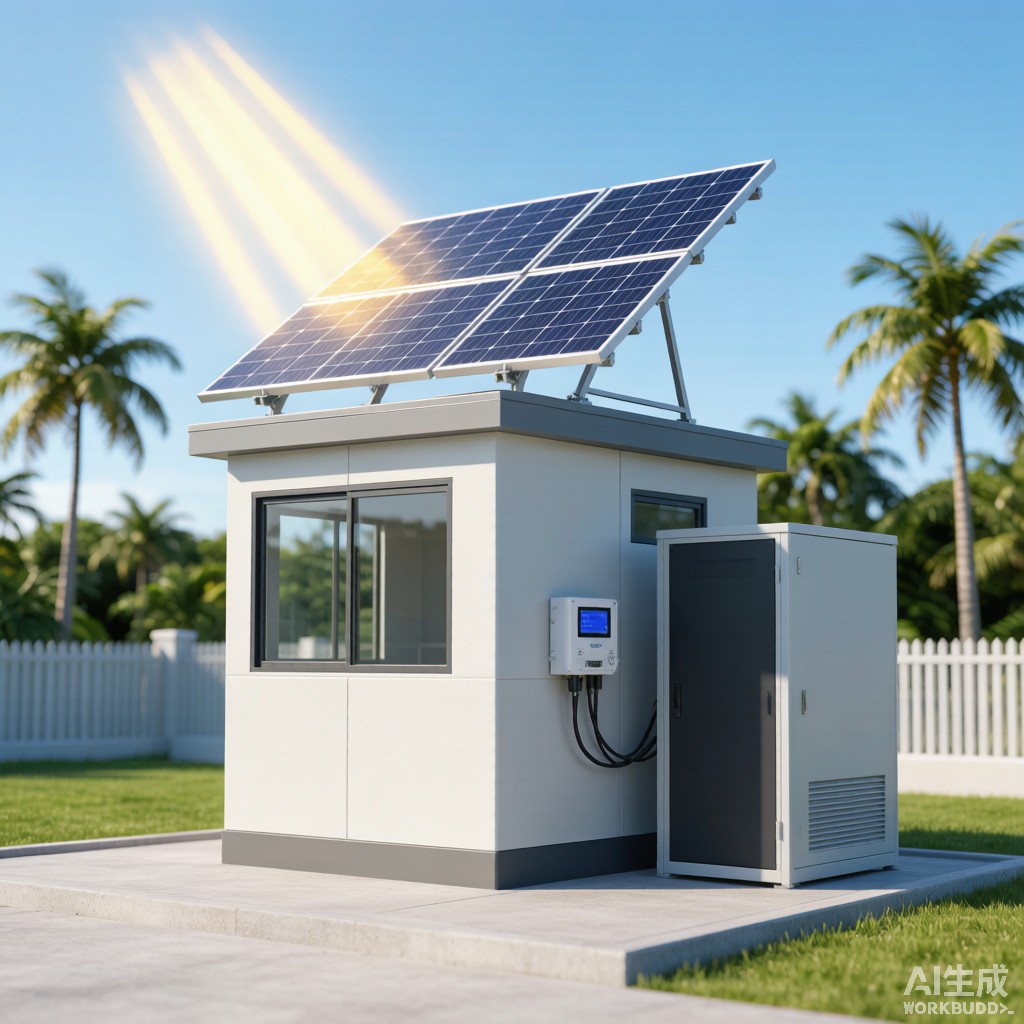
Designing an off-grid solar power system for a guard booth requires balancing PV array size, battery capacity, inverter rating, and load management against budget, footprint, and operational reliability. This article examines the engineering methodology, component selection criteria, and tropical climate considerations that produce a reliable, low-maintenance solar power system for 24/7 guard booth operation.
Load Assessment and Energy Budget
Equipment Loads
The first step in any solar system design is to characterize the energy load. For a typical prefabricated guard booth with security equipment and occupant amenities:
| Equipment Category | Typical Components | Power Each (W) | Daily Operating Hours | Daily Energy (Wh) |
|---|---|---|---|---|
| Lighting (LED, 4-6 fixtures) | 5x ceiling LED + 1x exterior | 15-25 W each | 12 (with motion sensors) | 900-1,500 |
| CCTV (4-6 cameras + NVR) | 5x IP cameras + 1x NVR | 5-15 W each | 24 (continuous) | 1,200-2,400 |
| Communication (radio + intercom) | 1x UHF radio + 1x intercom | 5-25 W each | 24 (standby, intermittent TX) | 120-600 |
| Access control (card reader + mag lock) | 1x reader + 1x maglock | 5-15 W each | 24 (continuous low power) | 240-720 |
| HVAC (exhaust fan + split AC) | 1x exhaust + 1x 9,000 BTU AC | 50 W fan + 900 W AC | 8 (daytime AC, 24 fan) | 7,500 |
| Occupant amenities (laptop, kettle) | 1x laptop charger + kettle | 60-1,500 W | 2 (intermittent) | 200-1,000 |
| Miscellaneous (UPS losses, sensors) | PIR sensors, door contacts, etc. | 10-20 W total | 24 | 240-480 |
| Total Typical Load | — | — | — | 10,400-14,100 Wh/day |
For guard booths without air conditioning (using only ceiling fans and exhaust ventilation), the daily energy requirement drops to approximately 4,000-6,000 Wh/day — substantially more economical to solar-power. For tropical deployments where cooling is essential for occupant comfort, the air conditioning load dominates and drives PV array sizing.
Load Profile by Time of Day
For energy storage sizing, the load profile through the day is as important as the daily total. A typical guard booth load profile for a 24-hour period:
| Time Window | Load Activities | Average Load (W) | Energy (Wh) |
|---|---|---|---|
| 00:00-06:00 | Lighting (dim security mode), CCTV, communication, fan | 250-350 | 1,800 |
| 06:00-18:00 | Full lighting, AC, CCTV, access control, occupancy charging | 900-1,400 | 14,400 |
| 18:00-24:00 | Lighting, AC, CCTV, evening occupancy peak | 700-1,100 | 6,600 |
| Total | — | — | 22,800 |
For the AC-equipped guard booth in this profile, the daily energy requirement is 20-25 kWh/day — a substantial load that requires a substantial PV system. The load is highest during daylight hours when PV generation is also at peak, which is favorable for direct solar supply; however, the evening and nighttime loads must be supplied from battery storage.
Tropical Peak Sun Hour Analysis
Geographic Solar Resource
Southeast Asia sits within 10° of the equator, where solar irradiance is reliable year-round with minimal seasonal variation. Peak sun hours (PSH) — the equivalent number of hours per day with 1,000 W/m² irradiance — are uniformly high across the region:
| Location | Latitude | A
ual PSH (avg) |
Wet Season PSH | Dry Season PSH |
|---|---|---|---|---|
| Jakarta, Indonesia | 6°S | 4.5 h/day | 4.0 | 5.0 |
| Kuala Lumpur, Malaysia | 3°N | 4.6 h/day | 4.2 | 5.0 |
| Bangkok, Thailand | 14°N | 4.8 h/day | 4.4 | 5.2 |
| Manila, Philippines | 14°N | 4.7 h/day | 4.3 | 5.1 |
| Ho Chi Minh, Vietnam | 11°N | 4.6 h/day | 4.2 | 5.0 |
| Singapore | 1°N | 4.5 h/day | 4.2 | 4.8 |
Compared to temperate climates (3.0-4.0 PSH typical for much of the US, Europe, and northern Asia), the equatorial PV resource is 15-30% more abundant, reducing required array area for any given load. However, tropical cloud cover during the wet season (May-October in SE Asia’s monsoon pattern) reduces output by 10-30% on individual days, requiring battery capacity to bridge multiple low-output days.
PV Array Sizing
Array Size Calculation
The PV array size is determined by the daily energy load, the peak sun hours at the location, and a series of derating factors that account for system inefficiencies:
P_array = E_daily / (PSH × η_system)
Where:
E_daily = Daily energy load (Wh/day)
PSH = Peak sun hours at the location
η_system = System derating factor (multiplicative product of individual losses)
System derating factors for guard booth installations in tropical climates:
| Loss Factor | Typical Value | Tropical Adjustment |
|---|---|---|
| PV module efficiency loss (dust, soiling) | 5-10% | 10-15% (more dust, biological growth) |
| Temperature derating | 3-8% | 10-15% (modules run hot in tropical sun) |
| Charge controller losses | 2-5% | 2-5% |
| Battery round-trip efficiency | 10-15% | 10-15% |
| Wiring and co
ection losses |
2-3% | 2-3% |
| PV module mismatch and aging | 2-5% | 5% |
| Total Derating | 25-35% | 35-45% (tropical) |
For a guard booth with 15 kWh/day load in Kuala Lumpur (4.6 PSH) and 40% system derating:
P_array = 15,000 / (4.6 × 0.60) = 5,435 W
Round up to available module sizes — typically 4× 400W monocrystalline PERC modules = 1,600 W or 6× 400W modules for a 2,400 W system. The 1,600 W system produces 4,400 Wh/day average vs the 15,000 Wh/day load — clearly inadequate if the goal is 100% solar supply.
For 100% solar supply at this load in this location, the array must be sized to the load, requiring 5,435 W — approximately 14× 400W modules. This array occupies 28-35 m² of rooftop or ground-mount area — substantial for a guard booth with typically only 6-10 m² of roof area available.
Battery Storage Sizing
Autonomy Requirements
Battery capacity is sized for the desired autonomy — the number of consecutive cloudy/rainy days the system can supply the load without PV input. For tropical Southeast Asia where monsoon periods can deliver 5-10 consecutive overcast days, the recommended autonomy is 2-3 days:
E_battery = E_daily × Autonomy_days / (DoD_max × η_battery)
Where:
DoD_max = Maximum depth of discharge (typically 80% for lithium)
η_battery = Battery round-trip efficiency (typically 92-95% for LFP)
For 15 kWh/day load, 3-day autonomy, 80% DoD, 93% LFP efficiency:
E_battery = 15,000 × 3 / (0.80 × 0.93) = 60,484 Wh = 60.5 kWh
At 48V nominal battery voltage (standard for off-grid inverters), this represents a 1,260 Ah battery capacity — typically configured as a 16-cell series string with 16× 50 Ah LFP cells in parallel, or equivalent 4-8× 100 Ah LFP battery modules.
LiFePO4 vs Lead-Acid for Tropical Installation
For tropical guard booth installations where ambient temperatures regularly exceed 30°C, battery selection is critical:
| Battery Property | LiFePO4 (LFP) | VRLA Lead-Acid (AGM) | Flooded Lead-Acid |
|---|---|---|---|
| Cycle Life (80% DoD) | 3,000-5,000 | 500-800 | 800-1,200 |
| Operating Temp | -10 to +55°C | -20 to +40°C | -20 to +45°C |
| Tropical Climate Suitability | Excellent (with thermal mgmt) | Marginal (high temp reduces life 50%) | Marginal (gassing, water loss) |
| Round-trip Efficiency | 92-95% | 80-85% | 75-82% |
| Maintenance Frequency | A
ual visual check |
Quarterly torque check | Monthly water refill |
| Initial Cost per kWh | $500-800 | $200-350 | $150-250 |
| Cost per kWh Over Life | $0.15-0.25 | $0.35-0.65 | $0.25-0.45 |
For guard booth installations in tropical climates, LiFePO4 (LFP) is the clear choice despite the higher initial cost. The cycle life is 4-6x longer than lead-acid, the high-temperature tolerance is superior (lead-acid capacity and life degrade severely at the 35-45°C ambient temperatures common in tropical guard booths), and there is no maintenance burden — no electrolyte refill, no terminal cleaning, no equalization charges. The 10-year life cycle cost comparison shows LFP as 40-60% lower total cost.
MPPT Charge Controller and Inverter Selection
MPPT Charge Controller Sizing
Maximum Power Point Tracking (MPPT) charge controllers extract 20-30% more energy from the PV array than PWM (Pulse Width Modulation) controllers, particularly in tropical conditions where temperature variation is significant. Sizing parameters:
| Load Scale | PV Array Power | Battery Voltage | MPPT Rating | Current Rating |
|---|---|---|---|---|
| Small (lighting + comm only) | 200-400 W | 12V | 20A MPPT | 12-15A charge current |
| Medium (CCTV + lighting + fan) | 800-1,500 W | 24V | 40-60A MPPT | 30-40A charge current |
| Large (full AC load) | 2,000-6,000 W | 48V | 80-100A MPPT | 60-90A charge current |
For guard booth installations, MPPT controllers must be specified with sufficient PV array voltage input to allow string configuration flexibility while matching battery bank voltage. Common configurations:
12V System (small booth, lighting only): 1-2 PV modules in series, 20-30A MPPT, 12V battery bank of 1-2 LFP cells.
24V System (medium booth): 2-3 PV modules in series, 40A MPPT, 24V battery bank of 8 LFP cells.
48V System (large AC booth): 4-8 PV modules in series per string, 80-100A MPPT, 48V battery bank of 16 LFP cells.
Inverter Selection
Inverters convert battery DC power to AC for the guard booth’s AC loads. Sizing principles:
Continuous Power: Sum all AC loads that operate simultaneously. For an AC-equipped guard booth: 900 W AC + 200 W other AC loads = 1,100 W continuous. Spec the inverter for 1,500 W continuous (giving 35% headroom).
Peak Power: AC compressors in split AC units draw 3-5x their rated power at startup. For a 900 W AC unit, peak inrush can be 2,700-4,500 W. Spec the inverter for 5,000 W peak.
Pure Sine Wave vs Modified Sine Wave: Pure sine wave is essential for sensitive electronics (CCTV recorders, communication equipment, laptop chargers). Modified sine wave produces audible noise in audio circuits and reduces life of inductive loads.
Low-Voltage Disco
ect: Important feature that protects the battery from over-discharge. Set LVD threshold at 20-30% state of charge for LFP batteries; the inverter disco
ects loads when the threshold is reached, preserving battery health.
Tropical Climate Specifics
Temperature Derating and Ventilation
PV modules lose 0.3-0.5% of rated power per °C above 25°C. In tropical sun, modules can easily reach 60-70°C, producing derating of 10-15%. Mitigation strategies:
Roof standoff mounting: Mount PV at least 100 mm above the roof surface to allow convective cooling airflow. This single change reduces module operating temperature by 10-15°C and recovers 5-8% of power output.
Light-colored module backsheets: Reflective backsheets reduce absorbed heat.
Eastern/western tilt orientation: A small (10-15°) tilt angle promotes rainwater cleaning of dust and biological growth.
Periodic cleaning: Manual cleaning of modules every 2-4 weeks in dusty environments restores 5-10% of output.
Soiling and Biological Growth
Tropical PV arrays accumulate dust, leaves, bird droppings, and biological growth (lichen, algae) at faster rates than in temperate climates. Soiling rates of 0.5-1.5% per day are typical in dusty conditions; the cumulative soiling loss over 4 weeks without cleaning can exceed 30%. Mitigation includes:
Anti-soiling coatings: Hydrophobic or hydrophilic coatings reduce dust adhesion and promote rain wash-off. Effective for 6-12 months before requiring reapplication.
Biodetergent cleaning every 3-6 months: For tropical installations, professional cleaning with biodetergent solutions twice yearly prevents permanent biological film buildup that would otherwise reduce output by 15-20%.
Vegetation management: Regular trimming of nearby trees prevents shadow casting and reduces leaf litter on modules.
Lightning Protection
Guard booths in tropical climates (especially Indonesia and Malaysia with 100-200 thunderstorm days per year) require comprehensive lightning protection for the PV system:
| Protection Layer | Component | Purpose |
|---|---|---|
| DC Side (PV array) | Type 2 DC SPD at combiner box | Protect charge controller and modules from induced surges |
| Battery Side | Type 2 DC SPD at battery disco
ect |
Protect battery management system |
| AC Side (inverter output) | Type 2 AC SPD at inverter AC output | Protect inverter and AC loads |
| Grounding | Equipotential bonding of all metallic enclosures, lightning ground ring if no facility ground | Provide controlled fault path |
For tropical installations in high-lightning zones, surge protection device (SPD) installation is as critical as the PV array sizing — a single nearby lightning strike without SPD protection can destroy inverter, charge controller, and battery BMS in one event.
ROI and Total Cost Analysis
Off-Grid Solar vs Grid Extension
For remote sites where utility grid extension would be required, off-grid solar is often the only economically viable option:
| Cost Component | Off-Grid Solar | Grid Extension (1km) |
|---|---|---|
| Initial Equipment | $8,000-15,000 | $15,000-40,000 (transformer, poles, wire) |
| Installation Labor | $2,000-4,000 | $5,000-15,000 |
| Permits and Fees | $200-500 | $2,000-8,000 |
| Recurring Monthly Electricity | $0 (free solar) | $50-200/month (utility bill) |
| Battery Replacement (5-10 years) | $3,000-6,000 | $0 |
| 10-Year Total Cost | $13,500-25,500 | $26,000-56,000 |
Off-grid solar typically breaks even with grid extension at distances of 500m-1km. For more remote sites, solar is the only practical option. The economic case strengthens further when accounting for the operational simplicity — no monthly utility billing in remote areas where meter reading would be a logistical burden.
Conclusion
Off-grid solar power systems with LiFePO4 battery backup provide a reliable, economically attractive solution for guard booth installations in remote tropical Southeast Asian sites. The combination of abundant equatorial solar resource (4.0-5.0 PSH), modern MPPT charge controllers that extract maximum energy from the PV array, high-cycle-life LFP batteries that tolerate tropical ambient temperatures without degradation, and demand-responsive AC loads controlled by pure sine wave inverters produces a system that operates reliably for 10+ years with minimal maintenance. With proper lightning protection in high-storm zones, periodic cleaning to address tropical soiling, and conservative array sizing that accommodates monsoon-season output reduction, a well-engineered solar power system delivers continuous 24/7 guard booth operation at a lower total cost than grid extension for sites beyond approximately 1 km from existing utility infrastructure.