Introduction: The Engineering Case for Sustainable Plastics
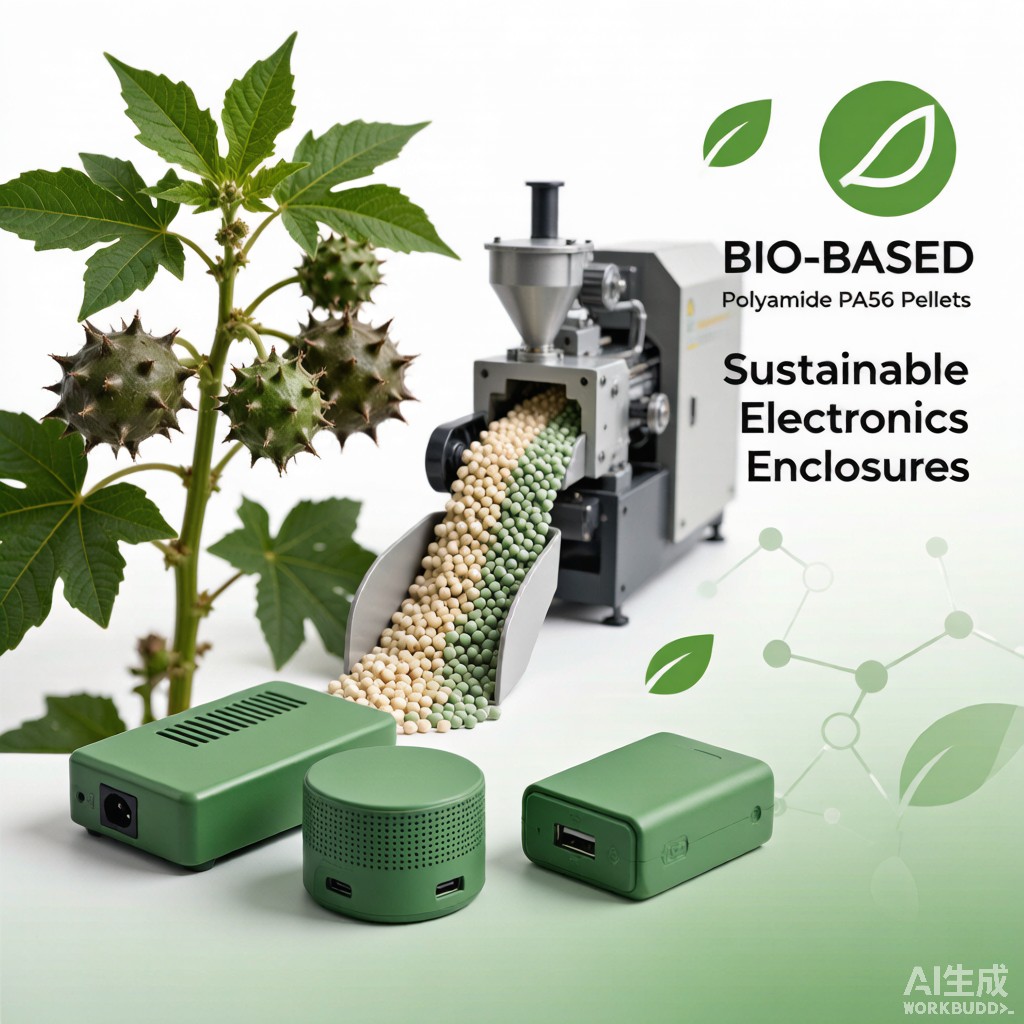
The electronics industry is increasingly compelled to address its environmental footprint, and one of the most visible opportunities is the replacement of petroleum-based engineering plastics with bio-based alternatives. For consumer electronics enclosures, polyamide 66 (PA66) and polyamide 6 (PA6) account for an estimated 8-15% of plastic part mass in products ranging from routers and smart speakers to power tool housings and appliance components. Replacing even a fraction of these with bio-based polyamide 56 (PA56) — derived from castor beans rather than fossil hydrocarbons — reduces carbon footprint by 50-70% over the part life cycle while delivering mechanical and thermal performance that meets the demanding requirements of electronic applications.
PA56 is the most commercially mature of the bio-based polyamides, with multiple grades available from major polymer suppliers (DSM EcoPaXX, Evonik VESTAMID Terra, Radici Group Radilon). This article examines the chemistry, properties, processing characteristics, and supply chain considerations of PA56 pellets for electronics enclosure applications, with particular focus on Southeast Asian manufacturing environments.
Castor Bean Chemistry and Polymerization
Renewable Feedstock
PA56 is synthesized from 1,5-diaminopentane (pentamethylenediamine, commonly abbreviated DAB or PDA) and adipic acid — both monomers can be sourced from castor oil derived from Ricinus communis seeds, a crop cultivated extensively in India, China, Brazil, and Southeast Asia. The manufacturing chain proceeds:
1. Castor oil extraction: Cold-pressing castor beans yields castor oil (40-50% by seed weight).
2. Sebacic acid production: Alkaline fusion of castor oil-derived ricinoleic acid yields sebacic acid.
3. Adipic acid biosynthesis: Alternative route via lysine or 6-aminovaleric acid from castor-derived intermediates.
4. Pentamethylenediamine synthesis: Biotechnological fermentation of sugarcane-derived lysine produces bio-based DAB.
5. Polymerization: Stoichiometric reaction of DAB and adipic acid yields PA56 with chain structure (CH₂)₅-NH-CO-(CH₂)₄-CO- repeated.
The bio-based carbon content of PA56 is typically 50-70% depending on feedstock sourcing and manufacturing route, measured by ASTM D6866 radiocarbon analysis. By comparison, petroleum-based PA66 has 0% bio-based carbon. The remaining 30-50% of PA56 carbon can also be bio-based with further process optimization, targeting 100% renewable content in commercial development grades.
Polymer Structure and Crystallinity
PA56 has an odd-even combination of methylene (CH₂) units (5 carbons in the diamine, 4 carbons in the diacid), giving it different crystal structure and thermal behavior than PA66 (6/4) or PA6 (6). The odd-even combination typically produces lower crystallinity (20-30% vs 35-45% for PA66) but provides a different balance of properties:
| Property | PA66 (Petroleum) | PA56 (Bio-Based) | PA6 (Petroleum) |
|---|---|---|---|
| Monomer Carbon Count | 6/4 (even/even) | 5/4 (odd/even) | 6 (single) |
| Density (g/cm³) | 1.14 | 1.13 | 1.14 |
| Glass Transition (Tg) | 50-60°C | 55-65°C | 45-55°C |
| Melting Point (Tm) | 255-265°C | 250-260°C | 215-225°C |
| Crystallinity (typical) | 35-45% | 20-30% | 30-40% |
| Mold Shrinkage (parallel) | 0.6-0.8% | 0.7-0.9% | 0.5-0.7% |
The bio-based PA56 has slightly lower melting point and crystallinity than PA66, but its glass transition temperature is comparable (or even slightly higher), giving it similar continuous-use temperature performance. For electronics enclosure applications, where service temperatures rarely exceed 80-100°C, this difference is rarely meaningful in design.
Mechanical and Thermal Performance
Reinforced Grade Properties
For electronics enclosure applications, glass fiber reinforcement is essential to meet the mechanical performance requirements of structural components. PA56-GF30 (30% glass fiber reinforced) properties compared to equivalent PA66-GF30:
| Property | PA56-GF30 | PA66-GF30 (Std) | PA6-GF30 | Test Standard |
|---|---|---|---|---|
| Tensile Strength (MPa) | 180-210 | 190-220 | 160-180 | ISO 527 |
| Tensile Modulus (GPa) | 8.5-10.0 | 9.0-11.0 | 7.5-9.5 | ISO 527 |
| Elongation at Break | 3-4% | 2.5-4% | 3-5% | ISO 527 |
| Flexural Strength (MPa) | 260-300 | 280-320 | 240-280 | ISO 178 |
| Charpy Impact (kJ/m²) | 10-15 | 9-14 | 12-18 | ISO 179 |
| HDT @ 1.8 MPa (°C) | 200-220 | 230-250 | 190-210 | ISO 75 |
| CTE (parallel, ppm/°C) | 20-30 | 20-30 | 20-35 | ISO 11359 |
| Moisture Absorption (23°C/50%RH) | 2.5-3.5% | 2.2-3.0% | 2.6-3.5% | ISO 62 |
PA56-GF30 delivers 90-95% of the mechanical performance of PA66-GF30 in a bio-based substrate, with similar moisture absorption behavior. The slightly lower HDT (200-220°C vs 230-250°C for PA66-GF30) is the only significant design trade-off — for electronics enclosures that do not see sustained temperatures above 150°C, this difference is academic.
Flame Retardant Compatibility
For consumer electronics enclosures requiring UL94 V-0 rating (the most common fire safety classification), the FR additive compatibility of bio-based PA56 has been validated by multiple compound suppliers:
| FR System | PA56 Compatibility | Loading for V-0 (1.6mm) | Performance Notes |
|---|---|---|---|
| Aluminum Hypophosphite (AlHP) | Excellent | 20-25% | Phosphorus-based, no halogen |
| Melamine Polyphosphate (MPP) | Good | 25-30% | Higher loading vs PA66 |
| Red Phosphorus (RP) | Excellent | 8-12% | Color limitation (red) |
| Decabromodiphenyl ethane + Antimony | Good | 15-18% | Halogenated, RoHS-pending |
The slightly higher FR loading required for PA56 (compared to PA66) reflects its lower crystallinity and aromatic content, both of which contribute to char formation. For natural-colored electronics enclosures, AlHP-based FR systems at 20-25% loading provide UL94 V-0 at 1.6 mm thickness with mechanical property retention within 10-15% of the unreinforced base resin.
Moisture Behavior in Tropical Climates
Equilibrium Moisture Content
Polyamides are hygroscopic by nature, absorbing water from humid air until reaching an equilibrium moisture content (EMC). The EMC depends on the surrounding relative humidity:
| Relative Humidity | PA56-GF30 EMC (wt%) | PA66-GF30 EMC (wt%) | Dimensional Effect |
|---|---|---|---|
| 30% RH (dry inland) | 1.3-1.7% | 1.1-1.5% | Minimal |
| 50% RH (typical indoor) | 2.5-3.5% | 2.2-3.0% | Slight |
| 70% RH (humid tropical indoor) | 4.0-5.5% | 3.5-5.0% | Noticeable |
| 85% RH (tropical outdoor) | 6.0-8.0% | 5.5-7.5% | Significant expansion |
For Southeast Asian indoor environments at 25-30°C and 70-85% RH (typical for tropical commercial buildings), PA56-GF30 reaches an EMC of 4-6%, which produces 1.0-1.5% dimensional expansion from the dry-state dimensions. This expansion must be accounted for in tooling design — mold dimensions are typically oversized by 0.5-1.0% to accommodate moisture pickup in service.
Drying Requirements
Because polyamides absorb moisture readily, they must be thoroughly dried before injection molding to prevent hydrolysis (molecular chain degradation) and surface defects (splay, silver streaking). PA56 drying parameters:
| Material Form | Drying Temperature | Drying Time | Target Moisture |
|---|---|---|---|
| Natural (un-reinforced) | 80°C | 4-8 hours | < 0.10% |
| Glass fiber reinforced | 80-100°C | 4-8 hours | < 0.10% |
| Flame retardant grade | 80°C | 8-12 hours | < 0.08% |
| Colored masterbatch | 80°C | 4-6 hours | < 0.10% |
For SE Asian manufacturing facilities, drying equipment with active dehumidification (desiccant or heat-of-compression type) is essential — conventional hot-air hopper dryers ca
ot achieve moisture levels below 0.15% in humid environments. Dehumidifying dryers with dew point control to -40°C can reliably reach the < 0.10% target.
Injection Molding Considerations
Process Window
PA56 processes within a similar window to PA66 but requires slightly tighter controls due to the lower crystallinity:
| Parameter | PA56-GF30 | PA66-GF30 | Notes |
|---|---|---|---|
| Barrel Temperature | 270-290°C | 280-300°C | Lower melt temperature for PA56 |
| Mold Temperature | 80-100°C | 80-120°C | Higher mold temp for better crystallinity |
| Injection Pressure | 80-120 MPa | 80-130 MPa | Similar |
| Injection Speed | Moderate | Moderate-Fast | PA56 lower speed reduces glass breakage |
| Cycle Time | 30-50s | 25-45s | PA56 slightly longer due to crystallization |
| Screw L:D Ratio | 20:1 minimum | 20:1 minimum | Both benefit from high L:D |
Tool Wear
The 30% glass fiber reinforcement of PA56-GF30 produces substantial tool wear over production runs. Compared to unfilled grades, expected tool life is reduced by 50-70%. For high-volume electronics enclosure production (more than 100,000 cycles between mold refinishing), tool steel selection should be:
Cavity/Core Steel: Hardened tool steel (HRC 58-62), pre-hardened (HRC 30-32) is inadequate.
Surface Treatment: Physical Vapor Deposition (PVD) coating (TiN, CrN, or DLC) provides 2-3x tool life extension vs uncoated surfaces.
Critical Features: Slides, lifters, and ejector pins should use D2 or D3 tool steel, or tungsten carbide inserts at wear surfaces.
Environmental and Regulatory Considerations
Carbon Footprint Reduction
Replacing PA66 with PA56 in an electronics enclosure delivers a 50-70% reduction in cradle-to-gate carbon footprint:
| Stage | PA66 (Petroleum) | PA56 (Bio-Based) | Reduction |
|---|---|---|---|
| Feedstock extraction | 2.2 kg CO₂e/kg | 0.5 kg CO₂e/kg (agricultural) | 77% |
| Monomer synthesis | 3.8 kg CO₂e/kg | 1.8 kg CO₂e/kg (biotech) | 53% |
| Polymerization | 1.0 kg CO₂e/kg | 1.0 kg CO₂e/kg | 0% |
| Compounding | 0.5 kg CO₂e/kg | 0.5 kg CO₂e/kg | 0% |
| Total Cradle-to-Gate | 7.5 kg CO₂e/kg | 3.8 kg CO₂e/kg | 49% |
For an electronics enclosure weighing 200 grams, replacing PA66-GF30 with PA56-GF30 saves approximately 0.74 kg CO₂e per enclosure. For a consumer electronics company producing 1 million enclosures a
ually, the savings equate to 740 to
es CO₂e per year — equivalent to the a
ual emissions of approximately 150 passenger vehicles.
End-of-Life and Biodegradability
Unlike biodegradable polymers (PLA, PHA), bio-based PA56 is not biodegradable — it has the same hydrolytic stability as PA66 and requires the same end-of-life management (mechanical recycling, energy recovery, or landfill). The bio-based carbon content is bio-based but does not indicate biodegradability; PA56 will persist in the environment for decades if released.
However, PA56 is fully compatible with existing nylon recycling streams. Mechanical recycling (sorting, shredding, re-extrusion) is well established for PA6, PA66, and increasingly for PA56 — this allows end-of-life PA56 enclosures to enter the same recycling supply chain as their petroleum-based counterparts.
Supply Chain Considerations for Southeast Asia
Castor Bean Sourcing
India dominates global castor seed production at approximately 70% of world supply, with China, Brazil, and smaller producers in Southeast Asia (Thailand, Vietnam) making up the remainder. For Southeast Asian manufacturers using PA56 pellets, the supply chain considerations are:
Bio-based content certification: Major PA56 suppliers provide ASTM D6866-certified bio-based content. Documentation includes chain-of-custody for castor oil feedstock through fermentation, polymerization, and compounding.
Supply security: Castor bean crops are a
ual and subject to weather-related yield variation. Multi-year supply contracts with multiple growers mitigate disruption risk. Major brands typically maintain 6-12 months of pellet inventory as buffer stock.
Logistics: Pellets are typically supplied in 25 kg bags or 500 kg-1000 kg octabins, transported in standard 20′ shipping containers. Sea freight from India to Southeast Asian ports is 14-21 days transit time.
Cost Premium and Market Acceptance
PA56 pellets command a 30-80% price premium over equivalent PA66 grades, depending on the specific compound formulation and purchase volume. For consumer electronics enclosures where end-customer pricing is highly competitive, this premium must be balanced against:
Marketing value: Sustainability claims supported by bio-based content (e.g., “Made with 65% bio-based materials”) can differentiate products in the consumer market.
Regulatory drivers: EU Ecodesign for Sustainable Products Regulation (ESPR), EPR schemes in France and Italy, and California SB 54 are driving demand for bio-based alternatives.
Brand commitments: Many major electronics brands (Apple, Dell, HP, Samsung) have publicly committed to 50%+ recycled or bio-based plastic in their products by 2030, creating procurement pull for PA56 and similar materials.
Conclusion
Bio-based polyamide PA56 has matured into a credible engineering substitute for petroleum-based PA66 in electronics enclosure applications. With 50-65% bio-based carbon content, 90-95% of the mechanical and thermal performance of PA66-GF30, established UL94 V-0 flame retardant systems, and demonstrated injection molding processability on conventional equipment, PA56 offers a practical path to reduced carbon footprint without compromising product quality. For Southeast Asian manufacturers serving global electronics brands with sustainability commitments, PA56 pellets provide a scalable, supply-stable material alternative supported by major polymer compound suppliers. While the 30-80% cost premium remains a barrier for cost-sensitive applications, the trajectory of bio-based polymer pricing — combined with regulatory pressure and corporate sustainability commitments — points toward broader adoption through the end of this decade.