Introduction: The Physics of Blocking Smoke with Moving Air
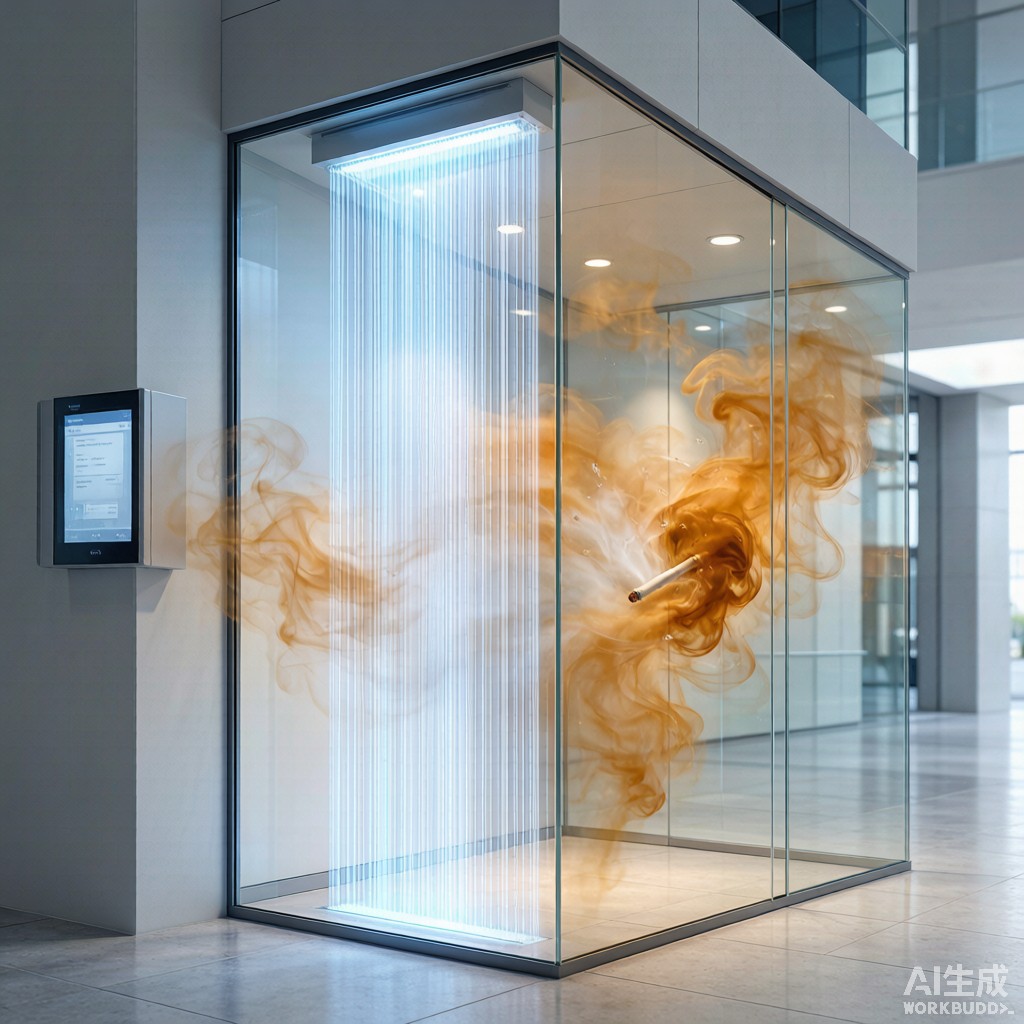
An air curtain — a precisely engineered sheet of high-velocity air projected across a doorway opening — is one of the most effective technologies for limiting smoke and odor escape from commercial smoking booths. Unlike a physical door, an air curtain allows unobstructed pedestrian flow while creating a hydrodynamic barrier that resists particle and gas transport. For smoking rooms in airports, hospitals, transit terminals, and office buildings where door closure is impractical or undesirable, air curtain technology achieves containment efficiencies of 80-95% — close to the level of a tightly sealed physical door without the operational inconvenience.
Engineering an air curtain for a smoking booth is fundamentally different from designing one for a cold storage entrance or a cleanroom. The challenges are: small particle size (cigarette smoke PM2.5 = 0.1-2.5 micrometers), low momentum in the smoke plume, frequent door cycling (every 30-90 seconds in busy facilities), and the need to integrate the air curtain with negative pressure ventilation to provide comprehensive containment. This article covers the fluid mechanics, nozzle geometry, performance testing, and tropical climate integration of air curtain containment systems.
Air Curtain Velocity Profile
Why Velocity Matters
Air curtain effectiveness is governed by the balance between the curtain’s downward momentum and the pressure-driven buoyancy of the smoke plume. The curtain velocity must be sufficient to displace or redirect buoyant smoke particles before they escape into the adjacent corridor. The minimum effective velocity depends on:
Smoke buoyancy velocity: Cigarette smoke plume rises at approximately 0.3-0.5 m/s near the source, accelerating to 1.0-1.5 m/s as it entrains hot air and rises to doorway height.
Cross-flow disturbance: When the door opens in a high-traffic area, the door movement itself generates a horizontal airflow of 0.5-2.5 m/s across the opening, which can push smoke out faster than the curtain can contain it.
Buoyancy vs density: A curtain moving downward (top-down discharge) must overcome buoyancy, requiring 25-40% higher velocity than a side-curtain arrangement.
| Application Type | Min Discharge Velocity | Recommended Velocity | Containment Efficiency Target |
|---|---|---|---|
| Restaurant/cold storage | 4 m/s | 6-8 m/s | 60-70% |
| Industrial door loading dock | 8 m/s | 10-15 m/s | 70-80% |
| Cleanroom entry | 12 m/s | 15-20 m/s | 85-92% |
| Smoking booth (non-negative) | 15 m/s | 18-22 m/s | 75-85% |
| Smoking booth (with negative pressure) | 10 m/s | 12-16 m/s | 90-97% |
For smoking rooms integrated with negative pressure ventilation (-7 to -12 Pa), the negative pressure itself provides 60-70% containment; the air curtain needs to add only the incremental performance to reach 90%+ containment. This synergy reduces required air curtain velocity and therefore acoustic noise and energy consumption.
Top-Down vs Side-Discharge Nozzle
The nozzle configuration significantly affects performance and installation practicality:
Top-Down Discharge (Recirculating): The air curtain is discharged from above the doorway as a downward jet. This configuration is the most effective for hot, buoyant smoke plumes because it directly opposes the rising direction. Recirculating units return the curtain air to the inlet side through a return grille, creating a closed-loop curtain that is mechanically efficient (50-70% less energy than blow-through designs).
Side Discharge (Non-Recirculating): Two opposing jets from each side of the doorway create a collision curtain in the middle of the opening. This configuration is preferred when headroom above the door is limited (under 200 mm) or when the door is in a wall that ca
ot accommodate a top-down housing. Side-discharge curtains require 30-50% higher volumetric flow to achieve equivalent containment because they dissipate energy in the central collision zone.
Angled Discharge (Hybrid):strong> A top-down jet angled 10-15° toward the room side (inside the smoking booth) combines the benefits of both configurations. The angle helps push smoke back into the room where the negative pressure system captures it, while the downward component maintains the buoyancy-blocking momentum.
Nozzle Geometry and Air Distribution
Slot Nozzle Design Parameters
The nozzle slot width and geometry determine the velocity profile across the doorway. A narrow slot (10-15 mm) produces a high-velocity, narrow jet that is effective for local smoke blocking but has poor lateral spread. A wide slot (25-50 mm) produces a more uniform but lower-velocity curtain.
| Slot Width | Velocity (at 350 m³/h/m) | Lateral Spread | Stability in Cross-Flow | Best Application |
|---|---|---|---|---|
| 10 mm | 11 m/s | Poor (narrow curtain) | Low | Small openings, integrated solutions |
| 20 mm | 5.5 m/s | Good | Medium | Standard commercial doors |
| 30 mm | 3.7 m/s | Very Good | High | High-traffic doors |
| 50 mm | 2.2 m/s | Excellent | Very High | Wide openings, low velocity |
For most commercial smoking booth applications, a 20-30 mm slot width with a discharge velocity of 12-16 m/s provides the optimal balance of containment performance, energy consumption, and acoustic noise. The slot must be manufactured with precision — slot width variation of more than ±1 mm across the width produces velocity irregularities that create gaps in the curtain and reduce containment efficiency by 10-20%.
Coanda Effect for Curtain Stability
The Coanda effect — the tendency of a moving fluid to follow a nearby curved surface — can be exploited to enhance air curtain stability. By adding a 2-3 mm lip along the discharge edge of the nozzle, the curtain hugs the wall surface for a longer distance before detaching, providing more uniform coverage across the doorway and reducing lateral curving under cross-flow disturbance.
This effect is most pronounced in doors with shallow overhead plenums (less than 100 mm) where the air curtain must be guided by the geometry of the installation. Coanda-enhanced nozzles are particularly effective in airport gate smoking rooms where the door is often operated by staff using baggage carts, creating strong cross-flow disturbances.
Integration with Negative Pressure Ventilation
System Synergy
An air curtain alone ca
ot achieve reliable containment of cigarette smoke without negative pressure backup. The air curtain provides rapid response to door operations (sub-second response, no mechanical latency) while the negative pressure system maintains containment during the door-closed periods. Together, the two systems provide defense-in-depth:
Door-Closed State (95%+ of occupied time): Negative pressure maintains -7 to -12 Pa, ensuring that any leakage through door seals flows into the room rather than out. No air curtain activity needed.
Door-Opening Transition (2-5 seconds): Negative pressure momentarily breaks as the door opens; the air curtain provides immediate containment by blocking the doorway cross-section with high-velocity air.
Door-Open State (5-15 seconds typical, longer for accessibility): The air curtain maintains containment while the negative pressure system refills the room with filtered makeup air.
Door-Close Recovery (5-15 seconds): Negative pressure is re-established once the door closes; the air curtain can reduce to standby velocity.
Makeup Air Path Optimization
For the air curtain to function most effectively, makeup air must enter the smoking booth from a controlled path — typically a transfer grille or dedicated duct from the corridor. If makeup air enters through gaps around the door (bypassing the curtain), the curtain is less effective because the differential pressure across the curtain is reduced.
Best practice: provide a transfer grille at the smoking booth door at floor level or behind a dedicated slot, with a path length of 1.5-3 meters of ductwork to dampen any cross-flow disturbance. The transfer grille should have a backdraft damper to prevent reverse flow during negative pressure operation when the door is closed.
Energy Consumption and Fan Selection
EC Motor vs AC Motor
Air curtain motors are either AC induction or brushless EC (electronically commutated) type. For smoking booth applications where the air curtain operates 16-24 hours daily, motor efficiency directly determines operating cost and heat dissipation (which affects the cooling load on the booth’s HVAC):
| Motor Type | Efficiency | Speed Control | A
ual Energy Cost (per unit, 18hr/day) |
Heat Output |
|---|---|---|---|---|
| AC Induction (single speed) | 60-70% | On/Off only | $340 | High (continuous full speed) |
| AC Induction (two speed) | 60-70% | Full or 50% | $220 | Medium (cycling) |
| EC Brushless (variable speed) | 80-90% | Stepless | $130 | Low (demand-responsive) |
EC motors provide 50-60% energy savings over single-speed AC motors and offer stepless speed control that can match curtain velocity to door traffic. For a typical airport smoking booth, this $200 per year savings per air curtain translates to a 2-3 year payback on the incremental EC motor cost.
Demand-Responsive Control
Advanced air curtain controllers use door position sensors (magnetic contact, optical presence detector, or radar motion sensor) to modulate curtain velocity. When the door is closed and pressure is maintained, the curtain can drop to a low standby velocity (4-6 m/s) that retains directional motion but saves energy. When the door begins to open, the controller ramps the curtain to full velocity (12-18 m/s) within 200-400 milliseconds — fast enough to establish containment before smoke begins escaping.
This demand-responsive control reduces a
ual energy consumption by 30-45% compared to always-on operation, with corresponding reductions in heat dissipation and acoustic noise. For smoking booths in libraries, hospitals, and other noise-sensitive environments, the standby mode operation at night produces noise levels under 35 dB(A) at 1 meter, well below the typical ambient noise floor.
Acoustic Management
Noise Sources and Mitigation
Air curtain noise has three principal sources: aerodynamic noise from the high-velocity jet, motor and fan noise, and turbulence generated at the discharge nozzle. The combined sound power level for a typical smoking booth air curtain at full velocity is 65-72 dB(A) at 1 meter — comparable to a bathroom exhaust fan. For acoustic-sensitive environments, mitigation measures include:
| Mitigation | Noise Reduction | Implementation |
|---|---|---|
| Aerodynamic nozzle redesign | 3-5 dB(A) | Smooth interior walls, gradual area transitions |
| Acoustic lining in plenum | 4-7 dB(A) | 25-50 mm melamine foam or fiberglass |
| Variable speed control (lower speeds) | 5-8 dB(A) | Demand-responsive ramp-down at night |
| Discharge silencer (louver) | 3-6 dB(A) | Perforated plate or honeycomb at slot outlet |
| Rubber isolation mounts | 2-3 dB(A) | Decouple unit from building structure |
A well-engineered smoking booth air curtain system achieves 55-60 dB(A) at 1 meter — quiet enough to allow conversation immediately outside the booth without raised voices.
Testing and Performance Verification
ASHRAE 120 Test Method
The ASHRAE Standard 120 “Method of Testing to Determine Flow Resistance of HVAC Duct Elements” provides the most widely cited methodology for air curtain performance verification. While originally developed for HVAC components, the same instrumentation and tracer gas approach can be adapted to measure air curtain containment efficiency for smoke and odor:
1. Establish steady-state operation of the air curtain (with or without negative pressure assistance).
2. Release a tracer gas (typically SF₆ at non-toxic concentrations) or simulated smoke (glycol fog, theatrical smoke) inside the smoking booth.
3. Measure tracer concentration inside the booth and at multiple points 1-5 meters outside the door.
4. Calculate containment efficiency as (1 – C_outside/C_inside) × 100%.
Acceptance criteria for smoking booth air curtain installations: containment efficiency ≥ 90% measured over 30 minutes of normal door cycling (one door opening every 30-60 seconds with 5-10 second duration).
CFD Modeling for Optimization
For complex installations (airport gates, hospital entrances with high pedestrian flow), computational fluid dynamics (CFD) modeling is invaluable for optimizing nozzle placement and velocity profile before physical installation. Modern CFD packages (ANSYS Fluent, OpenFOAM, Star-CCM+) can model turbulent air curtain behavior coupled with buoyant smoke plume dynamics, providing:
– Velocity vector field visualization across the doorway
– Particle trajectory analysis for 0.1-2.5 micrometer particles
– Identification of local recirculation zones that create smoke escape paths
– Optimization of nozzle angle and velocity for specific door geometry
For a typical smoking booth door, a 4-8 hour CFD simulation provides design confidence that the curtain will achieve 85-90% containment efficiency before physical installation and commissioning costs are incurred.
Conclusion
Air curtains provide a practical, economical containment solution for commercial smoking booths where physical doors are operationally impractical. The technology works through hydrodynamic principles: a precisely directed high-velocity air jet that opposes the buoyancy of smoke particles and blocks their escape. Engineered with discharge velocities of 12-18 m/s (lower when combined with negative pressure assistance), top-down slot nozzle geometry, EC brushless motor efficiency, and demand-responsive control, an air curtain system achieves 85-95% smoke containment efficiency while maintaining unobstructed pedestrian access. For high-traffic facilities like airports, hospitals, and transit terminals in tropical Southeast Asian climates, the technology has matured into a reliable, low-maintenance solution that meets regulatory containment standards and provides defensible air quality performance for the lifetime of the installation.