Introduction: The Thermal Challenge of Tropical Smoking Booths
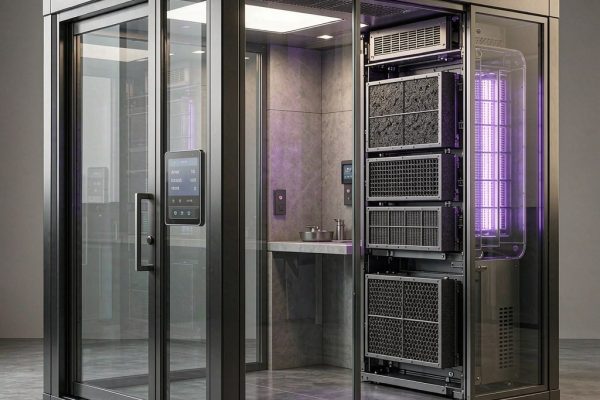
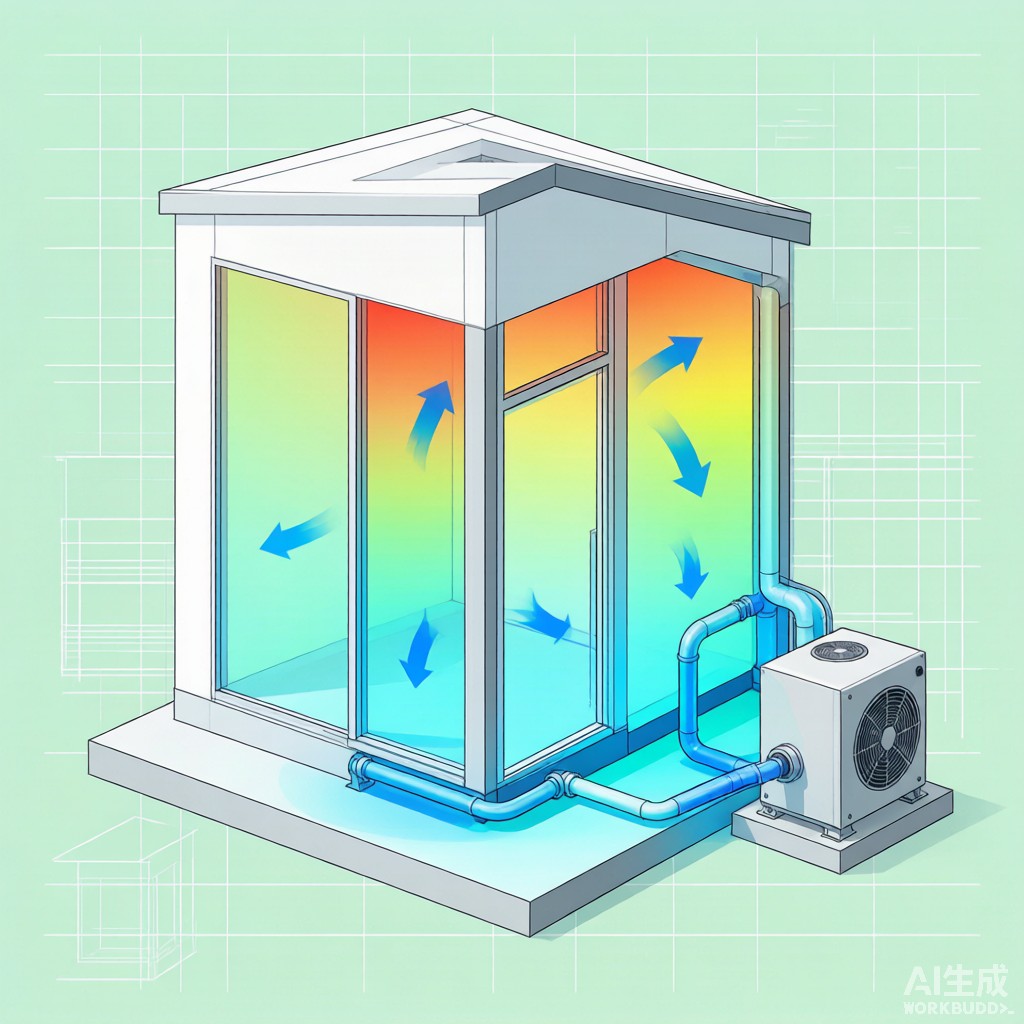
Outdoor smoking booths installed in Southeast Asian transit hubs, commercial complexes, and industrial facilities face some of the most demanding HVAC conditions in the world. Ambient temperatures routinely exceed 35°C, solar radiation peaks above 900 W/m², and relative humidity remains persistently above 80%. Unlike indoor smoking rooms that benefit from building HVAC systems, outdoor booths must be self-contained climate control units that maintain occupant comfort while simultaneously managing tobacco smoke through high-volume air filtration.
Undersized HVAC systems produce uninhabitable booth interiors (45°C+ within minutes), while oversized systems waste energy and create uncomfortable cold-spot drafts. Accurate cooling load calculation is therefore essential for specifying smoking booth HVAC equipment that balances comfort, air quality, and energy efficiency in tropical environments.
Cooling Load Components
The total cooling load (Q_total) for an outdoor smoking booth comprises five major components:
Q_total = Q_envelope + Q_solar + Q_ventilation + Q_internal + Q_infiltration
Each component is calculated separately and summed to determine the required AC capacity.
1. Envelope Heat Gain (Q_envelope)
Heat transfer through the booth’s walls, roof, floor, and glazing is driven by the temperature differential between the interior setpoint (24°C) and the outdoor design temperature. For a typical smoking booth (2.0 m W × 2.0 m D × 2.4 m H):
| Surface | Area (m²) | U-value (W/m²·K) | ΔT (°C) | Heat Gain (W) |
|---|---|---|---|---|
| Roof (insulated, 50mm PIR + 1.5mm Al) | 4.0 | 0.45 | 13 | 23 |
| Walls (insulated, 50mm PIR + 1.2mm steel) | 19.2 | 0.50 | 13 | 125 |
| Glazing (6mm tempered, 2 sides) | 4.8 | 5.80 | 13 | 362 |
| Floor (100mm concrete + tile) | 4.0 | 0.70 | 8 | 22 |
| Total Q_envelope | 532 W | |||
Glazing is the dominant envelope heat gain source, contributing 68% of the total despite covering only 17% of the surface area. Upgrading to double-glazed Low-E units (U = 2.7 W/m²·K) reduces glazing heat gain to 169 W — a 53% reduction — but adds approximately $800–1,200 to booth cost. For tropical installations, this upgrade typically pays back in 18–24 months through reduced AC operating costs.
2. Solar Radiation Gain (Q_solar)
Solar radiation through glazing is the single largest cooling load component for outdoor booths. Using the ASHRAE solar heat gain coefficient (SHGC) method:
| Surface | Area (m²) | SHGC | Solar Irradiance (W/m²) | Heat Gain (W) |
|---|---|---|---|---|
| Roof (reflective, SRI > 78) | 4.0 | 0.15 | 900 | 540 |
| East glazing (morning sun) | 2.4 | 0.70 | 650 | 1,092 |
| West glazing (afternoon sun) | 2.4 | 0.70 | 850 | 1,428 |
| Total Q_solar (peak) | 3,060 W | |||
Solar gain through west-facing glazing alone (1,428 W) exceeds the entire envelope heat transfer. Applying solar control film (SHGC reduced from 0.70 to 0.35) cuts glazing solar gain by 50%, reducing total Q_solar to 1,884 W. External shading devices (awnings, louvers) that prevent direct sunlight from reaching glazing can reduce solar gain by an additional 60–80%.
3. Ventilation Load (Q_ventilation)
Smoking booths require high ventilation rates to maintain acceptable air quality. ASHRAE 62.1 recommends a minimum of 25 L/s per occupant for smoking lounges, but practical designs targeting PM2.5 levels below 25 μg/m³ typically specify 100–150 L/s per occupant. This fresh air must be cooled from outdoor conditions to the supply air temperature:
Q_ventilation = ρ × V̇ × (h_outdoor – h_supply)
Where ρ = air density (1.2 kg/m³), V̇ = volumetric flow rate, and h = enthalpy.
| Parameter | Value |
|---|---|
| Outdoor design conditions (SE Asia) | 35°C DB / 28°C WB |
| Outdoor enthalpy (h_outdoor) | 90.2 kJ/kg |
| Supply air (13°C DB / 12°C WB) | 34.1 kJ/kg |
| Enthalpy difference (Δh) | 56.1 kJ/kg |
| Ventilation rate (2 occupants) | 200 L/s (720 m³/h) |
| Mass flow rate | 0.24 kg/s |
| Q_ventilation | 13,464 W (3.83 tons) |
Ventilation load dominates the total cooling load, representing over 70% of Q_total. This is the fundamental HVAC challenge of smoking booths: the air quality requirement forces massive fresh air intake that overwhelms the envelope and solar gains. Two strategies mitigate this load:
- Energy recovery ventilator (ERV): Transfers sensible and latent energy from exhaust air to incoming fresh air, reducing Δh by 50–65%. An ERV with 65% total effectiveness reduces Q_ventilation to 4,712 W — a 65% reduction.
- Recirculation with filtration: Rather than 100% outdoor air, recirculate 60–70% of booth air through HEPA H13 + activated carbon filtration, reducing fresh air requirement to 60–80 L/s. This cuts Q_ventilation by 60–70% while maintaining air quality.
4. Internal Heat Gains (Q_internal)
| Source | Heat Gain (W) | Notes |
|---|---|---|
| Occupants (2 × 130W sensible + 100W latent) | 460 | ASHRAE Fundamentals, seated activity |
| Lighting (LED, 12 W/m²) | 48 | 4 m² floor area |
| Exhaust fan motor (in airstream) | 150 | EC motor, 200 m³/h |
| Electronics (display, sensors) | 30 | Minimal |
| Total Q_internal | 688 W |
5. Infiltration Load (Q_infiltration)
Well-sealed booths with gasketed doors maintain slight negative pressure (−5 to −10 Pa) for smoke containment, which drives modest infiltration through door seals and panel joints. Estimated at 0.5 air changes per hour (ACH), this contributes approximately 200–300 W of additional cooling load.
Total Load Summary and AC Sizing
| Component | Without ERV (W) | With ERV + Recirculation (W) |
|---|---|---|
| Q_envelope | 532 | 532 |
| Q_solar (with solar film) | 1,884 | 1,884 |
| Q_ventilation | 13,464 | 4,712 |
| Q_internal | 688 | 688 |
| Q_infiltration | 250 | 250 |
| Q_total | 16,818 W (4.8 tons) | 8,066 W (2.3 tons) |
| Safety factor (1.15) | 19,341 W (5.5 tons) | 9,276 W (2.6 tons) |
Without energy recovery, a 5.5-ton (19 kW) AC unit is required — a substantial system for a 4 m² booth. With ERV and 60% recirculation, the requirement drops to 2.6 tons (9.3 kW), reducing equipment cost by 40–50% and operating power consumption by 55–65%.
Equipment Selection for Tropical Conditions
AC Unit Specifications
For tropical outdoor installations, the AC unit must be specified with design ambient temperature of 43°C (not the standard 35°C rating point). At 43°C ambient, a unit’s rated capacity is derated by approximately 15–20%. Therefore, a unit rated 11 kW at 35°C delivers only 8.8–9.4 kW at 43°C — which must be accounted for in the selection.
Recommended specifications for a 2-occupant tropical smoking booth with ERV:
- Nominal capacity: 12,000–14,000 Btu/h (3.5–4.1 kW) at 43°C ambient
- Inverter compressor (variable speed) for part-load efficiency
- R32 or R410A refrigerant (R32 preferred for lower GWP)
- IP54 outdoor unit rating for monsoon rain protection
- Anti-corrosion coating on condenser fins (Blue Fin or Gold Fin)
Energy Optimization Strategies
Beyond equipment sizing, several design strategies reduce operational energy consumption:
- Cool roof coating (SRI > 80): Reflective roof paint reduces roof surface temperature by 15–25°C, cutting Q_solar roof component by 60%.
- Occupancy-based control: IR or CO₂ sensors detect occupancy and reduce ventilation rate by 60% when unoccupied, saving 30–40% of daily energy.
- Night purge mode: During cooler nighttime hours (26–28°C), flush the booth with 100% outdoor air to pre-cool interior mass, reducing morning startup load.
Conclusion
Accurate cooling load calculation reveals that ventilation air — not solar gain or envelope transfer — is the dominant thermal load for outdoor smoking booths in tropical Southeast Asia. By integrating energy recovery ventilation with recirculation filtration, designers can reduce AC capacity requirements by 45–50% while maintaining air quality standards. For facility managers specifying smoking booth installations in Singapore, Malaysia, Thailand, and Vietnam, prioritizing ERV integration and solar control glazing yields the fastest payback and lowest lifetime operating cost.