Introduction: The EMI Shielding Challenge in Flexible Wearables
The rapid proliferation of flexible wearable electronics — smartwatches, health monitoring patches, foldable smartphones, and e-textiles — has created an unprecedented challenge for electromagnetic interference (EMI) shielding. Traditional metal shielding solutions (copper cans, nickel-plated frames, conductive fabrics) are rigid or semi-rigid, making them incompatible with devices that must endure thousands of flex cycles while maintaining shielding effectiveness above 20 dB across a broad frequency spectrum.
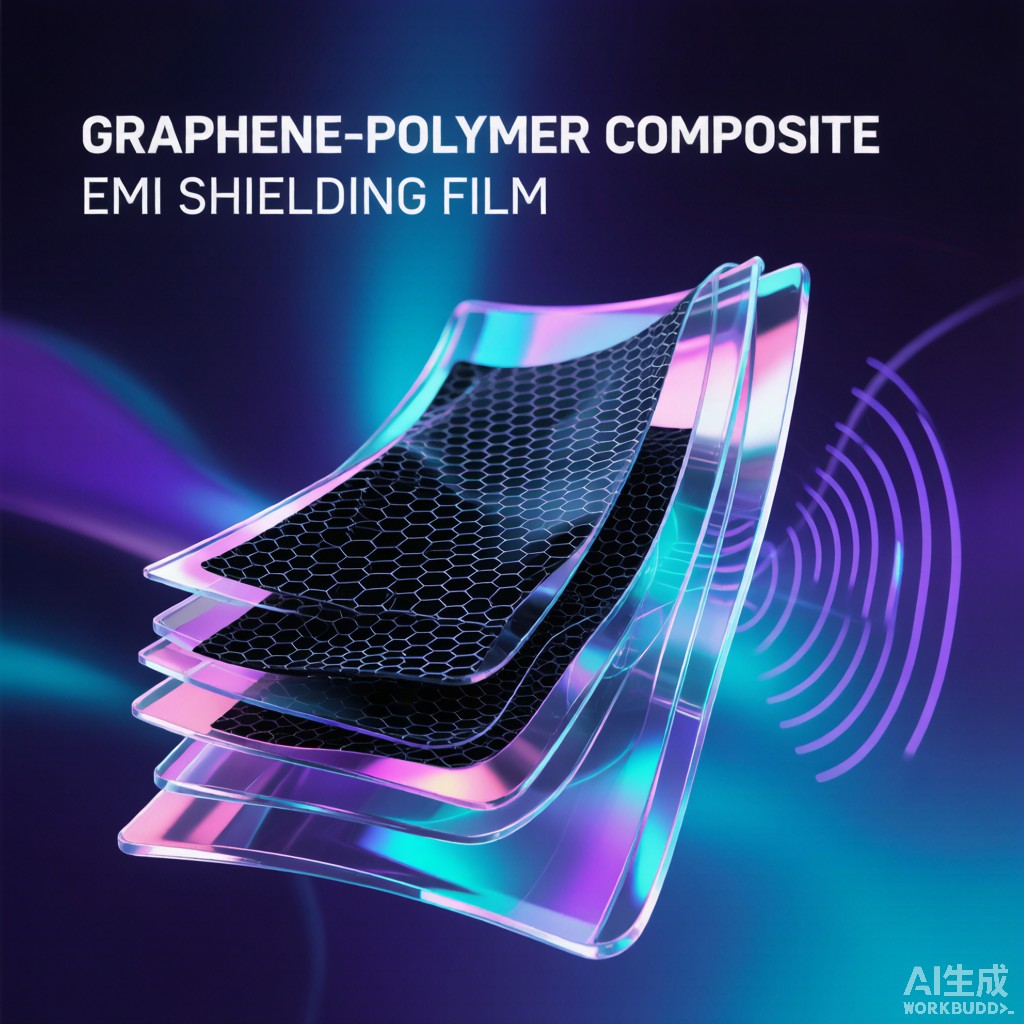
Graphene-polymer composite films have emerged as a leading solution for flexible EMI shielding, combining the exceptional electrical conductivity and high aspect ratio of graphene nanoplatelets with the mechanical flexibility and processability of polymer matrices. This article examines the shielding mechanisms, material design principles, and performance characteristics of graphene-polymer composite films for wearable electronics applications.
Graphene Filler Properties and Shielding Mechanisms
Why Graphene Outperforms Conventional Fillers
Graphene’s effectiveness as an EMI shielding filler stems from three key properties:
| Property | Graphene Nanoplatelet | Carbon Black | Carbon Fiber | CNT |
|---|---|---|---|---|
| Electrical conductivity (S/m) | 10⁶–10⁷ | 10²–10³ | 10⁴–10⁵ | 10⁴–10⁶ |
| Aspect ratio | 500–5,000 | 1–5 | 50–200 | 100–10,000 |
| Surface area (m²/g) | 500–1,200 | 50–150 | 0.5–2 | 200–1,000 |
| Percolation threshold (vol%) | 0.5–2.0 | 5–15 | 3–8 | 0.1–1.0 |
| Thermal conductivity (W/m·K) | 3,000–5,000 | 10–50 | 500–1,000 | 2,000–4,000 |
| Cost (USD/kg, 2026) | 50–200 | 5–15 | 20–40 | 300–1,000 |
Graphene’s high aspect ratio and surface area enable it to form conductive percolation networks at very low loading levels (0.5–2.0 vol%), which preserves the polymer matrix’s mechanical flexibility — a critical requirement for wearable applications. Carbon nanotubes (CNTs) achieve even lower percolation thresholds but at 3–10× the cost of graphene nanoplatelets.
Absorption-Dominant Shielding Mechanism
Unlike metal shielding, which primarily reflects electromagnetic waves, graphene-polymer composites achieve shielding predominantly through absorption. This is advantageous for wearable devices because reflected radiation can interfere with nearby ante
as and sensors. The total shielding effectiveness (SE_total) is the sum of reflection (SE_R) and absorption (SE_A) components:
SE_total = SE_R + SE_A
For a typical graphene-polymer composite film (5 vol% graphene in PDMS, 0.5 mm thick), the contribution breakdown at 8.2 GHz is:
| Frequency | SE_total (dB) | SE_R (dB) | SE_A (dB) | Absorption Ratio |
|---|---|---|---|---|
| 1 GHz | 18 | 6 | 12 | 67% |
| 3 GHz | 25 | 7 | 18 | 72% |
| 8.2 GHz (X-band) | 32 | 8 | 24 | 75% |
| 12 GHz | 35 | 8 | 27 | 77% |
| 26 GHz (5G mmWave) | 28 | 7 | 21 | 75% |
The absorption-dominant mechanism arises from graphene’s high dielectric loss tangent (tan δ ≈ 0.5–1.5 at microwave frequencies) and the internal multiple reflection pathways created by the layered graphene-polymer interfaces. Each graphene nanoplatelet acts as a miniature dipole ante
a, converting electromagnetic energy into heat through ohmic losses.
Polymer Matrix Selection for Wearable Applications
Matrix Material Comparison
| Polymer Matrix | Flexibility | SE at 5 vol% (dB, X-band) | Cycle Life (flex) | Biocompatibility | Processing |
|---|---|---|---|---|---|
| PDMS (silicone) | Excellent | 30–35 | >10,000 | Excellent (ISO 10993) | Solution casting |
| TPU (thermoplastic polyurethane) | Very good | 28–33 | 5,000–8,000 | Good | Melt compounding |
| PEDOT:PSS | Good | 25–30 | 3,000–5,000 | Good | Solution casting |
| Epoxy | Poor (rigid) | 35–42 | <500 | Moderate | Compression molding |
| PVA (polyvinyl alcohol) | Good | 22–28 | 2,000–4,000 | Excellent | Solution casting |
For skin-contact wearables, PDMS is the preferred matrix due to its excellent biocompatibility (ISO 10993 certified), unlimited flex life, and tolerance to body fluids. TPU offers a cost-effective alternative for non-skin-contact applications such as smartwatch internal shielding layers, where its melt processability enables high-throughput film production.
Film Fabrication Methods
Solution Casting vs Melt Compounding
Solution casting disperses graphene nanoplatelets in a solvent (e.g., toluene for PDMS, DMF for TPU) via ultrasonication (30–60 min, 200–400 W), mixes with the polymer solution, and casts onto a substrate followed by solvent evaporation and curing. This method achieves superior graphene dispersion and higher SE at the same loading but is limited to thin films (< 1 mm) and involves solvent handling.
Melt compounding uses a twin-screw extruder to disperse graphene directly into the polymer melt, followed by film extrusion or compression molding. While dispersion quality is lower (agglomerates above 5 μm are common), the process is solvent-free, scalable, and compatible with existing plastic film production lines in Southeast Asian electronics manufacturing facilities.
Layered Architecture for Enhanced Performance
A layered film architecture — alternating graphene-rich and polymer-rich layers — can boost SE by 5–10 dB compared to uniform composites at the same total graphene loading. The layer interfaces create impedance mismatches that enhance multiple internal reflections, effectively trapping electromagnetic energy within the film. A three-layer PDMS film (graphene-rich / polymer-rich / graphene-rich) at 4 vol% total graphene achieves SE = 38 dB in the X-band, comparable to a 0.2 mm copper foil, while maintaining flex endurance above 8,000 cycles.
Flex Reliability and Environmental Stability
Flex Cycle Testing
Wearable EMI shielding films must maintain SE after repeated flexing. Testing per IPC-TM-650 2.6.18 (flexural endurance) with a 25 mm bend radius at 1 Hz reveals:
| Film Type | Initial SE (dB) | SE after 1,000 cycles | SE after 5,000 cycles | SE after 10,000 cycles |
|---|---|---|---|---|
| 5 vol% GNP/PDMS (uniform) | 32 | 31 | 28 | 24 |
| 5 vol% GNP/PDMS (3-layer) | 38 | 37 | 35 | 32 |
| 5 vol% GNP/TPU (uniform) | 30 | 29 | 26 | 22 |
| Copper foil (0.05mm, reference) | 45 | 43 | 38 | Cracked/failed |
The three-layer graphene-PDMS film retains 84% of its initial SE after 10,000 flex cycles, while copper foil develops fatigue cracks that cause catastrophic SE degradation. This demonstrates the fundamental advantage of polymer-based shielding for flexible applications.
Southeast Asian Climate Stability
In tropical conditions (35°C, 85% RH), PDMS-based graphene composites show excellent stability: SE variation less than 1 dB after 1,000 hours of exposure. TPU-based films absorb 0.5–1.2% moisture, causing slight SE reduction (2–3 dB) that recovers after drying. PVA-based films are not recommended for tropical environments due to their high moisture absorption (15–25%) and water solubility.
Comparison with Conventional Shielding Solutions
| Parameter | Graphene-PDMS Film | Copper Foil Tape | Conductive Fabric | Nickel Paint |
|---|---|---|---|---|
| SE (dB, X-band) | 32–38 | 45–60 | 25–40 | 30–45 |
| Thickness (mm) | 0.3–0.5 | 0.05–0.10 | 0.1–0.3 | 0.05–0.15 |
| Flex endurance (cycles) | >10,000 | <2,000 | 5,000–10,000 | <500 |
| Weight (g/m²) | 150–300 | 450–900 | 50–150 | 100–300 |
| Biocompatible | Yes | No | Variable | No |
| Cost (USD/m²) | 15–40 | 5–15 | 8–25 | 10–30 |
Graphene-polymer films are not a universal replacement for metal shielding — they ca
ot match the SE of copper at equivalent thickness. However, for flexible wearable applications where metal foils fail due to fatigue cracking, graphene composites offer the best combination of shielding performance, flex reliability, and biocompatibility.
Conclusion
Graphene-polymer composite films represent a paradigm shift in EMI shielding for flexible wearable electronics. Their absorption-dominant mechanism, low percolation threshold, and exceptional flex endurance make them ideally suited for health monitoring patches, smartwatch internals, and e-textile applications. While cost remains higher than conventional metal shielding, the total value proposition — including flex reliability, biocompatibility, and design freedom — favors graphene composites in the growing wearable electronics market across Southeast Asia and globally.