Introduction: Why Formability Testing Matters for SMT Terminals
In SMT co
ector manufacturing, copper strip undergoes progressive die stamping operations that include blanking, forming, drawing, and coining. Among these, deep drawing — where a flat copper blank is transformed into a cup-shaped terminal or contact housing — imposes the most severe formability demands on the material. A copper strip with inadequate drawability will tear during production, generating scrap rates above 5% and causing progressive die damage that cascades into dimensional drift across the production run.
The Erichsen cup test (ISO 20482) is the industry-standard method for evaluating the deep draw formability of sheet metals, including copper alloys used in SMT terminal manufacturing. This article examines the test methodology, interpretation of results, and how formability data translates into material selection decisions for specific SMT terminal geometries.
Erichsen Cup Test Methodology
Test Apparatus and Procedure
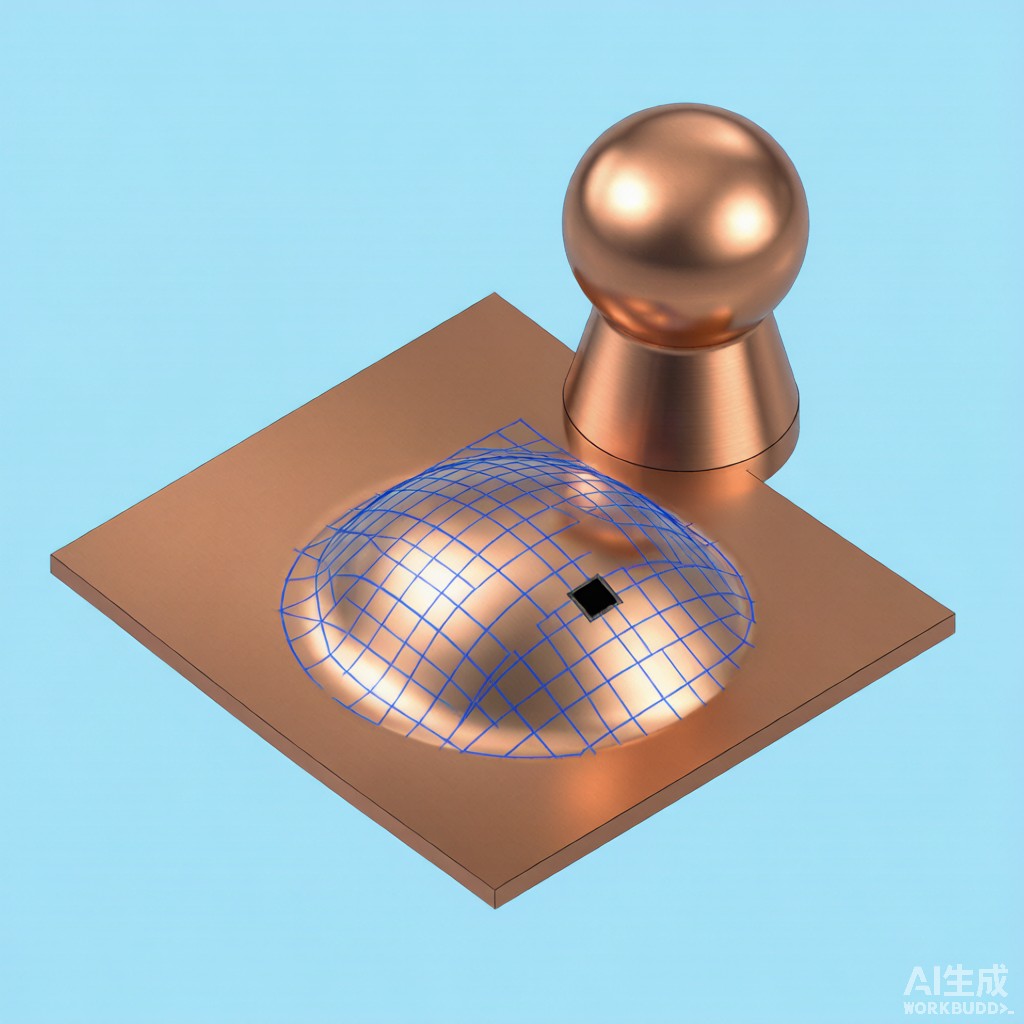
The Erichsen test uses a hemispherical punch (typically 20 mm diameter) to deform a clamped sheet specimen until fracture occurs. The punch depth at the moment of fracture — measured in millimeters — is the Erichsen number (IE), which serves as a direct formability index.
| Parameter | Specification | Standard |
|---|---|---|
| Punch diameter | 20 mm (hemispherical) | ISO 20482 |
| Die opening diameter | 27 mm | ISO 20482 |
| Die shoulder radius | 0.75 mm | ISO 20482 |
| Specimen size | 90 × 90 mm (minimum) | ISO 20482 |
| Specimen thickness | 0.1–2.0 mm (typical SMT range) | — |
| Holding force | 10 kN (sufficient to prevent draw-in) | ISO 20482 |
| Punch speed | 5–20 mm/min | ISO 20482 |
| Lubrication | Standardized oil or grease | ISO 20482 |
For SMT copper strip applications, the test is typically performed on specimens cut in three orientations relative to the rolling direction: 0° (parallel), 45° (diagonal), and 90° (transverse). The variation in IE values across these orientations reveals the material’s planar anisotropy — a critical factor in terminal design, as asymmetric draw behavior causes earing and uneven wall thickness in drawn cups.
Interpreting Erichsen Numbers for SMT Copper Strip
Higher IE values indicate better stretch-formability. For SMT terminal manufacturing, the following IE benchmarks apply to 0.3 mm thick copper strip in the a
ealed (O60) temper:
| Copper Alloy | IE (mm), 0.3mm t | Typical SMT Application | Drawability Rating |
|---|---|---|---|
| C11000 (ETP Cu, O60) | 11.5–13.0 | General-purpose terminals, battery contacts | Excellent |
| C19400 (CuFe2P, O60) | 10.0–11.5 | Lead frames, power terminals | Very good |
| C26000 (Cartridge Brass, O60) | 12.5–14.5 | Deep-drawn co
ector shells, RF shields |
Excellent (best) |
| C52100 (Phosphor Bronze, O60) | 9.5–11.0 | Spring contacts, high-reliability terminals | Good |
| C7521 (Nickel Silver, O60) | 9.0–10.5 | EMI shielding cans, decorative trim | Good |
Brass (C26000) consistently yields the highest IE values due to its FCC crystal structure with favorable stacking fault energy (approximately 75 mJ/m²), which promotes uniform dislocation glide and delays strain localization. Phosphor bronze (C52100) has lower formability because tin additions increase solid solution strengthening and reduce stacking fault energy, promoting planar slip and earlier crack initiation.
Key Formability Parameters Beyond the Erichsen Number
Strain-Hardening Exponent (n-value)
The n-value, determined from the Hollomon equation (σ = Kεⁿ), quantifies a material’s ability to distribute strain uniformly before necking. Higher n-values indicate greater resistance to localized thi
ing — a critical property for deep drawing, where material must flow from the flange into the cup wall without premature fracture.
| Alloy | n-value (O60) | Implication for Deep Draw |
|---|---|---|
| C11000 | 0.35–0.45 | Excellent strain distribution; tolerates complex draws |
| C19400 | 0.28–0.35 | Good; suitable for moderate draw ratios |
| C26000 | 0.45–0.55 | Superior; deepest draw capability |
| C52100 | 0.25–0.32 | Limited; pre-a
ealing critical for deep draws |
For SMT terminals requiring draw ratios (blank diameter / punch diameter) exceeding 1.8, an n-value above 0.35 is strongly recommended. Below this threshold, the material will neck prematurely at the punch nose radius, producing fracture rates that escalate with die wear.
Plastic Strain Ratio (r-value)
The r-value (Lankford coefficient) measures resistance to thi
ing during drawing. It is defined as the ratio of true width strain to true thickness strain in a uniaxial tensile test. An r-value greater than 1.0 indicates that the material resists thi
ing more than narrowing — desirable for deep drawing.
For copper alloys in the a
ealed condition, typical r-values range from 0.8 to 1.2. Brass C26000 exhibits the highest normal anisotropy (r̄ = 1.0–1.2), while phosphor bronze C52100 shows the lowest (r̄ = 0.8–0.9). The planar anisotropy parameter (Δr) indicates earing tendency: values close to zero produce uniform cup heights, while large absolute values cause 2-ear or 4-ear formations that waste material and require trimming.
Forming Limit Diagrams for SMT Terminal Design
While the Erichsen test provides a single-number formability index, forming limit diagrams (FLDs) offer a comprehensive map of strain combinations that a material can sustain without fracture. FLDs plot the major strain (ε₁) against minor strain (ε₂) and define a forming limit curve (FLC) above which fracture is predicted.
For SMT terminal manufacturing, the critical strain states are:
- Biaxial stretching (ε₁ = ε₂): Occurs at the punch nose during cup forming; this is the strain state directly assessed by the Erichsen test.
- Plane strain (ε₂ = 0): Occurs at the cup wall where circumferential compression is constrained; this is typically the lowest point on the FLC and the most common failure mode in deep-drawn terminals.
- Uniaxial tension (ε₂ = -ε₁/2): Occurs in the flange draw-in region; high r-values improve performance here.
For a 0.3 mm a
ealed C11000 copper strip, the FLC at plane strain typically intersects at ε₁ ≈ 0.35–0.40. Terminal designs that produce strain states near this limit during finite-element simulation should trigger a material upgrade to C26000 brass or a redesign to reduce the draw ratio.
Practical Application: Material Selection for SMT Terminal Geometries
Decision Matrix
| Terminal Type | Draw Ratio | Recommended Alloy | Minimum IE (mm) | Temper |
|---|---|---|---|---|
| Flat stamp terminal | 1.0 (no draw) | C52100 | 8.0 | H02 |
| Shallow cup contact | 1.0–1.4 | C19400 or C11000 | 9.5 | O60 |
| Medium draw housing | 1.4–1.8 | C11000 | 11.0 | O60 |
| Deep draw co
ector shell |
1.8–2.2 | C26000 | 12.5 | O60 |
| Very deep draw enclosure | 2.2+ | C26000 (multi-stage draw) | 13.0 | O60 + intermediate a
eal |
Southeast Asian Manufacturing Considerations
In tropical Southeast Asian stamping facilities, ambient humidity (80–95% RH) and temperature fluctuations (25–38°C) affect both the copper strip and the stamping lubricant. High humidity accelerates oxidation of a
ealed copper, forming surface oxide films that increase friction during drawing and reduce the effective IE by 5–10%. Maintaining a
ealed copper strip in nitrogen-flushed bags until immediately before stamping, and using water-soluble drawing compounds with rust inhibitors, helps preserve formability.
Temperature also affects lubricant viscosity: at 35°C ambient, many standard drawing oils thin beyond their optimal viscosity range, reducing film strength at the punch-workpiece interface. Selecting lubricants with viscosity-temperature stability (high viscosity index, VI > 120) ensures consistent draw performance across seasonal temperature swings common in Vietnam, Thailand, and Indonesia manufacturing sites.
Conclusion
The Erichsen cup test provides a fast, standardized formability assessment that directly predicts deep draw performance of copper strip for SMT terminal manufacturing. By combining IE values with n-value, r-value, and forming limit diagram analysis, engineers can make informed material selection decisions that minimize production scrap and ensure terminal dimensional integrity. For the deepest draw applications, brass C26000 remains the formability champion, while C11000 ETP copper offers an excellent balance of formability, conductivity, and cost for moderate draw ratio terminals.