As consumer electronics and IoT devices increasingly adopt plastic enclosures for weight reduction, design flexibility, and cost savings, electromagnetic interference (EMI) shielding becomes a critical design challenge. Unlike metal housings that provide inherent shielding through conductivity and permeability, plastic enclosures require functionalized surfaces to contain electromagnetic emissions and prevent susceptibility. Conductive paint coatings offer a versatile, cost-effective solution that can be applied to complex geometries without the dimensional constraints of metal cans or conductive gaskets. This article examines the formulation science, application methods, performance characteristics, and selection criteria for silver, nickel, and graphite conductive paint EMI shielding systems.
Conductive Paint Fundamentals
How Conductive Paint Provides EMI Shielding
Conductive paint creates EMI shielding through two primary mechanisms: reflection and absorption. When electromagnetic waves encounter a conductive surface, the free electrons in the conductive filler network oscillate, reflecting a portion of the incident energy. The remaining energy penetrates the coating where resistive losses (I²R heating in the conductive paths) dissipate it as heat. The shielding effectiveness (SE) depends on:
- Surface resistivity (ρs): Lower values (<0.1 Ω/sq) provide higher reflection-dominated shielding at lower frequencies.
- Coating thickness (t): Thicker coatings increase absorption, particularly at higher frequencies where skin depth becomes comparable to coating thickness.
- Filler loading and co
ectivity:
Percolation threshold must be exceeded to establish continuous conductive pathways. - Filler morphology: Flake-shaped fillers (silver, nickel) create overlapping platelet networks more efficiently than spherical particles.
Formulation Components
A complete conductive paint formulation comprises four functional components:
- Conductive filler: Silver flake (65–80 wt%), nickel powder (40–60 wt%), or graphite (30–50 wt%)
- Polymer binder: Acrylic, polyurethane, epoxy, or vinyl resin providing adhesion and environmental protection
- Solvent system: Water-based or solvent-based (toluene, xylene, alcohols) controlling viscosity and drying
- Additives: Dispersants, wetting agents, rheology modifiers, and corrosion inhibitors
Silver Flake Conductive Paint
Performance Characteristics
Silver remains the benchmark conductive filler due to its unmatched electrical conductivity (6.3×10⁷ S/m) and chemical stability. Silver flake conductive paints achieve:
- Surface resistivity: 0.01–0.05 Ω/sq at 25–50 μm dry film thickness
- Shielding effectiveness: 60–80 dB from 30 MHz to 1 GHz; 40–60 dB at 1–6 GHz
- Adhesion: ASTM D3359 Grade 4B–5B on ABS, PC/ABS, and nylon substrates with proper primer
- Corrosion resistance: Excellent; silver does not oxidize significantly in ambient conditions
Silver Migration Concerns
Under DC bias in humid environments (≥65% RH), silver ions migrate through the polymer matrix toward cathodic regions, forming dendritic bridges that can cause short circuits. Mitigation strategies include:
- Coating thickness ≥25 μm to increase ionic path length
- Addition of 2–5% palladium or platinum to the silver filler
- Topcoat of insulating conformal coating over the conductive paint
- Design practices avoiding DC bias across coated surfaces in high-humidity environments
Cost Position
Silver flake paints command premium pricing at $800–$1,500 per kilogram of paint, with material cost per shielded enclosure ranging from $0.50–$3.00 depending on surface area and thickness. This cost restricts silver systems to high-value applications including medical electronics, aerospace, and premium consumer devices.
Nickel Powder Conductive Paint
Performance Characteristics
Nickel offers a compelling cost-performance compromise. With conductivity of 1.4×10⁷ S/m and ferromagnetic properties (μr ≈ 100–600), nickel provides both electric and magnetic field shielding:
- Surface resistivity: 0.5–2.0 Ω/sq at 50–75 μm dry film thickness
- Shielding effectiveness: 40–60 dB from 30 MHz to 1 GHz; 30–50 dB at 1–3 GHz
- Magnetic shielding: Effective against H-fields below 100 MHz due to ferromagnetic permeability
- Corrosion resistance: Good; passive oxide layer (NiO) forms protective barrier
Application Considerations
Nickel’s higher density (8.9 g/cm³ vs 10.5 g/cm³ for silver) and spherical particle morphology require higher loadings (45–60 wt%) to achieve percolation. The resulting paints exhibit higher viscosity and may require spray application rather than brush or dip methods. Nickel also catalyzes oxidation of certain polymer binders, requiring stabilized resin systems with antioxidant additives.
Cost Position
Nickel conductive paints cost $150–$400 per kilogram, making them approximately 5–10× less expensive than silver formulations on a per-kilogram basis. Per-enclosure material costs range from $0.10–$0.80, enabling deployment in mass-market consumer electronics.
Graphite Conductive Paint
Performance Characteristics
Graphite provides the lowest-cost conductive filler option, relying on its layered crystal structure (sp² hybridized carbon) for in-plane conductivity:
- Surface resistivity: 5–50 Ω/sq at 50–100 μm dry film thickness
- Shielding effectiveness: 20–40 dB from 30 MHz to 1 GHz; limited effectiveness above 1 GHz
- Weight advantage: Lowest density filler (2.2 g/cm³), beneficial for weight-sensitive applications
- Chemical stability: Excellent; graphite is inert across pH 1–14 and temperature ranges −50°C to +400°C
Limitations
Graphite’s anisotropic conductivity (10⁴× higher in-plane than through-plane) and high percolation threshold (30–50 wt%) limit its shielding performance. The platelet morphology also creates surface roughness (Ra 5–15 μm) that may interfere with tight-tolerance assembly or aesthetic requirements. Graphite systems are best suited for applications requiring moderate shielding (20–35 dB) where cost minimization is paramount.
Comparative Performance Summary
| Property | Silver Flake | Nickel Powder | Graphite |
|---|---|---|---|
| Surface resistivity (Ω/sq) | 0.01–0.05 | 0.5–2.0 | 5–50 |
| SE @ 100 MHz (dB) | 70–85 | 50–65 | 25–40 |
| SE @ 1 GHz (dB) | 60–75 | 40–55 | 20–35 |
| SE @ 5 GHz (dB) | 45–60 | 30–45 | 15–25 |
| Typical thickness (μm) | 25–50 | 50–75 | 75–150 |
| Paint cost ($/kg) | 800–1,500 | 150–400 | 50–150 |
| Adhesion (ASTM D3359) | 4B–5B | 3B–5B | 2B–4B |
| Temperature range (°C) | −40 to +125 | −40 to +150 | −50 to +200 |
| Salt spray resistance (hrs) | 500–1,000 | 250–500 | 1,000+ |
| Color | Silver-gray | Dark gray | Black |
Application Methods and Process Control
Spray Application
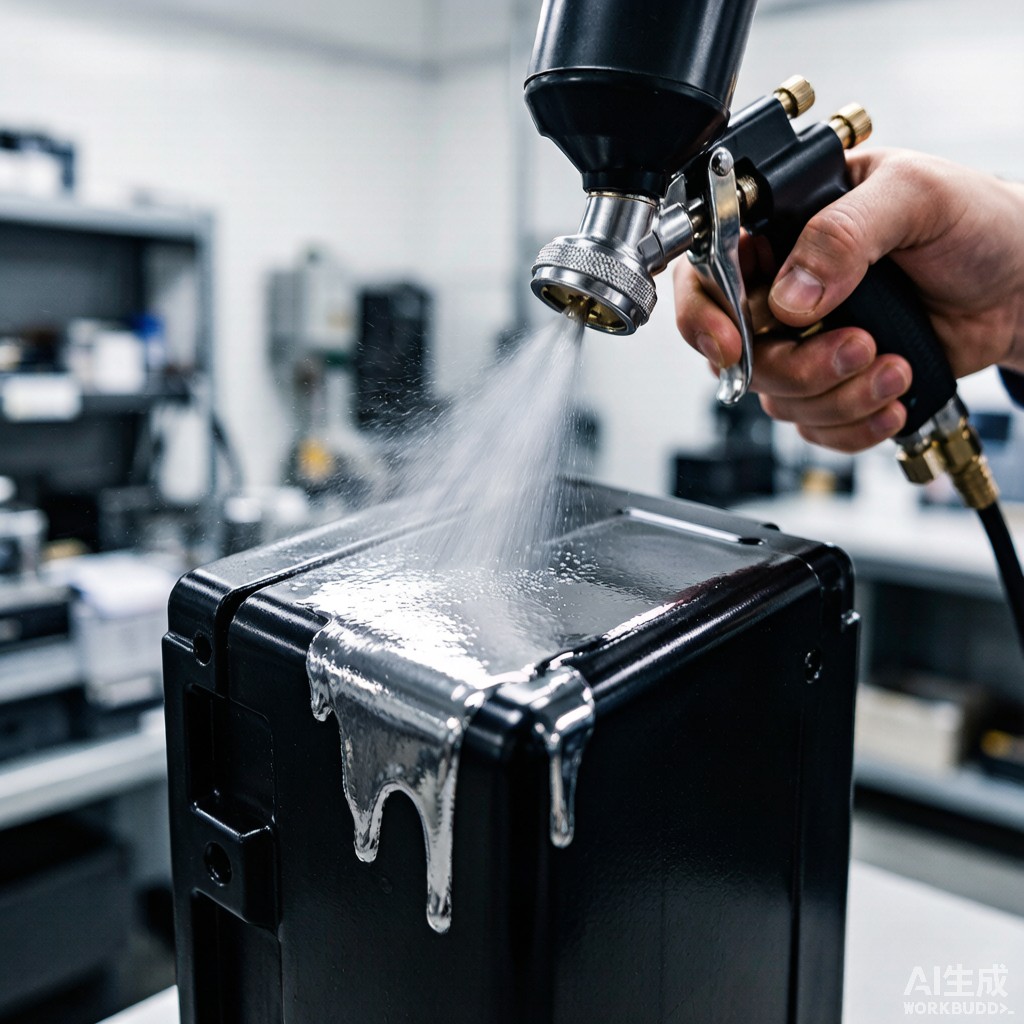
Air-atomized or HVLP spray is the dominant application method for production volumes. Key parameters include:
- Fluid pressure: 15–30 psi
- Atomization air: 30–50 psi
- Nozzle diameter: 1.0–1.4 mm
- Target wet film thickness: 50–100 μm (depending on solids content)
- Flash time between coats: 5–15 minutes
- Cure schedule: 60–80°C for 30–60 minutes (air-cure alternatives: 24 hours at 23°C)
Dip Coating
Dip coating provides uniform coverage on complex internal geometries but requires viscosity control (typically 200–500 cP) to prevent drip marks and sagging. Withdrawal speed of 5–15 cm/min balances film thickness uniformity against run-out.
Surface Preparation
Critical for adhesion achievement:
- Degreasing: Isopropyl alcohol or alkaline cleaner to remove mold release agents
- Abrasion: Light scuffing with 320-grit abrasive or plasma/UV treatment for low-energy plastics (PP, PE)
- Primer: Compatible adhesion promoter for ABS, PC/ABS (typically chlorinated polyolefin or acrylic)
- Masking: Precision masking of co
ector apertures, LED windows, and grounding pads
Design Integration Guidelines
Grounding and Electrical Continuity
Conductive paint alone provides surface conductivity; effective EMI containment requires low-impedance grounding to the PCB ground plane. Best practices include:
- Grounding pads: Unpainted contact areas (5×5 mm minimum) at PCB mounting locations
- Conductive gasket integration: Elastomer gaskets at mating seams where paint coatings ca
ot ensure continuity
- Overlap design: Minimum 5 mm overlap of conductive paint at enclosure seams
- Contact impedance: Target <10 mΩ at all grounding interfaces
Aperture and Ventilation Management
Conductive paint ca
ot shield openings. For enclosures requiring ventilation or display apertures:
- Use conductive mesh (100–200 μm stainless steel or copper) over ventilation holes
- Apply conductive paint around aperture perimeters extending 10 mm beyond the opening
- Install transparent conductive coatings (ITO, AZO) over display windows (15–25 dB SE at >$50/m²)
Environmental and Regulatory Considerations
RoHS and REACH Compliance
Silver and graphite formulations are inherently RoHS-compliant. Nickel is RoHS-compliant but carries REACH SVHC notification requirements for nickel compounds above 0.1% w/w. Water-based formulations reduce VOC emissions and improve workplace safety but may require longer cure times or elevated temperature drying.
Southeast Asian Climate Factors
Tropical humidity (80–95% RH) and salt-laden coastal air accelerate corrosion at coating defects and grounding interfaces. Recommendations include:
- Minimum coating thickness of 35 μm for coastal applications
- Epoxy-based binders (vs acrylic) for superior moisture barrier properties
- Periodic resistance monitoring at grounding pads (quarterly for critical infrastructure)
- Storage of painted enclosures in climate-controlled conditions (<70% RH) prior to assembly
Conclusion
Conductive paint EMI shielding provides a flexible, scalable solution for plastic electronics enclosures across the cost-performance spectrum. Silver flake formulations deliver benchmark shielding effectiveness for mission-critical applications where $0.50–$3.00 per enclosure is acceptable. Nickel powder systems offer the optimal compromise for consumer electronics at 5–10× lower material cost with moderate shielding degradation. Graphite-based paints serve cost-sensitive applications requiring only modest EMI attenuation while providing the highest thermal and chemical stability.
For Southeast Asian electronics manufacturers, material selection must balance performance requirements against tropical climate challenges. Epoxy-bonded nickel systems with rigorous surface preparation and ≥50 μm coating thickness represent the sweet spot for most consumer and industrial applications in humid, salt-laden environments. As 5G and IoT device proliferation increases EMI regulatory pressure, conductive paint technology will remain an essential tool in the EMC engineer’s arsenal.