Introduction: The Regulatory Imperative for Halogen-Free Flame Retardant Plastics
The global electronics industry is undergoing a decisive shift away from brominated flame retardants (BFRs) in enclosure plastics. Driven by the EU Restriction of Hazardous Substances (RoHS) Directive 2011/65/EU, IEC 61249-2-21 halogen-free requirements, and major OEM sustainability commitments (Apple, Samsung, Dell have all eliminated BFRs from enclosures since 2015–2018), manufacturers must now deliver UL94 V-0 flame retardancy without bromine or chlorine chemistry.
PC/ABS (polycarbonate/acrylonitrile-butadiene-styrene) blends are the dominant enclosure material for consumer electronics, networking equipment, and industrial control devices — prized for their balance of impact resistance, dimensional stability, and surface aesthetics. Achieving V-0 flame retardancy in these blends without halogenated additives requires sophisticated alternative chemistry. This article examines the three primary halogen-free FR systems for PC/ABS and their implications for injection molding in Southeast Asian electronics manufacturing.
PC/ABS Base Material: Why It Dominates Electronics Enclosures
Mechanical and Thermal Properties
PC/ABS blends combine the heat resistance and impact strength of polycarbonate with the processability and cost-effectiveness of ABS. Standard commercial grades (typically 65:35 to 80:20 PC:ABS ratio) offer:
| Property | PC/ABS (70:30) | Pure PC | Pure ABS | Standard |
|---|---|---|---|---|
| Tensile Strength | 50–60 MPa | 65–70 MPa | 40–50 MPa | ASTM D638 |
| Flexural Modulus | 2,200–2,600 MPa | 2,400–2,800 MPa | 2,000–2,400 MPa | ASTM D790 |
| Izod Impact (notched, 23°C) | 450–600 J/m | 700–850 J/m | 200–350 J/m | ASTM D256 |
| HDT @ 1.82 MPa | 100–110°C | 130–140°C | 85–95°C | ASTM D648 |
| Mold Shrinkage | 0.5–0.7% | 0.5–0.7% | 0.4–0.7% | ASTM D955 |
| MFI (260°C/5kg) | 15–25 g/10min | 10–15 | 20–35 | ASTM D1238 |
| Density | 1.13–1.15 g/cm³ | 1.20 | 1.04–1.07 | — |
The key advantage of PC/ABS for enclosures is its exceptional notched Izod impact resistance (450–600 J/m), which enables thin-wall designs (1.5–2.5 mm) that survive 1.5 m drop tests without fracture — critical for portable electronics and field-deployed equipment.
Halogen-Free Flame Retardant Chemistry for PC/ABS
FR Mechanism Classification
Halogen-free flame retardants for PC/ABS operate through three primary mechanisms:
1. Gas-Phase Radical Quenching (Phosphorus-based FRs): Organophosphorus compounds (resorcinol bis(diphenyl phosphate) — RDP, bisphenol A bis(diphenyl phosphate) — BDP) decompose at 350–450°C, releasing PO• radicals that scavenge H• and OH• radicals in the flame zone, breaking the radical chain reaction that sustains combustion. RDP/BDP are the industry-standard halogen-free FRs for PC/ABS, effective at 8–14% loading.
2. Char-Forming / Intumescent Mechanism (Nitrogen-phosphorus FRs): Melamine polyphosphate (MPP) and ammonium polyphosphate (APP) with char-forming synergists (pentaerythritol derivatives) create an expanding carbonaceous char layer that insulates the underlying polymer from heat and blocks fuel (pyrolysis gases) from reaching the flame. Effective at 15–25% loading.
3. Endothermic Cooling (Metal Hydroxides): Aluminum trihydrate (ATH, Al(OH)₃) and magnesium hydroxide (MDH, Mg(OH)₂) endothermically decompose at 200–340°C, releasing water vapor (30–35% by weight) that dilutes combustible gases and cools the polymer surface. However, ATH/MDH require very high loading (40–60%) for V-0 in PC/ABS, severely degrading mechanical properties — making them unsuitable for thin-wall electronics enclosures.
Comparative Performance of Halogen-Free FR Systems
| FR System | Typical Loading | UL94 (1.6mm) | Impact Retention | Process Window | Cost Index |
|---|---|---|---|---|---|
| RDP/BDP (phosphate ester) | 10–14% | V-0 | 75–90% | 260–280°C | 1.0 |
| MPP + synergist (intumescent) | 18–25% | V-0 | 55–70% | 240–270°C | 0.85 |
| Phosphazene (cyclic PN) | 6–10% | V-0 | 85–95% | 270–290°C | 1.4 |
| ATH (>60%) — reference | 55–65% | V-1 only | 15–30% | 200–230°C | 0.5 |
| Brominated FR (legacy) | 8–12% + Sb₂O₃ | V-0 | 70–85% | 240–280°C | 0.9 |
RDP/BDP phosphate esters remain the dominant choice for halogen-free PC/ABS V-0 enclosures due to their balance of effectiveness, processability, and property retention. The liquid nature of RDP (viscosity 300–600 mPa·s at 25°C) also acts as a plasticizer, improving melt flow by 10–25% — beneficial for thin-wall molding but requiring adjustment of MFI specifications.
Phosphazene-based FRs (hexaphenoxycyclotriphosphazene and its derivatives) represent the next generation, achieving V-0 at lower loading (6–10%) with minimal impact on mechanical properties (impact retention 85–95%). Their higher cost (1.4× vs phosphate esters) is offset by thi
er possible wall sections (1.0 mm vs 1.5 mm minimum for RDP/BDP), reducing material consumption by 15–20%.
Injection Molding Processing Guidelines
Drying Requirements
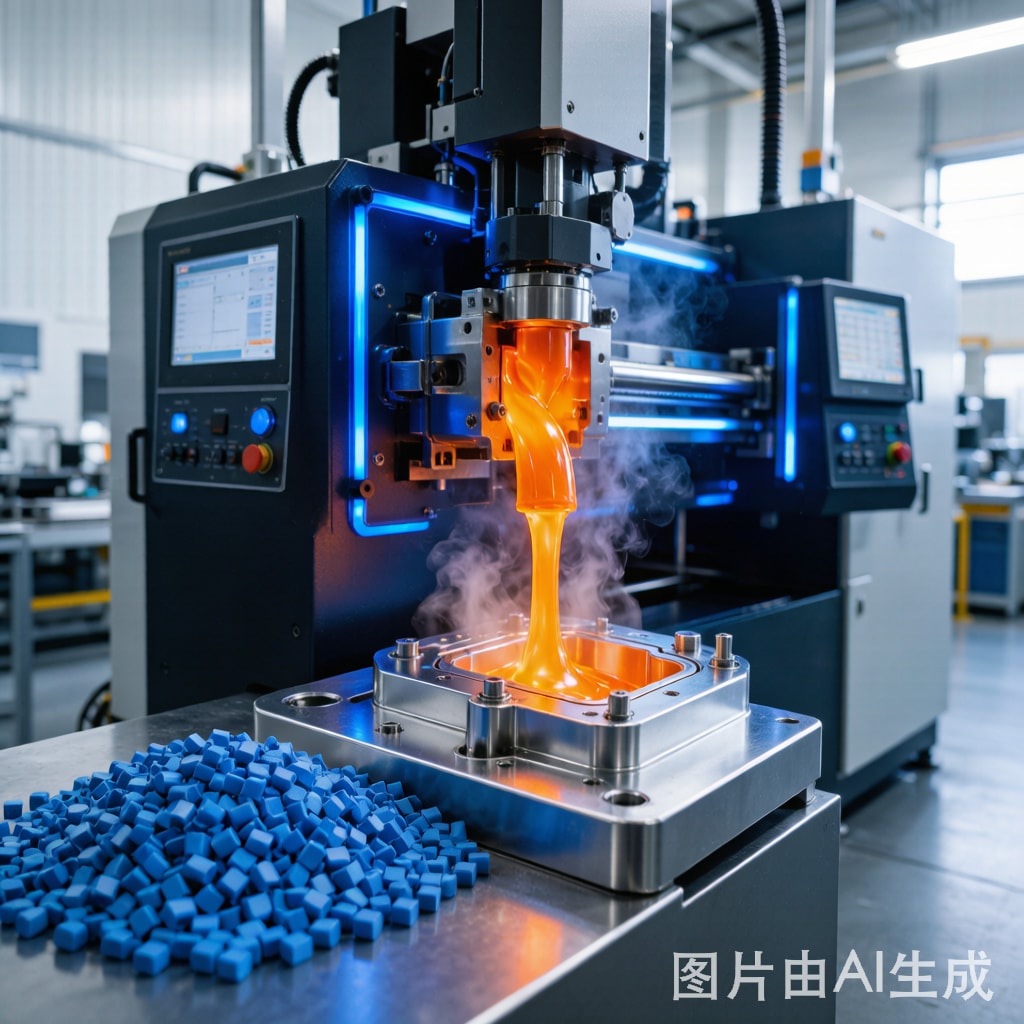
PC/ABS is hygroscopic; moisture absorption above 0.04% causes splay marks (silver streaking), surface defects, and chemical degradation at processing temperatures. Pre-drying is mandatory:
– Drying temperature: 80–100°C (maximum 110°C to prevent ABS phase degradation)
– Drying time: 3–4 hours (desiccant dryer, dew point ≤−30°C)
– Maximum residual moisture: ≤0.02% (Karl Fischer titration verification)
– Hopper residence time in humid SE Asian conditions: ≤30 minutes without active drying
Important: Phosphate ester FRs (RDP/BDP) are partially hydrolyzable — excessive moisture during processing can degrade the FR additive itself, reducing V-0 performance by 10–20%. This makes drying control doubly critical for FR-grade PC/ABS.
Processing Parameters
– Melt temperature: 250–280°C (upper limit 290°C; RDP/BDP start decomposing above 300°C)
– Mold temperature: 60–80°C (higher mold temp improves surface gloss but extends cycle time)
– Injection speed: Medium (40–60 mm/s); too fast causes shear-induced FR additive migration to surface (visible as surface haze)
– Back pressure: 3–5 bar (low back pressure reduces shear heating; critical for FR compounds)
– Screw L/D ratio: 20–24:1 with low-compression ratio screw (1.8–2.2:1 compression section) to minimize shear
Flame Retardancy Testing and UL94 V-0 Compliance
UL94 Vertical Burn Test Protocol
The UL94 V-0 rating for 1.5–1.6 mm specimens requires:
– Afterflame time (t1 + t2): ≤10 seconds per specimen, ≤50 seconds total for 5 specimens
– Afterglow time (t2 + t3): ≤30 seconds per specimen
– No flaming drips that ignite cotton indicator (absolute fail criterion for V-0)
– No specimen burns to the holding clamp
Common failure modes in halogen-free PC/ABS:
– Flaming drips: The most frequent V-0 failure. Phosphorus FRs in the gas phase are less effective at preventing drip than brominated FRs in the condensed phase. Mitigations: increase PC:ABS ratio (→75:25), add anti-dripping PTFE (0.3–0.5%, fibrillating grade), increase FR loading by 1–2%.
– Afterflame >10s: Insufficient FR concentration or poor FR dispersion. Mitigation: verify FR dispersive mixing, increase FR loading, check for processing-induced FR degradation.
Comparative Flammability: Glow Wire and LOI Testing
| Test | Standard | RDP/BDP PC/ABS | Brominated PC/ABS | Unfilled PC/ABS |
|---|---|---|---|---|
| UL94 Vertical Burn (1.6mm) | UL94 | V-0 | V-0 | HB |
| Glow Wire Ignition 750°C | IEC 60695-2-13 | Pass (no ignition) | Pass | Fail |
| Glow Wire Flammability 850°C | IEC 60695-2-11 | Pass (flame <5s) | Borderline | Fail |
| LOI (Limiting Oxygen Index) | ASTM D2863 | 28–32% | 27–30% | 21–23% |
| Cone Calorimeter (pHRR) | ISO 5660 | 250–350 kW/m² | 200–300 kW/m² | 550–700 kW/m² |
Notably, halogen-free PC/ABS FR grades often outperform brominated equivalents in glow wire testing — a critical advantage for products destined for the EU market, where IEC 60335-1 (household appliances) mandates 750°C glow wire ignition testing for unattended appliances and 850°C for attended appliances.
Southeast Asian Manufacturing Considerations
Humidity Effects on FR PC/ABS
Phosphate ester FR compounds (RDP/BDP) are mildly hygroscopic. In Southeast Asian factory conditions (80–95% RH, 30–35°C):
– Equilibrium moisture pickup: 0.15–0.25% within 2 hours of open hopper exposure (vs 0.08% for non-FR PC/ABS)
– Surface blush (white haze): Visible after 0.10% moisture content, caused by FR additive hydrolysis at melt temperature
– Mechanical degradation: —8% impact and —5% tensile per 0.1% excess moisture
Hopper dryers with integral dehumidification and closed-loop material handling are strongly recommended for FR PC/ABS processing in Southeast Asia.
Regulatory Landscape
Southeast Asian electronics export markets increasingly require halogen-free certification:
– EU: RoHS (mandatory), WEEE, EU Eco-Label
– Korea: Eco-Assurance (KEA) halogen-free tier
– Japan: J-Moss (JIS C 0950) marking for halogen-containing products
– China: China RoHS 2 (SJ/T 11364) mandatory declaration
– Global: IEC 61249-2-21 ≤900 ppm Cl, ≤900 ppm Br, ≤1500 ppm total halogens
Selecting halogen-free FR PC/ABS compound from the outset future-proofs product compliance across all major export markets.
Conclusion
Halogen-free flame retardant PC/ABS modified plastic pellets based on RDP/BDP phosphate ester chemistry deliver robust UL94 V-0 compliance at 1.6 mm wall thickness with 75–90% impact property retention — sufficient for the majority of consumer and industrial electronics enclosure applications. Next-generation phosphazene FRs push this envelope further to 1.0 mm V-0 with >85% property retention. Processing requires rigorous moisture control (≤0.02% residual), moderate melt temperatures (250–280°C), and low-shear screw configurations. For Southeast Asian manufacturers serving global electronics brands, halogen-free FR PC/ABS represents both a regulatory necessity and a competitive differentiator in markets increasingly demanding environmentally responsible enclosure materials.