The Oxidation Problem in SMT Copper Strip
Bare copper strip — the foundational material for SMT (Surface Mount Technology) lead frames, contacts, and EMI shielding components — is inherently vulnerable to surface oxidation. When exposed to ambient air, copper forms a progressive oxide sequence: Cu₂O (cuprous oxide, reddish) → CuO (cupric oxide, black) → and in humid/sulfurous environments, Cu₂S (copper sulfide, dark tarnish). Each oxidation stage degrades solderability, increases contact resistance, and can cause catastrophic yield loss in downstream SMT assembly.
For electronics supply chains operating in Southeast Asian climates — where ambient humidity routinely reaches 80–95% RH and temperature swings of 10–15°C between day and night accelerate condensation-driven corrosion — oxidation prevention is not a quality nicety; it is a supply chain survival requirement.
This article systematically reviews oxidation prevention strategies for stored SMT copper strip, from anti-tarnish coatings to packaging systems and shelf life management protocols.
Oxidation Mechanisms and Their Impact on SMT Assembly
Thermodynamic Basis of Copper Oxidation
Copper oxidation follows well-characterized kinetics:
- Initial Cu₂O formation: Parabolic growth law — oxide thickness ∝ √t (time). At 25°C, 50% RH, visible oxide film (≈50 Å) forms within 24 hours on freshly exposed copper
- Accelerated CuO growth: Activated above 150°C or in humid-sulfurous atmospheres. Rate increases exponentially with temperature (Arrhenius behavior)
- Sulfide tarnish: Atmospheric H₂S and SO₂ react with copper even at room temperature. Urban/industrial environments contain 0.5–5 ppb H₂S, sufficient to form visible tarnish in 3–7 days
SMT Assembly Impact
| Oxidation Level | Visual Indicator | Solder Wetting | Contact Resistance | Assembly Impact |
|---|---|---|---|---|
| Clean surface (≤10 Å oxide) | Bright, reflective copper | Excellent (wetting time <1s) | Baseline | No issues |
| Light oxide (50–200 Å) | Slight dulling, pinkish-brown | Good (wetting time 1–3s) | +5–15% | Typically acceptable with flux |
| Medium oxide (200–1000 Å) | Brown-black discoloration | Marginal (needs aggressive flux) | +20–50% | Rework risk, voiding increase |
| Heavy oxide (>1000 Å) | Black, rough surface | Poor to non-wetting | +100–500% | Scrap or chemical cleaning required |
Anti-Tarnish Coating Technologies
Organic Anti-Tarnish Coatings (Progard/Verdipass)
Organic anti-tarnish coatings are the most widely used protection for SMT copper strip. These thin (0.5–2 μm) organic films — typically benzotriazole (BTA) or tolyltriazole (TTA) derivatives — chemisorb onto the copper surface, forming a passivation layer that blocks oxygen and moisture access.
Advantages:
- No effect on solderability — coatings dissolve in standard solder flux during reflow
- Very thin — no dimensional impact on strip thickness or flatness
- Cost-effective — adds $0.01–0.03/kg to strip cost
- Easy to apply — spray or immersion process at coil manufacturer
Limitations:
- Shelf life protection limited to 3–6 months at moderate humidity (≤60% RH)
- At 80%+ RH, organic films degrade through hydrolysis, reducing protection to 1–3 months
- Not resistant to mechanical abrasion — handling contact points may break the film locally
- Not suitable for long-term storage (>6 months) or outdoor/industrial atmosphere exposure
Tin Plating (Electroplated or Hot-Dipped)
Tin plating (3–8 μm) provides robust oxidation protection and excellent solderability:
Advantages:
- Permanent protection — tin does not oxidize significantly in normal atmospheres
- Excellent solderability — tin is itself the standard solder substrate material
- Long shelf life (>12 months) without special packaging
- Electrically conductive surface — suitable for contact/co
ector applications
Limitations:
- Higher cost — adds $0.15–0.40/kg depending on thickness and plating method
- Thickness addition — 3–8 μm per side changes effective strip dimensions
- Tin whisker risk — pure tin plating can grow whiskers over time (mitigated by matte tin or tin-bismuth alloys)
- Not suitable when bare copper surface is required for etching (chemical milling lead frames)
Nickel Underplate + Gold Flash
For high-reliability co
ector/contact applications on copper strip:
Advantages:
- Maximum corrosion resistance — nickel barrier + gold flash survives years of storage
- Low contact resistance — gold flash (<0.5 μm) provides stable contact surface
- Premium appearance — gold color signals quality to customers
Limitations:
- Highest cost — adds $0.50–1.50/kg
- Solderability requires gold dissolution — thin gold (<0.5 μm) dissolves into solder, but thick gold causes embrittlement
- Nickel barrier (2–5 μm) significantly changes strip dimensions
- Overkill for lead frame strip where tin plating suffices
Silver Plating
Silver offers unique advantages for RF/EMI applications:
Advantages:
- Highest electrical conductivity of any metal — optimal for RF shielding and high-frequency contacts
- Good solderability without embrittlement risk
- Moderate cost — adds $0.10–0.30/kg
Limitations:
- Tarnishes in sulfurous atmospheres (Ag₂S) — dark tarnish is cosmetic and slightly increases contact resistance, but does not significantly reduce solderability
- Copper migration through silver at elevated temperatures — requires nickel barrier for long-term reliability
- Not suitable for lead frames (chemical etching compatibility issues)
Packaging Systems for Oxidation Prevention
Vacuum Sealing with Desiccant
The gold standard for copper strip storage packaging:
- Coils vacuum-sealed in multi-layer barrier film (aluminum foil laminate, WVTR <0.01 g/m²/day)
- Internal desiccant packets (silica gel or molecular sieve) targeting <10% RH inside the sealed environment
- Outer carton with foam cushioning to prevent mechanical damage to the barrier film
- Shelf life: 12+ months even in tropical warehouse conditions
Cost impact: Adds $0.50–1.50 per coil depending on size. Justified for high-value precision strip (tolerance ±0.005 mm, temper H04) where oxidation scrap cost exceeds packaging cost.
Nitrogen-Purged Sealing
An alternative to vacuum sealing:
- Coils sealed in barrier film after nitrogen gas purge — displaces oxygen from inside the package
- Combined with desiccant for humidity control
- Shelf life: comparable to vacuum sealing (12+ months)
- Slightly higher packaging cost but easier to open without coil distortion (vacuum packaging compresses coils slightly)
Cleanroom Packaging (Class 10,000)
For strip destined for semiconductor lead frame fabrication:
- Packaging performed in Class 10,000 cleanroom to prevent particulate contamination
- Anti-static i
er bags (surface resistivity 10⁶–10⁹ Ω/sq) prevent ESD damage to thin strip
- Double-bagging: i
er clean bag + outer barrier bag with desiccant
- Labeling with oxidation exposure time indicator (color-changing humidity indicator card)
Standard Industrial Packaging
For less critical applications (EMI shielding strip, bus bar stock):
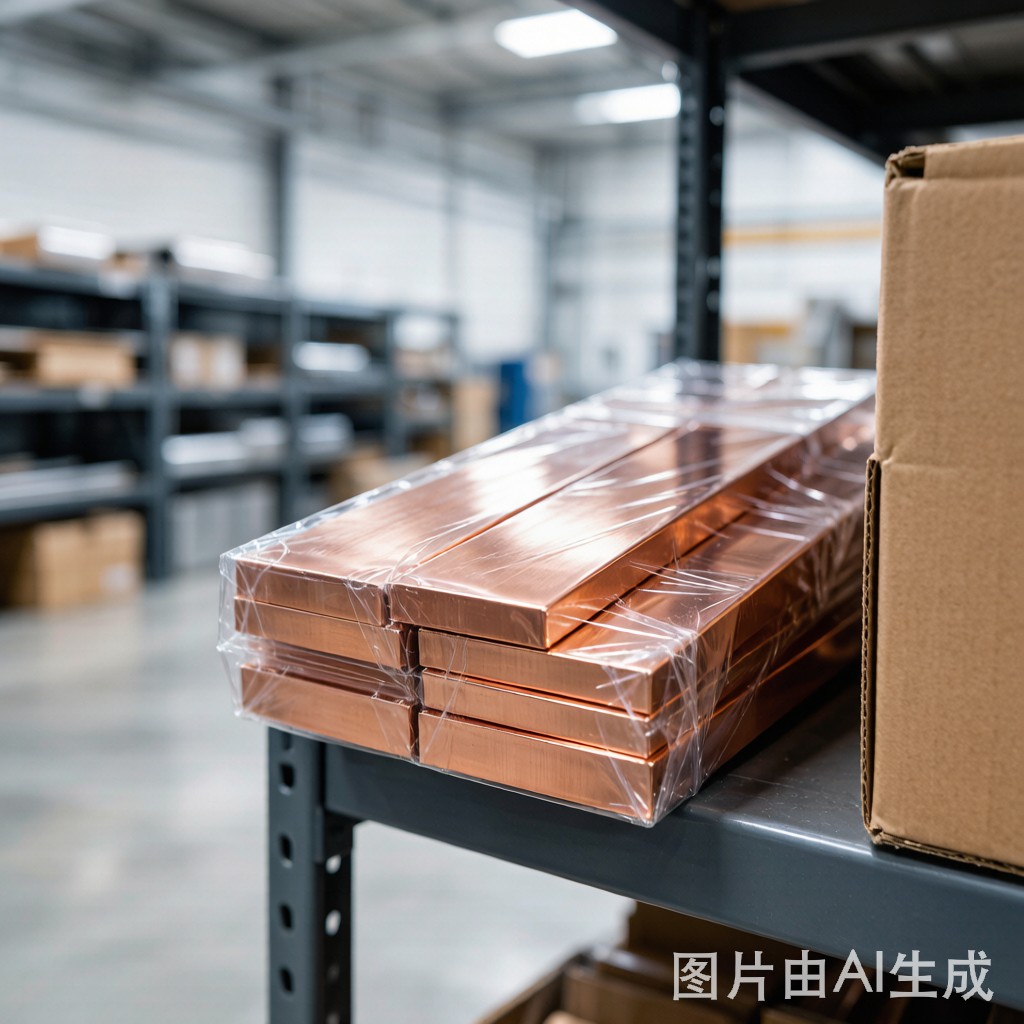
- Coils wrapped in anti-tarnish paper (BTA-impregnated kraft paper)
- Plastic stretch wrap for physical protection
- No desiccant or barrier film — relies on anti-tarnish coating on the strip surface
- Shelf life: 1–3 months in moderate climate; 1–4 weeks in tropical humidity
Storage Environment Management
Warehouse Conditions for Southeast Asian Operations
| Parameter | Recommended Value | Typical Local Challenge | Mitigation |
|---|---|---|---|
| Temperature | 20–25°C (±3°C) | 30–38°C ambient | Air-conditioned storage zone |
| Relative Humidity | ≤40% RH | 80–95% RH outdoor | Dehumidified warehouse or nitrogen-purged cabinets |
| Air Quality | H₂S <1 ppb, SO₂ <5 ppb | Industrial/urban 2–10 ppb | Activated carbon air filtration, sealed storage |
| UV Exposure | Minimal | Strong tropical sunlight through windows | UV-blocking window film, opaque packaging |
| Handling | Clean gloves, no bare skin contact | Perspiration and skin oils accelerate tarnish | Training + nitrile glove requirement |
FIFO Inventory Management
First-In-First-Out (FIFO) inventory management is essential for oxidizable copper strip:
- Maximum storage duration: 6 months for anti-tarnish coated strip; 12+ months for vacuum-sealed or tin-plated strip
- Re-inspection protocol: Every 3 months, sample coils from each batch for visual and solderability testing (dip test per JIS Z3197)
- Reject criteria: Visible tarnish on >5% of coil surface, or solder wetting time >3 seconds with standard flux
Recovery Procedures for Oxidized Strip
When oxidation occurs despite preventive measures, recovery options exist:
Chemical Cleaning
- Acid pickling: 10–20% H₂SO₄ immersion for 30–60 seconds removes Cu₂O and CuO — restores bright surface but adds processing cost and waste treatment burden
- BTA re-passivation: After acid cleaning, reapply organic anti-tarnish coating to prevent immediate re-oxidation
- Limitation: Acid cleaning etches the copper surface, removing 0.5–2 μm of material — unacceptable for precision tolerance strip (±0.005 mm)
Mechanical Cleaning
- Brush abrasion: Fine abrasive brushes remove surface oxide without significant material removal — suitable for heavier gauge strip (>0.30 mm)
- Vapor honing: Fine abrasive media in dry ice or water vapor — gentle cleaning with minimal dimensional impact
Conclusion
Oxidation prevention for stored SMT copper strip requires a layered defense strategy: the right anti-tarnish coating matched to the application’s shelf life and solderability requirements, appropriate packaging (vacuum-sealed with desiccant for premium precision strip, BTA-impregnated paper for standard grades), and disciplined warehouse environmental management (≤40% RH, ≤25°C, H₂S-free air). For Southeast Asian electronics supply chains where high humidity is the default environment, investing in proper packaging and storage infrastructure pays for itself rapidly by avoiding scrap costs that typically run 5–15× the preventive packaging cost. Select your protection level based on the strip’s end use, storage duration, and local climate conditions — and verify effectiveness with regular solderability testing throughout the storage lifecycle.