Introduction
The electrification of transportation is driving unprecedented demand for compact, high-current interco
ects inside battery packs. Electric vehicle battery management systems (BMS) must monitor cell voltage, balance charge, and protect against overcurrent conditions — all within tight spatial and thermal constraints. SMT copper strip components are emerging as a preferred solution for current sensing, cell-to-module bussing, and fuse links in BMS electronics, offering a surface-mountable alternative to traditional wire leads and bolted busbars.
Current Sensing with SMT Copper Shunts
One of the most common applications of copper strip in BMS is the current sense shunt. A precisely calibrated copper strip of known resistance (typically in the micro-ohm range) is placed in series with the battery current path. The voltage drop across the strip is measured by a high-precision analog front-end (AFE), and Ohm’s law gives the current. SMT copper shunts offer several advantages over Hall-effect sensors:
- Linearity: Copper shunts provide a linear voltage response across the full current range, with no saturation or magnetic hysteresis effects.
- Accuracy: Tolerances of ±1% or better are achievable with controlled strip dimensions and alloy resistivity.
- Bandwidth: No inherent bandwidth limitation from magnetic core materials, enabling fast overcurrent detection.
- Cost: Copper shunts are typically lower cost than isolated Hall-effect sensors for high-current applications.
Copper Alloy Selection for BMS Shunts
Not all copper alloys are suitable for precision shunts. The ideal alloy has a low, stable temperature coefficient of resistance (TCR) and good solderability. Common choices include:
- C11000 (ETP Copper): High conductivity (100% IACS) but TCR of approximately +0.0039/°C, requiring significant temperature compensation in the BMS firmware.
- C19400 (Cu-Fe-P): Lower conductivity (65% IACS) but higher strength and better solderability than C11000. Often used for lead frames and moderate-current shunts.
- C18080 (Cu-Cr-Sn): Precipitation-hardened alloy with excellent strength and conductivity balance, suitable for high-current fuse links and busbars.
- Manganin/CuMn12Ni (C12000): Very low TCR (~0.00002/°C) but lower conductivity. Used for precision measurement shunts where temperature stability is paramount.
Cell-to-Module Busbars and Power Routing
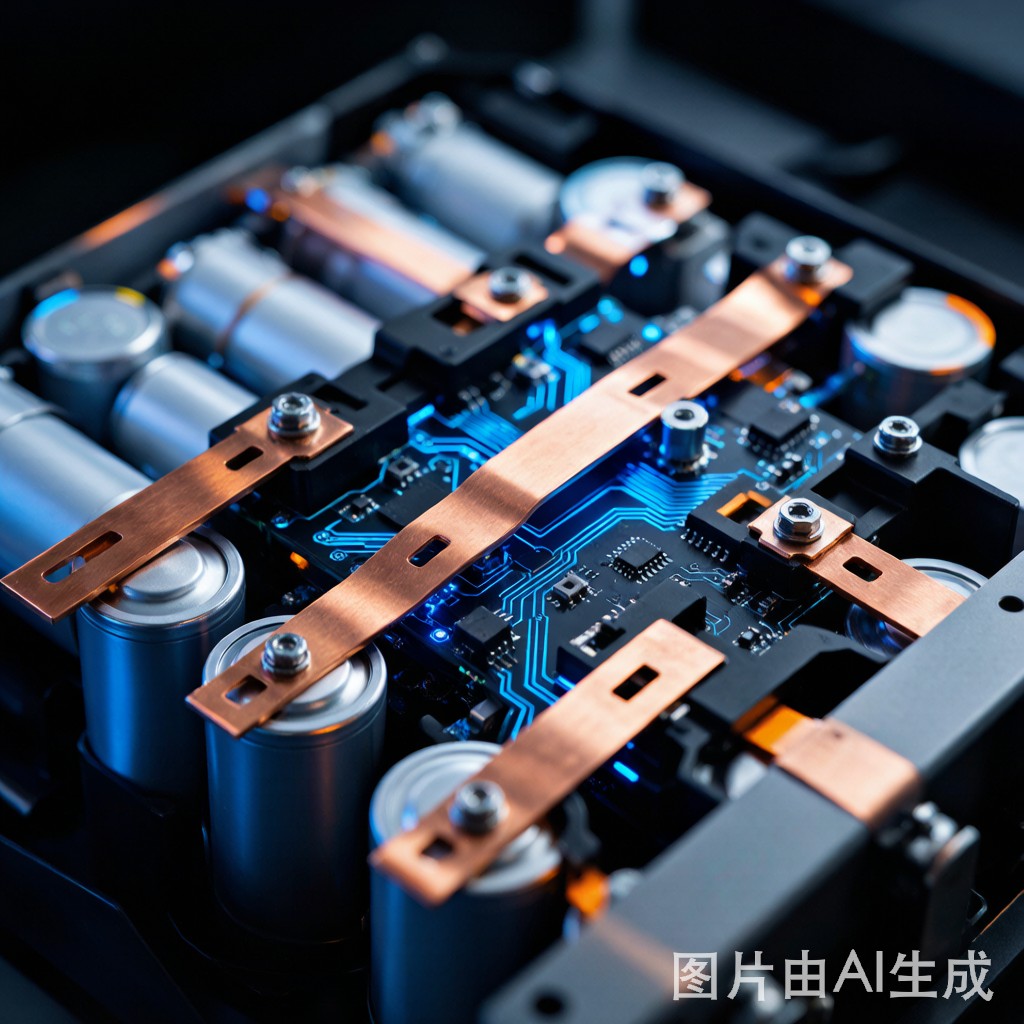
Beyond sensing, copper strip serves as the backbone of cell-to-cell and cell-to-module electrical co
ections. In cylindrical cell modules, nickel-plated copper strips spot-welded to cell terminals carry the full pack current. In prismatic and pouch cell modules, SMT copper busbars are soldered directly to the PCB or bus plate, carrying current from the cell terminals to the BMS and main power contacts.
Designers must account for current capacity and temperature rise. A useful rule of thumb for copper strip in still air is that a 10°C temperature rise above ambient requires approximately 1 mm² of copper cross-sectional area per 10 A of continuous current, though this varies significantly with cooling, termination quality, and duty cycle. For BMS applications where adjacent components include temperature-sensitive battery cells and electronics, lower current densities are often mandated to prevent localized heating.
Thermal and Mechanical Reliability
Automotive BMS components experience severe thermal cycling. Under-hood temperatures can reach 85°C, while battery modules may operate from -40°C to +60°C. The CTE mismatch between copper strip (17 ppm/K), FR-4 PCB (14-17 ppm/K in-plane), and solder joints creates cyclic stress. SMT copper strip components should be designed with:
- Adequate solder fillet area: Larger pad and strip end geometry reduce stress concentration at the solder joint.
- Stress relief features: Strategic bends or slots in the copper strip can absorb CTE mismatch without cracking solder joints.
- High-temperature solders: For high-temperature zones, SAC305 or high-reliability Sn-Ag-Cu variants may be preferred over low-temperature alloys.
- Coating compatibility: Nickel or tin plating must resist oxidation and maintain solderability throughout the vehicle lifetime.
Conclusion
SMT copper strip is playing an increasingly vital role in electric vehicle battery management systems, from precision current sensing to high-current cell bussing. The combination of high conductivity, compact form factor, and surface-mount compatibility makes copper strip an ideal interco
ect technology for the demanding automotive environment. By selecting the right alloy, optimizing current density and thermal management, and designing for solder joint reliability under thermal cycling, engineers can leverage copper strip to improve BMS performance, safety, and longevity.