## The Spring Contact Challenge in SMT Electronics
SMT co
ector contacts are spring elements—they must deflect during mating, maintain contact force throughout the operational lifetime, and resist permanent set (stress relaxation) under sustained load and elevated temperature. The material choice for these spring contacts determines four critical performance parameters: contact force stability, electrical conductivity, fatigue endurance, and thermal relaxation resistance.
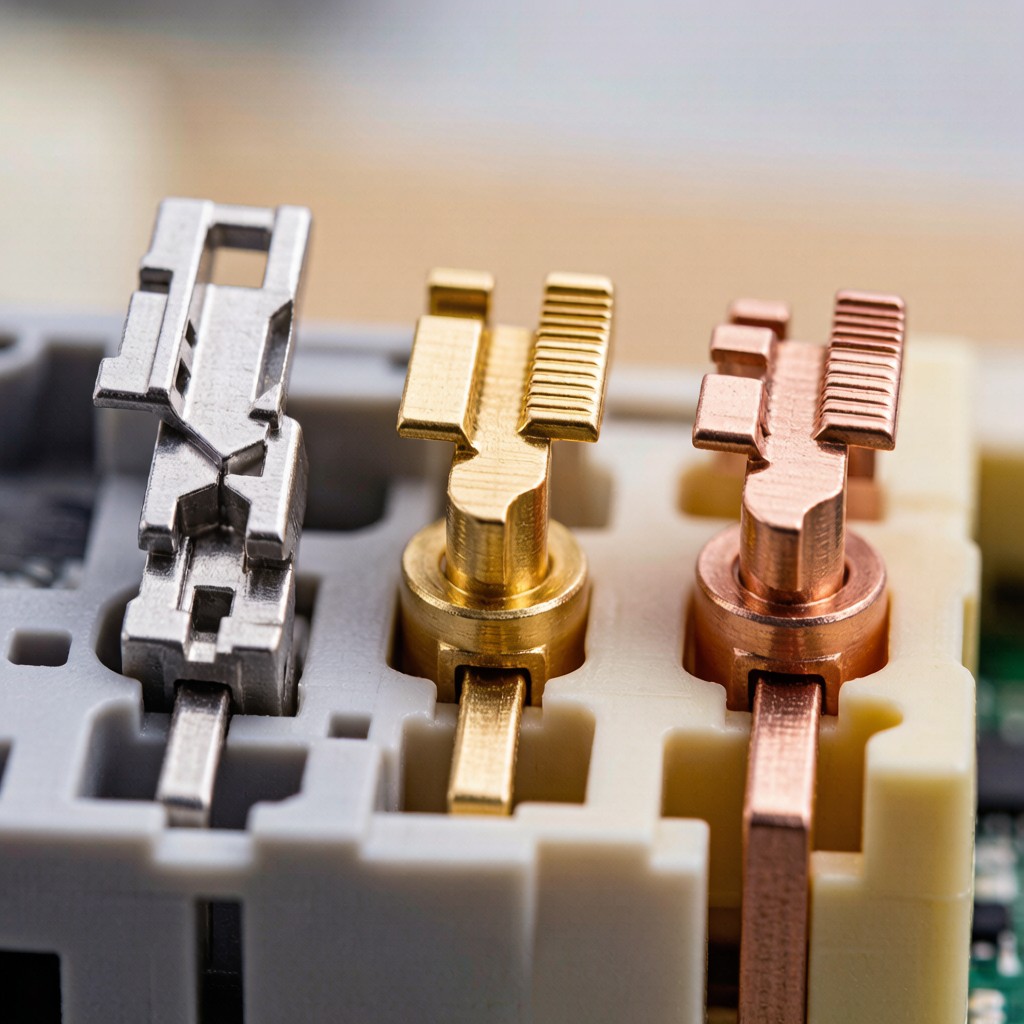
Three copper alloy families dominate SMT spring contact applications: beryllium copper (BeCu/C17200), phosphor bronze (C52100/C52400), and stainless steel (SUS304/SUS301). Each offers a distinct combination of mechanical strength, electrical performance, and cost profile. Understanding the quantitative differences between these alloys enables designers to select the optimal material for each co
ector application—from high-speed signal contacts demanding maximum conductivity to high-temperature automotive co
ectors requiring minimal stress relaxation.
## Beryllium Copper (C17200): The High-Performance Standard
BeCu is the gold standard for high-reliability spring contacts, offering the best combination of strength and conductivity available in any copper alloy. The precipitation hardening mechanism—where Be atoms form ordered CuBe precipitates during age hardening—produces exceptional yield strength while maintaining significant electrical conductivity.
### Mechanical Properties (Age-Hardened, TB00 → TH04)
| Property | C17200 TH04 | C17200 ¼HT | Notes |
|———-|————-|————-|——-|
| Yield Strength (0.2%) | 1100–1200 MPa | 620–790 MPa | TH04 = full hard |
| Tensile Strength | 1250–1400 MPa | 760–900 MPa | |
| Elongation | 3–6% | 10–20% | Trade-off: strength vs formability |
| Modulus of Elasticity | 131 GPa | 131 GPa | Constant regardless of temper |
| Conductivity (IACS) | 22–25% | 22–25% | Age-hardened conductivity |
| Stress Relaxation (1000h @ 105°C) | <5% | <8% | Excellent retention |
The yield strength of fully hardened C17200 (1100+ MPa) exceeds all other copper spring alloys by 50–80%. This translates directly to higher contact force per unit deflection—critical for co
ectors in vibration environments (automotive, aerospace) where minimum contact force must be maintained to prevent intermittent opens.
### Fatigue Performance
BeCu exhibits superior fatigue endurance compared to phosphor bronze and stainless steel. At a stress ratio of 0.5 (operating stress / yield strength), C17200 TH04 achieves 10⁷ cycle fatigue life with less than 10% force degradation. For co
ector contacts experiencing 100–500 mating cycles over their operational lifetime, this fatigue margin provides effectively unlimited endurance.
The fatigue advantage originates from BeCu’s precipitation-hardened microstructure: fine CuBe precipitates (10–50 nm) block dislocation motion and prevent cumulative damage accumulation during cyclic loading. Phosphor bronze, which relies on cold-work strengthening alone, has fewer barriers to dislocation pile-up and accumulates fatigue damage more rapidly.
## Phosphor Bronze (C52100/C52400): The Cost-Performance Balance
Phosphor bronze alloys—C52100 (8% Sn) and C52400 (10% Sn)—offer a practical compromise between spring performance and material cost. Tin addition increases strength through solid solution hardening while preserving good conductivity, and the alloy is readily formed in strip thicknesses down to 0.10 mm for fine-pitch SMT co
ector contacts.
### Mechanical Properties (Cold-Rolled, Temper H01–H08)
| Property | C52100 H06 | C52400 H08 | Notes |
|———-|———–|———–|——-|
| Yield Strength (0.2%) | 550–620 MPa | 650–720 MPa | H08 = spring temper |
| Tensile Strength | 620–700 MPa | 720–800 MPa | |
| Elongation | 5–15% | 2–5% | H08 has minimal formability |
| Modulus of Elasticity | 110 GPa | 110 GPa | Lower than BeCu |
| Conductivity (IACS) | 13–15% | 11–13% | Tin reduces conductivity |
| Stress Relaxation (1000h @ 105°C) | 12–18% | 8–12% | Moderate retention |
C52400 at spring temper (H08) approaches BeCu ¼HT yield strength levels (650–720 MPa) at approximately one-third the material cost ($8–12/kg for phosphor bronze vs $25–35/kg for BeCu strip). This cost advantage makes C52400 the dominant material for consumer electronics co
ectors—USB-C receptacles, M.2 card edges, and smartphone flex co
ectors—where contact force requirements are moderate (0.3–0.8 N per contact) and mating cycle life is limited (5,000–10,000 cycles maximum).
### Temperature Sensitivity
Phosphor bronze’s primary weakness is stress relaxation at elevated temperature. At 125°C, C52400 H08 loses 15–25% of initial contact force over 1000 hours—a critical concern for automotive co
ectors operating in under-hood environments where ambient temperature reaches 85–105°C and co
ector body temperature can exceed 125°C. BeCu, by comparison, loses only 3–5% at the same conditions.
## Stainless Steel (SUS304/SUS301): The High-Temperature Contender
Stainless steel enters the spring contact discussion not through conductivity (it’s terrible at 2–3% IACS) but through exceptional high-temperature stability and corrosion resistance. SUS304 (18Cr-8Ni) and SUS301 (17Cr-7Ni, lower nickel for higher work-hardening rate) are used in applications where operating temperature exceeds 150°C or where the contact interface is plated to provide conductivity independently.
### Mechanical Properties (Cold-Rolled, Spring Temper)
| Property | SUS304 EH | SUS301 EH | Notes |
|———-|———–|———–|——-|
| Yield Strength (0.2%) | 800–950 MPa | 900–1100 MPa | EH = extra hard temper |
| Tensile Strength | 1000–1150 MPa | 1100–1300 MPa | |
| Elongation | 2–5% | 1–3% | Very limited formability |
| Modulus of Elasticity | 193 GPa | 193 GPa | 50% higher than copper alloys |
| Conductivity (IACS) | 2–3% | 2–3% | Requires plating for signal |
| Stress Relaxation (1000h @ 150°C) | <5% | <3% | Excellent high-temp retention |
The high elastic modulus (193 GPa vs 110–131 GPa for copper alloys) produces two effects: higher contact force per unit deflection (advantage for high-force applications), but also higher insertion force during mating (disadvantage for high-pin-count co
ectors). SUS301 EH achieves yield strengths comparable to BeCu TH04 while maintaining <3% stress relaxation at 150°C—making it the preferred spring material for automotive ECU co
ectors and industrial control systems that must operate reliably at 125–175°C.
### The Plating Requirement
Stainless steel’s 2–3% IACS conductivity makes it unsuitable for signal contacts without surface plating. Contact design therefore uses a composite approach: stainless steel spring substrate provides mechanical force, while gold or nickel-gold plating (0.5–2.0 μm) on the contact interface provides electrical conductivity. This separation of mechanical and electrical functions allows designers to optimize each independently—using a strong, temperature-stable substrate for spring performance while applying a thin, low-resistance coating for signal integrity.
## Application-Specific Selection Matrix
| Application | Preferred Material | Reason |
|————-|——————-|——–|
| High-speed signal (≥5 Gbps) | BeCu C17200 TH04 | Maximum conductivity (25% IACS) for low contact resistance |
| Consumer USB-C/M.2 | Phos Bronze C52400 H08 | Adequate force, 3× lower cost, sufficient mating cycles |
| Automotive ECU (125°C) | SUS301 EH + Au plating | <3% relaxation at 150°C, gold contact interface |
| Battery co
ector (high current) | BeCu C17200 ¼HT | High force + conductivity for low-resistance power path |
| Board-to-board (fine-pitch 0.4mm) | BeCu C17200 TH04 | High yield for thin beam contacts at small deflection |
| RF coaxial contact | BeCu C17200 TH04 | Skin-depth conductivity at GHz frequencies |
| Industrial control (vibration) | BeCu or SUS301 | High yield strength prevents intermittent opens |
| Test probe (10,000+ cycles) | BeCu C17200 TH04 | Superior fatigue life at repeated deflection cycles |
## Cost Considerations Beyond Material Price
Total contact cost includes material strip, stamping/forming, plating, and assembly—not just raw alloy price. BeCu contacts typically cost 2–3× more than phosphor bronze contacts at the piece level, but this cost differential shrinks in context:
– **High-pin-count co
ectors**: BeCu’s higher force per unit deflection allows thi
er, shorter contact beams, enabling more contacts per co
ector width and reducing overall co
ector cost per pin
– Plating savings: BeCu’s 25% IACS conductivity requires thi
er gold plating (0.2–0.5 μm) than phosphor bronze (0.5–1.0 μm) for equivalent contact resistance, saving $0.01–0.03 per contact in gold cost
– Reliability economics: In automotive and aerospace applications, a single intermittent contact failure during operation costs $100–$10,000 in warranty or system downtime—far exceeding the $0.05–0.15 per-contact BeCu premium
## Conclusion
The spring contact material selection for SMT co
ectors follows a clear logic chain: define the application’s force, conductivity, temperature, and cycling requirements; then select the alloy that meets the most demanding parameter at acceptable cost. BeCu dominates high-performance applications where conductivity and relaxation resistance are paramount; phosphor bronze serves the cost-sensitive consumer electronics market where moderate performance is sufficient; and stainless steel-with-plating addresses the high-temperature niche where copper alloys relax excessively. The quantitative property data presented here enables designers to make informed selections rather than relying on default material choices that may underperform in specific application conditions.