Copper bus bars are the backbone of power distribution — carrying hundreds to thousands of amperes in switchgear, motor control centers, UPS systems, and industrial power panels. The bare copper is an excellent conductor, but without insulation, it presents a severe safety hazard: flashover between phases, arc fault initiation, perso
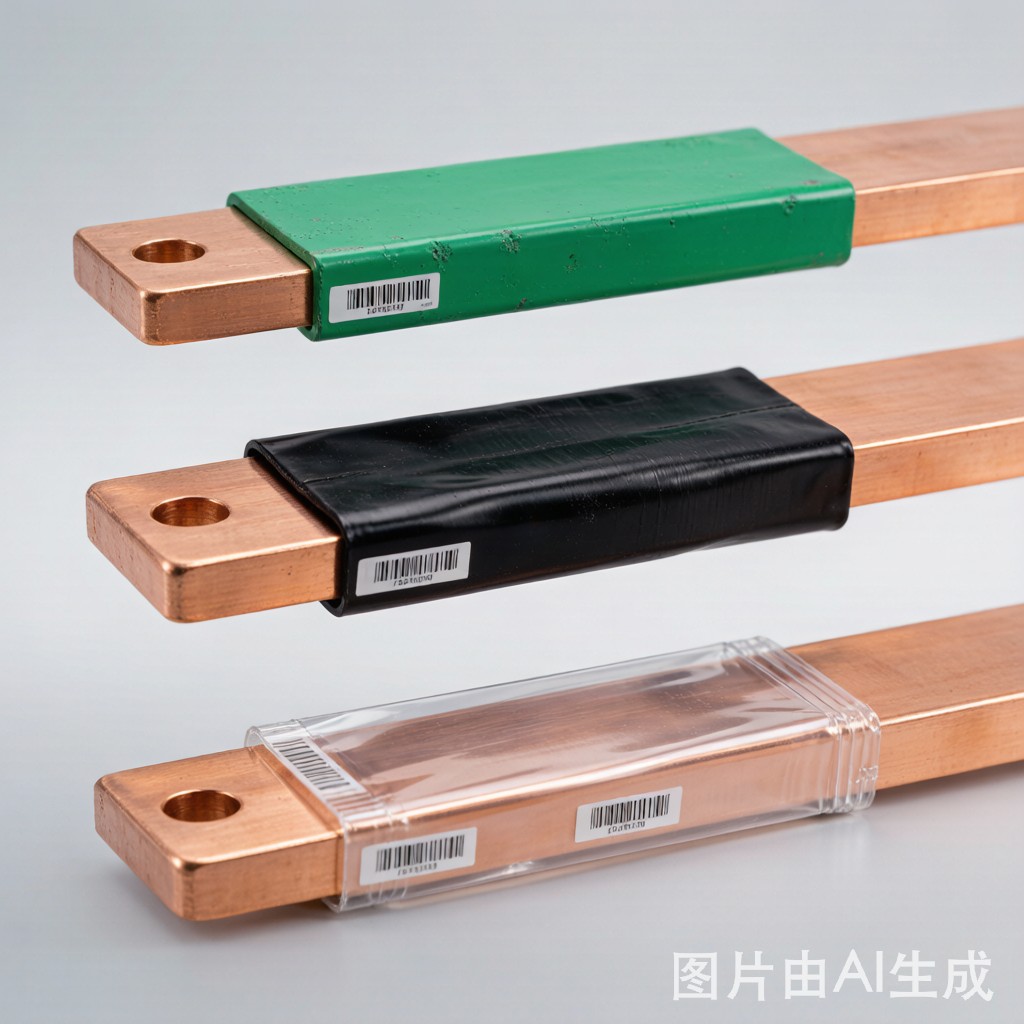
el shock risk, and corrosion from environmental exposure. Three insulation methods dominate the market: epoxy powder coating, PVC heat shrink sleeving, and polyester (Mylar) film wrapping. Each has distinct advantages in dielectric strength, thermal performance, partial discharge resistance, and installed cost — and the choice is driven by the specific electrical, thermal, and mechanical requirements of the installation.
Dielectric Strength and Electrical Performance
The primary function of bus bar insulation is to prevent dielectric breakdown between adjacent phases and between phase and ground. The dielectric strength (in kV/mm) and the total insulation thickness set the maximum operating voltage the bus bar system can withstand:
| Insulation Method | Dielectric Strength (kV/mm) | Typical Thickness | Withstand Voltage (Typical) |
|---|---|---|---|
| Epoxy powder coating | 20–35 | 0.2–0.5 mm (200–500 μm) | 4–17.5 kV |
| PVC heat shrink sleeving | 15–25 | 0.3–1.0 mm | 4.5–25 kV |
| Polyester Mylar film wrap | 150–300 | 0.025–0.25 mm (1–10 layers) | 3.75–75 kV |
Polyester Mylar film has dramatically higher dielectric strength than epoxy or PVC — 150–300 kV/mm versus 15–35 kV/mm — because it is a dense, oriented polymer film with very few microscopic defects. A single layer of 0.025 mm (1 mil) Mylar film provides approximately 3.75 kV of dielectric withstand. Multiple layers are wrapped to achieve the required voltage rating, and the inter-layer air gap provides additional insulation. However, Mylar’s high dielectric strength comes with a practical limitation: the film must be wrapped by hand or semi-automated equipment, and the quality of the wrap — consistency of overlap, tension, and layer count — directly affects the insulation performance.
PVC heat shrink sleeving provides a thick, uniform insulation layer applied by sliding the sleeve over the bus bar and applying heat to shrink it into intimate contact. The insulation thickness is consistent, and the heat-shrink process produces pinhole-free coverage (assuming quality sleeve material). The dielectric strength of PVC is adequate for low-voltage (< 1 kV) and medium-voltage (1–15 kV) applications.
Epoxy powder coating is applied electrostatically (the bus bar is grounded, and charged epoxy powder is sprayed onto the surface) and then cured at 180–220°C for 10–20 minutes. The resulting coating is a continuous, pinhole-free polymer layer with consistent thickness. However, epoxy is more brittle than PVC or Mylar at cold temperatures and can crack under mechanical stress or thermal cycling.
Thermal Performance and Temperature Class
Bus bars generate heat from I²R losses, and the insulation must withstand the operating temperature without degradation. The thermal class (per IEC 60085) defines the maximum continuous operating temperature:
| Insulation Method | Thermal Class | Max Continuous Temp | Short-Term Peak |
|---|---|---|---|
| Epoxy powder coating (standard) | Class F (155°C) | 155°C | 180°C |
| Epoxy powder coating (high-temp) | Class H (180°C) | 180°C | 200°C |
| PVC heat shrink sleeving | Class A (105°C) | 105°C | 120°C |
| Polyester Mylar film | Class B (130°C) | 130°C | 150°C |
The thermal class is a critical constraint. PVC heat shrink’s 105°C maximum limits its use to bus bars with conservative current density (typically < 1.5 A/mm² for copper in 40°C ambient). Epoxy powder coating's 155°C rating allows higher current density (2.0–2.5 A/mm²) — which translates to smaller, lighter, and lower-cost copper bus bars for the same current rating. For switchgear operating at rated current for extended periods, the higher thermal class of epoxy is a significant design advantage.
Thermal conductivity of the insulation material also affects the bus bar’s ability to dissipate heat:
- Epoxy powder coating: 0.2–0.5 W/m·K. Relatively low, but the thin coating (0.2–0.5 mm) minimizes thermal resistance.
- PVC heat shrink: 0.15–0.20 W/m·K. The thicker sleeve (0.3–1.0 mm) combined with lower thermal conductivity increases the thermal resistance more than epoxy.
- Mylar film: 0.15–0.20 W/m·K. The very thin film minimizes thermal resistance despite the low thermal conductivity.
For all three insulation methods, the thermal resistance added by the insulation is small compared to the convection and radiation thermal resistances from the bus bar surface to ambient air. The insulation typically adds 1–5°C of temperature rise, with the numerical order being Mylar < Epoxy < PVC (due to thickness effects, not material conductivity differences).
Partial Discharge Resistance
Partial discharge (PD) is the silent killer of medium-voltage bus bar insulation. PD occurs when microscopic voids, air gaps, or delaminations within the insulation experience localized dielectric breakdown at voltages below the full insulation rating. Each PD event erodes the insulation material, and over months to years of continuous operation, the cumulative damage can cause a full insulation failure.
Partial discharge resistance of the three materials:
- Epoxy powder coating: Excellent. The continuous, void-free coating produced by the electrostatic spray and thermal cure process has very few initiation sites for PD. Epoxy is the standard insulation for medium-voltage (5–15 kV) bus bars specifically because of its PD resistance.
- Polyester Mylar film: Good, but sensitive to wrap quality. Mylar film itself is highly PD-resistant, but the inter-layer air gaps in a wrapped insulation system are PD initiation sites. Mylar-wrapped bus bars for medium-voltage applications must be vacuum-impregnated with varnish or encapsulated to eliminate inter-layer voids.
- PVC heat shrink: Moderate. PVC sleeving is generally void-free when properly shrunk, but PVC is more susceptible to erosion from PD than epoxy. PVC sleeving is typically limited to low-voltage (< 1 kV) applications where PD is not a design concern.
For bus bars operating above 1 kV, partial discharge testing (per IEC 60270) is a standard quality assurance test. The PD inception voltage (PDIV) should be at least 1.2× the rated line-to-ground voltage. Epoxy-coated bus bars typically achieve PDIV of 1.5–2.0× rated voltage; Mylar-wrapped bus bars require careful process control to achieve 1.2×.
Installation and Manufacturing Considerations
The manufacturing process for each insulation method influences cost, throughput, and design flexibility:
Epoxy powder coating: The bus bar is first cleaned (degreasing, sandblasting, or acid etch to remove surface oxides), then preheated to 150–200°C. Electrostatic spray guns apply the epoxy powder, which melts and flows on contact with the hot copper. A post-cure oven cycle (10–20 minutes at 180–220°C) crosslinks the epoxy. The process is highly automated and suitable for high-volume production. However, complex bus bar geometries with deep bends, tapped holes, or threaded studs require masking before coating, which adds labor cost. Masked areas are bare copper and require alternative insulation (heat shrink caps, insulating boots).
PVC heat shrink sleeving: The sleeve is cut to length, slid over the bus bar, and heated with a hot air gun or shrink tu
el at 120–175°C. The sleeve shrinks to approximately 50% of its as-supplied diameter, conforming tightly to the bus bar surface. The process is simple, low-capital, and suitable for low to medium volumes. However, complex bus bar shapes with bends, offsets, and multiple taps are difficult to sleeve — the sleeve must be slid over the longest straight section, and bends with small radius may cause the sleeve to wrinkle or not shrink uniformly. For complex geometries, multiple sleeve sections are applied, leaving exposed copper at the joints.
Polyester Mylar film wrapping: The film is hand-wrapped or machine-wrapped around the bus bar in a spiral pattern, with 50% overlap between successive wraps. The number of layers determines the voltage rating. After wrapping, the film is secured with adhesive tape or a final layer of heat-shrink tubing. The process is labor-intensive and more difficult to automate than epoxy coating or sleeving. Mylar wrapping is well-suited to complex bus bar shapes because the flexible film conforms to bends and offsets. It is the standard insulation for custom, low-volume bus bar assemblies where the amortized tooling cost of epoxy coating is prohibitive.
Cost Comparison
| Insulation Method | Material Cost (USD/m²) | Capital Equipment | Labor Content | Best Volume Range |
|---|---|---|---|---|
| Epoxy powder coating | $3–8 | $50,000–$200,000 (spray + oven line) | Low (automated) | High volume (> 1,000 units/month) |
| PVC heat shrink sleeving | $5–15 | $500–$5,000 (heat gun or tu
el) |
Medium | Low to medium volume |
| Polyester Mylar film wrap | $2–6 (film only) | $1,000–$10,000 (wrapping machine) | High (hand wrapping) | Low volume, custom designs |
For high-volume bus bar production (e.g., standard switchgear bus bars manufactured in quantities of 1,000+ per month), epoxy powder coating has the lowest total cost despite the higher capital investment, because the labor content is minimal and the material cost is moderate. For medium-volume or custom bus bars (100–500 units/month), PVC heat shrink sleeving offers the best balance of capital, labor, and material cost. For one-off or prototype bus bars, Mylar film wrapping is the most cost-effective because it requires no tooling or dedicated equipment.
Application Selection Guide
Choose epoxy powder coating when:
- Medium-voltage operation (1–15 kV) where partial discharge resistance is required.
- High continuous operating temperature (> 105°C) is needed.
- High-volume production amortizes the capital investment in coating equipment.
- Complex bus bar shapes can be masked cost-effectively.
Choose PVC heat shrink sleeving when:
- Low-voltage operation (< 1 kV) is the design requirement.
- Simple, straight bus bar geometries with few bends or taps.
- Medium production volumes (100–1,000 units/month).
- Quick turnaround and low capital investment are priorities.
Choose polyester Mylar film wrapping when:
- Custom or low-volume bus bar assemblies where tooling costs must be avoided.
- Complex bus bar shapes with bends, offsets, and multiple taps.
- Very high dielectric strength per unit thickness is needed (high-voltage, space-constrained designs).
- Field-applied insulation is required (retrofit or repair applications).
For Southeast Asian switchgear and power distribution manufacturers, epoxy powder coating has become the standard for medium-voltage bus bars as regional electrical infrastructure upgrades drive demand for higher-reliability insulation. PVC sleeving remains dominant in the low-voltage panel board market where its lower cost and simpler processing align with the price-sensitive nature of commercial and residential electrical distribution products. The choice between these three methods is fundamentally a systems engineering decision — balancing dielectric performance, thermal management, partial discharge resistance, manufacturing economics, and the specific requirements of the installation environment.