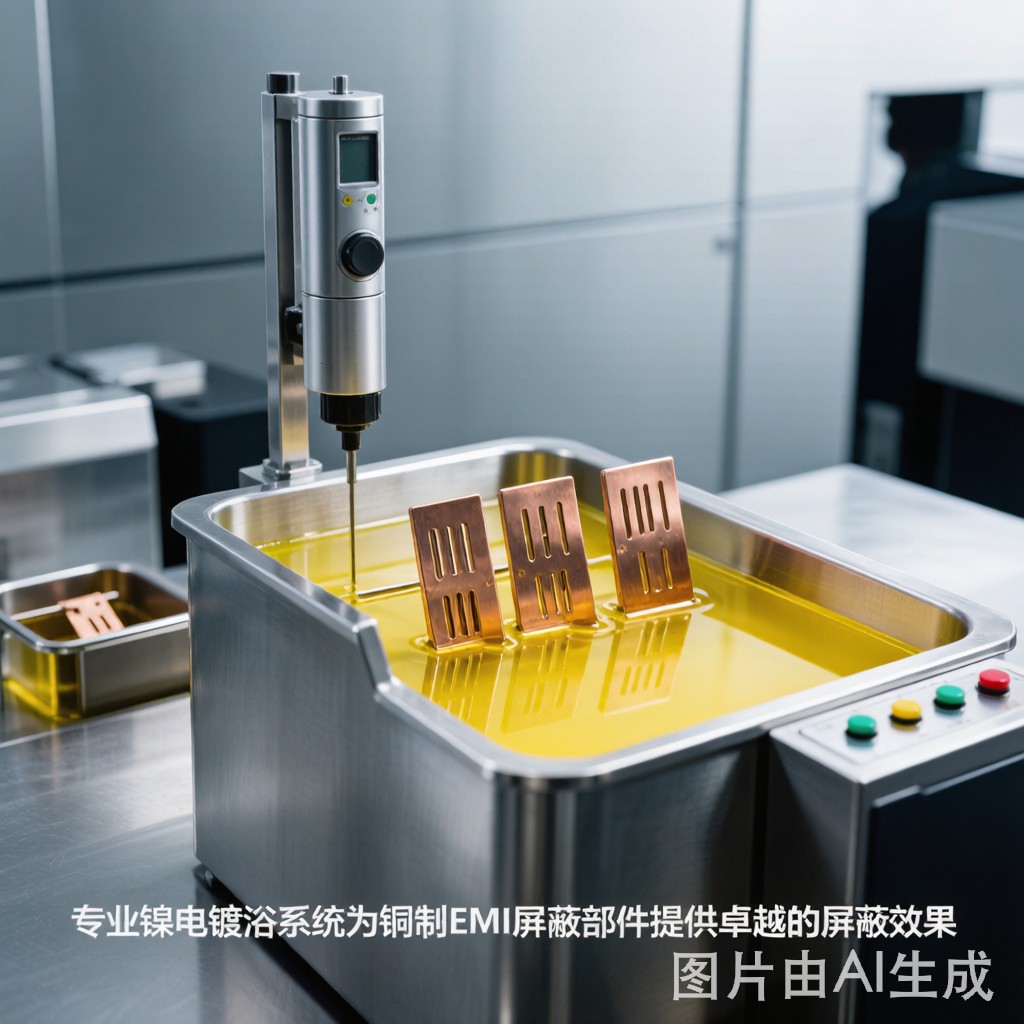
Nickel electroplating on copper substrates is the foundational surface finish for EMI shielding components: shield cans, spring fingerstock gaskets, co
ector shells, and RF enclosure walls. The nickel layer provides corrosion resistance, wear durability, and a solderable or wire-bondable surface. But the choice of nickel plating chemistry — specifically, nickel sulfamate versus Watts nickel (nickel sulfate) — fundamentally changes the mechanical properties, deposit stress, throwing power, and ultimately the reliability of the plated EMI shielding part.
The Two Dominant Nickel Plating Chemistries
Both sulfamate and Watts baths are acidic nickel electroplating solutions operating at pH 3.5–4.5 and temperature 45–60°C. The difference is in the nickel salt used as the primary source of nickel ions:
Watts nickel bath (developed by Oliver P. Watts, 1916): Nickel sulfate hexahydrate (NiSO₄·6H₂O) is the primary nickel source, typically 240–330 g/L. Nickel chloride (NiCl₂·6H₂O) is added at 30–60 g/L as a secondary nickel source and anode activator. Boric acid (H₃BO₃) at 30–45 g/L serves as a pH buffer.
Nickel sulfamate bath: Nickel sulfamate (Ni(NH₂SO₃)₂·4H₂O) is the primary nickel source, typically 300–450 g/L. Nickel chloride or nickel bromide is added at 0–15 g/L (much lower than Watts). Boric acid at 30–45 g/L. The sulfamate anion (NH₂SO₃⁻) produces dramatically lower internal stress in the deposit than the sulfate-chloride system.
| Parameter | Watts Nickel | Nickel Sulfamate |
|---|---|---|
| Primary nickel salt | NiSO₄·6H₂O (240–330 g/L) | Ni(NH₂SO₃)₂·4H₂O (300–450 g/L) |
| Chloride content | 30–60 g/L NiCl₂·6H₂O | 0–15 g/L NiCl₂ or NiBr₂ |
| Nickel metal concentration | 60–80 g/L | 60–100 g/L |
| Operating temperature | 50–60°C | 45–55°C |
| pH range | 3.5–4.5 | 3.5–4.5 |
| Cathode current density | 2–5 A/dm² | 2–10 A/dm² |
| Deposition rate at 5 A/dm² | ~1.0 μm/min | ~1.1 μm/min |
| Internal stress (as-plated) | 120–250 MPa tensile | 3–50 MPa tensile (or compressive) |
| Hardness (Vickers, as-plated) | 150–250 HV | 200–400 HV |
Internal Stress: The Critical Difference
For EMI shielding components — especially thin, formed spring contacts and fingerstock gaskets — internal stress in the nickel deposit is the most important performance parameter. Internal stress arises from the co-deposition of hydrogen, organic additives, and hydroxide species during nickel electrodeposition. Tensile stress causes the deposit to contract relative to the copper substrate, producing:
- Plating blistering and peeling: The nickel layer delaminates from the copper substrate under tensile stress. Common on sharp corners, edges, and formed features where stress concentrates.
- Spring force degradation: Tensile stress in the nickel layer counteracts the spring force of the copper substrate, reducing contact pressure in EMI fingerstock by 10–40% after aging.
- Fatigue cracking: Under repeated compression cycles (insertion/removal of EMI gaskets), high-stress nickel deposits develop microcracks that propagate into the copper substrate and cause premature fatigue failure.
Watts nickel deposits typically exhibit tensile stress of 120–250 MPa as-plated, which can increase to 300+ MPa with certain brightener packages. Nickel sulfamate deposits, by comparison, exhibit 3–50 MPa tensile stress — and can be formulated to produce compressive stress (negative values) with the addition of stress-reducing agents like saccharin (1–3 g/L). Compressive stress is actually beneficial for fatigue resistance: it acts as a pre-load that must be overcome before crack initiation can occur.
For EMI fingerstock and spring contacts subjected to > 100,000 compression cycles, nickel sulfamate is the standard choice. Watts nickel is reserved for non-spring applications — shield cans, enclosure walls, and cosmetic surfaces where internal stress does not affect functional performance.
Throwing Power and Plating Uniformity
Throwing power — the ability of the plating bath to deposit a uniform thickness of nickel across a complex shape — is critical for EMI shielding components with deep-drawn features, narrow slots, and internal corners. Poor throwing power produces thin nickel at recessed areas (inadequate corrosion protection) and thick nickel at high-current-density edges (brittleness, stress cracking).
Watts nickel has moderate throwing power. The high chloride content improves conductivity but reduces the polarization that drives uniform deposition. Nickel sulfamate has somewhat better throwing power due to the lower chloride content and higher nickel metal concentration, but both chemistries benefit from:
- Auxiliary anodes: Internal anodes placed inside deep features to equalize the current distribution.
- Pulse plating: Alternating periods of high current density (deposition) and low/zero current density (relaxation) improves nickel distribution in recessed areas by allowing the nickel ion concentration to recover at the cathode surface.
- Solution agitation: Air agitation, eductor flow, or cathode bar movement to maintain uniform nickel ion concentration at all part surfaces.
For complex EMI shield can geometries with aspect ratios (depth/width) > 3:1, neither Watts nor sulfamate alone provides adequate throwing power — pulse plating or auxiliary anodes are required regardless of bath chemistry.
Plating Rate and Production Throughput
Nickel sulfamate supports higher cathode current density than Watts nickel — up to 10 A/dm² versus 5 A/dm² — because the sulfamate anion does not decompose at the anode to produce oxidizing species that degrade the deposit. This translates to a deposition rate advantage of approximately 2× for sulfamate (2.2 μm/min at 10 A/dm² vs 1.0 μm/min at 5 A/dm² for Watts).
For a typical EMI shielding component requiring 5 μm of nickel, sulfamate plates at approximately 2.3 minutes per part versus 5 minutes for Watts. In high-volume production (100,000+ parts per day), this difference translates to reduced plating line footprint, lower capital cost, and higher throughput. The trade-off is the higher cost of nickel sulfamate chemistry: $8–12/kg for sulfamate concentrate versus $3–5/kg for nickel sulfate.
Brightener Chemistry and Deposit Appearance
Both Watts and sulfamate baths can be operated with organic brighteners to produce a bright, reflective finish desirable for visible EMI shielding surfaces. The brightener package is typically proprietary (supplied by the plating chemical vendor) but generally includes:
- Class I brighteners (carriers): Saccharin, benzene sulfonamides, or naphthalene sulfonates. Reduce grain size and produce a semi-bright to bright deposit.
- Class II brighteners (levelers): Butynediol, coumarin, or proprietary acetylenic compounds. Produce a mirror-bright finish by preferentially adsorbing on high-current-density areas and leveling the deposit.
- Wetting agents: Sodium lauryl sulfate or proprietary surfactants that reduce surface tension and prevent hydrogen gas bubble pitting.
Important caution for EMI applications: Organic brighteners co-deposit with the nickel and increase deposit hardness, internal stress, and electrical resistivity. For EMI shielding components where the nickel layer carries surface currents (skin effect at RF frequencies), brightener content increases the surface resistivity of the nickel, reducing shielding effectiveness at frequencies above 1 GHz. For these applications, a semi-bright sulfamate nickel (no brightener, or saccharin-only) provides the optimal balance of corrosion resistance, stress control, and electrical conductivity.
Application Selection Guide
Choose Watts nickel when:
- The component is a simple shield can, enclosure, or cosmetic part with no spring function.
- Internal stress and fatigue performance are not critical.
- Cost per liter of plating solution is the dominant factor.
- Compatibility with existing legacy Watts nickel lines is required.
Choose nickel sulfamate when:
- The component is a spring contact, fingerstock gasket, or any part that undergoes repeated mechanical cycling.
- Low internal stress (< 50 MPa) is required to prevent blistering, peeling, or spring force degradation.
- High plating rate and throughput are important.
- Compressive stress (via saccharin addition) is desired for fatigue enhancement.
- High-frequency EMI performance demands low-resistivity nickel with minimal organic co-deposition.
For the Southeast Asian EMI shielding component market, nickel sulfamate has become the dominant bath chemistry for high-performance applications — particularly spring contacts, fingerstock gaskets, and automotive-grade EMI shielding where reliability requirements (AEC-Q200, USCAR-2) mandate stress-controlled plating. Watts nickel retains significant market share in cost-sensitive consumer electronics shield cans where the nickel layer is primarily cosmetic with a secondary corrosion-protection function.