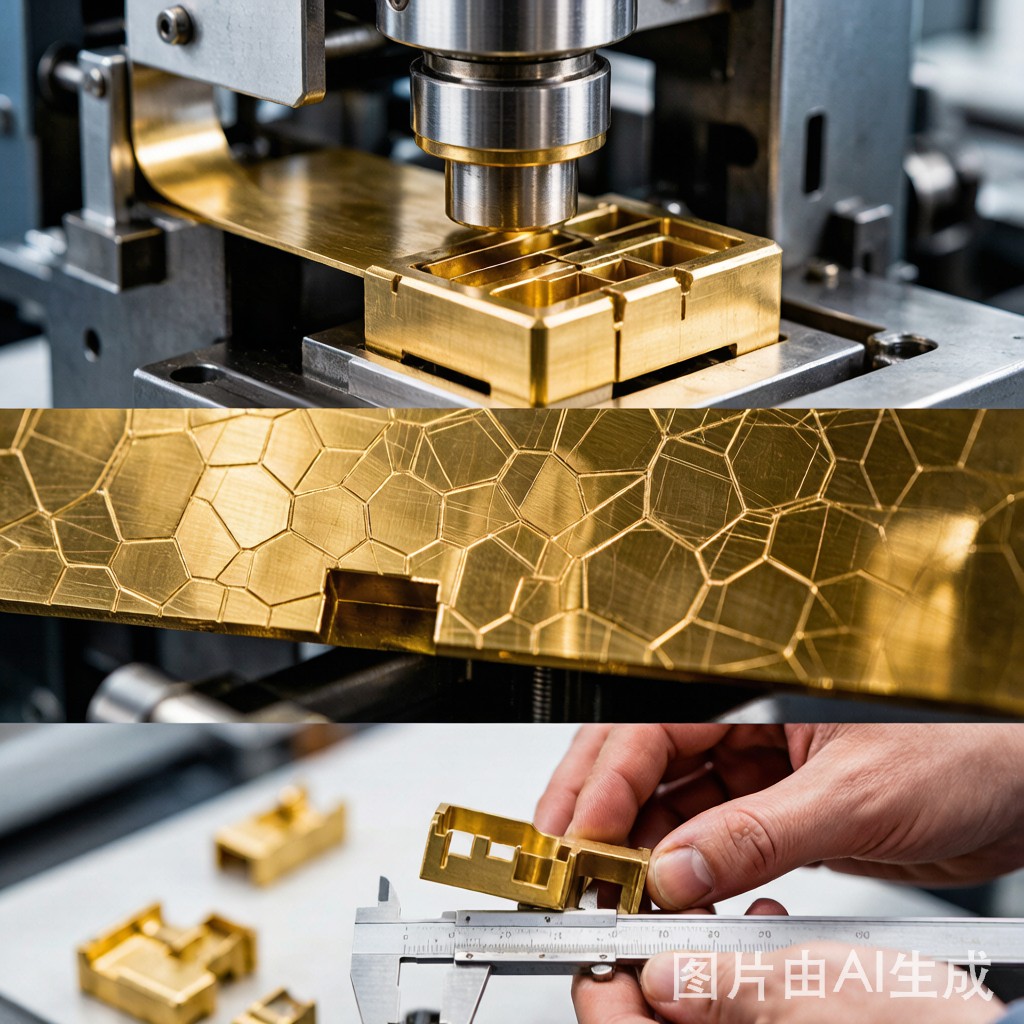
The relationship between brass strip microstructure and stamping performance is one of the most underappreciated variables in electronic co
ector manufacturing. A brass strip with grain size ASTM 8 (average grain diameter 22 μm) will stamp 2–3 million parts before tool refurbishment; the same alloy with grain size ASTM 5 (64 μm) may produce only 1.0–1.5 million parts — with worse surface finish throughout the run. Grain size control in brass strip is a metallurgical lever that directly affects progressive die stamping economics: tool life, burr height, surface finish, and scrap rate.
Grain Size Fundamentals for Brass Strip
Grain size in brass strip is the result of the a
ealing process. After cold rolling to final thickness, the brass strip passes through a continuous a
ealing furnace where it is heated to 400–650°C (depending on alloy), held for 10–60 seconds, and quenched. During a
ealing, the cold-worked, elongated grains recrystallize into new, equiaxed grains. The final grain size depends on:
- A
ealing temperature
: Higher temperature produces larger grains. The relationship is exponential — a 50°C increase can double the grain diameter. - A
ealing time
: Longer time at temperature allows grain growth. In continuous aealing lines, the strip speed and furnace zone lengths determine the effective a
ealing time.
- Prior cold work: Heavier cold reduction (higher percentage of thickness reduction before a
ealing) produces finer recrystallized grains because more nucleation sites are available.
- Alloy composition: C2680 (yellow brass, 65% Cu) recrystallizes to finer grain sizes than C2600 (cartridge brass, 70% Cu) at the same a
ealing conditions, due to the higher zinc content providing more grain boundary pi
ing.
Grain size is measured per ASTM E112 using the intercept method or the comparison chart method. Standard grain sizes for electronic-grade brass strip range from ASTM 6 to ASTM 9:
| ASTM Grain Size | Avg Grain Diameter | Grains/mm² | Typical Application |
|---|---|---|---|
| ASTM 5 | 64 μm | 250 | Deep-drawn enclosures, cosmetic surfaces |
| ASTM 6 | 45 μm | 500 | General-purpose stamped co
ectors |
| ASTM 7 | 32 μm | 1,000 | Fine-pitch lead frames, precision terminals |
| ASTM 8 | 22 μm | 2,000 | High-reliability SMT lead frames, micro-co
ectors |
| ASTM 9 | 16 μm | 4,000 | Ultra-fine-pitch (< 0.3 mm) semiconductor lead frames |
Grain Size and Tool Wear
Tool wear in brass stamping is dominated by two mechanisms: abrasive wear and adhesive wear. Grain size affects both.
Abrasive wear: As the brass strip slides across the die surface under high contact pressure (500–1,500 MPa at the cutting edge), the strip surface acts as a lap. Larger grains produce a rougher strip surface (higher Ra) that accelerates die wear. The wear rate scales approximately with Ra^1.5 — doubling the surface roughness increases die wear by 2.8×. An ASTM 5 grain strip typically has Ra 0.15–0.25 μm after skin-pass rolling; ASTM 8 grain strip achieves Ra 0.05–0.12 μm at the same skin-pass reduction.
Adhesive wear: Under the extreme contact pressure at the cutting edge, localized welding between the brass strip and the tool steel (typically D2, M2, or carbide) can occur. When the strip separates from the tool, microscopic brass particles weld to the tool surface and build up over successive stamping cycles. This galling effect is accelerated by larger grain sizes because the larger, softer grains deform plastically under lower contact pressure, increasing the real area of contact between the strip and tool. An ASTM 5 grain strip may gall a D2 tool within 500,000 strokes; ASTM 8 grain strip with the same tool typically reaches 1.5–2.0 million strokes before galling initiates.
Burr Formation and Grain Size
Burr height — the raised edge of brass material that forms at the cut surface during stamping — is the most common stamping defect and the primary reason for tool sharpening. Burr height increases with stamping cycle count as the punch and die edges wear, but the starting burr height and the rate of burr growth are both influenced by grain size.
A fine-grained strip (ASTM 7–8) produces lower initial burr height because the fracture path during shearing propagates through many small grain boundaries rather than following a single large grain boundary. Large grains (ASTM 5) provide long, uninterrupted shear paths that produce taller, more irregular burrs.
Typical burr height specifications for electronic co
ectors:
| Application | Max Burr Height | Recommended Grain Size |
|---|---|---|
| Consumer co
ector terminals |
0.05 mm | ASTM 6–7 |
| Automotive co
ector terminals |
0.03 mm | ASTM 7–8 |
| SMT lead frame leads | 0.02 mm | ASTM 8 |
| Fine-pitch QFN lead frames (0.4 mm pitch) | 0.01 mm | ASTM 8–9 |
For SMT lead frame applications, burrs exceeding 0.02 mm can cause co-planarity failures — the lead does not sit flat on the PCB pad, creating an open or insufficient solder joint. Fine grain size is mandatory for these applications; it is not a cost optimization but a functional requirement.
Surface Finish and Cosmetic Quality
The surface finish of the stamped part — visible on co
ector shells, EMI shield can exteriors, and consumer-visible surfaces — is directly influenced by grain size. During stamping, the brass surface undergoes plastic deformation as it flows into the die cavity. Large grains produce orange peel surface texture — a characteristic rough, dimpled appearance caused by individual large grains deforming independently rather than uniformly. Orange peel is visible to the naked eye when grain size exceeds approximately 40 μm (ASTM 6).
For visible surfaces on electronic products, orange peel is a cosmetic defect that triggers rejection. Fine-grained brass (ASTM 7 and finer) eliminates orange peel by ensuring that the surface deformation is distributed across many small grains, producing a smooth, uniform appearance even after significant forming strains.
Surface roughness after stamping (without subsequent polishing):
- ASTM 5–6 grain: Ra 0.4–0.8 μm with visible orange peel on formed surfaces.
- ASTM 7 grain: Ra 0.2–0.4 μm, minimal orange peel.
- ASTM 8–9 grain: Ra 0.1–0.2 μm, no visible orange peel.
A
ealing Process Control
Producing consistent grain size across an entire coil of brass strip requires precise control of the continuous a
ealing process:
- Furnace temperature uniformity: ±5°C across the strip width and along the furnace length. A 10°C temperature variation across the strip width can produce a 1–2 point variation in ASTM grain size from the center to the edge — causing inconsistent stamping performance across the coil width.
- Strip speed consistency: ±2% of setpoint. Speed variations change the effective a
ealing time and directly affect grain size.
- Quench rate: After a
ealing, the strip must be quenched rapidly (typically water quench, cooling rate > 100°C/s) to freeze the grain structure and prevent grain growth during cooling. Slow cooling allows grain growth that produces mixed grain sizes — some large, some small — which is worse for stamping than uniformly large grains.
- Atmosphere control: The a
ealing furnace operates under a reducing atmosphere (typically N₂ + 5–10% H₂, dew point < -20°C) to prevent oxidation of the brass surface during a
ealing. Dew point excursions cause surface oxidation that obscures grain boundaries and can produce a brittle surface layer.
Grain Size Specification for Procurement
When specifying brass strip for stamping, the grain size requirement must be explicit on the purchase order. A complete specification includes:
- ASTM grain size number: G = 7–8 (typical for SMT lead frames). Use the average grain size, not the range, because mixed grain sizes are worse than uniformly larger grains.
- Measurement method: ASTM E112, intercept method or comparison method. The intercept method is preferred for quantitative results.
- Sampling frequency: Minimum one sample per coil (head and tail). For high-reliability applications, one sample every 500 kg of strip.
- Acceptance criteria: Average G within specification range, and no single field with G outside the range by more than 1 point.
- Grain size uniformity: Variation of less than 1 ASTM point across the coil width and from head to tail of the coil.
For Southeast Asian electronic co
ector and lead frame manufacturers, specifying and verifying brass strip grain size is a low-cost, high-impact quality control practice. The incremental cost of fine-grained brass (ASTM 8 vs ASTM 6) is typically 3–8% of the strip price — approximately $0.15–$0.40 per kilogram for C2680/C2600 strip at 2026 Southeast Asian market prices. The return on this investment comes from 50–100% longer tool life, lower scrap rates, fewer burr-related defects, and the ability to quote on higher-specification contracts requiring fine-pitch lead frame quality.