The electronics manufacturing industry generates approximately 50 million to
es of plastic waste a
ually, with SMT co
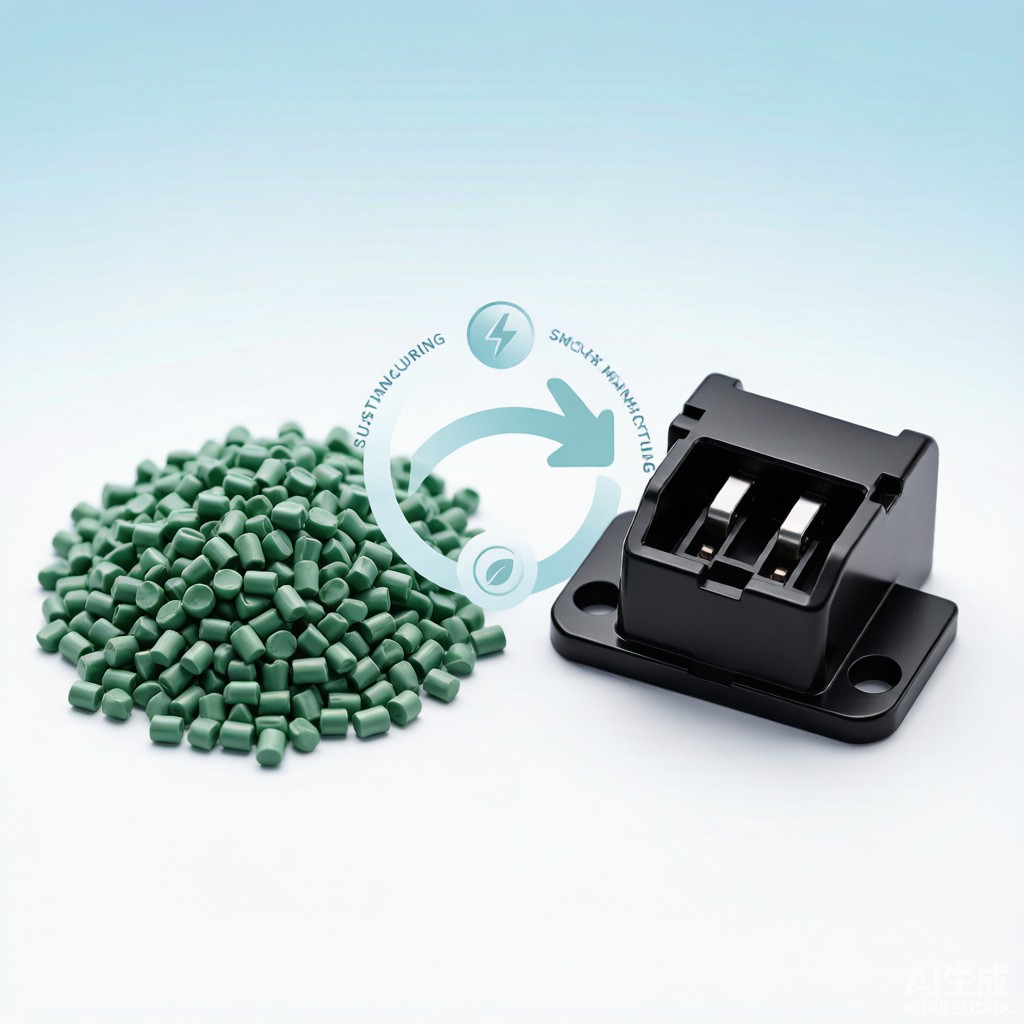
ector housings, chip carriers, and transport trays representing a significant fraction. Recycled polycarbonate (rPC) modified plastic pellets offer a pathway to circular economy compliance without sacrificing the mechanical, thermal, and flammability performance that SMT applications demand. However, integrating rPC into SMT co
ector housing production requires careful engineering to address polymer degradation, additive depletion, contaminant management, and regulatory certification. This article examines the technical considerations for rPC modified plastic pellets in sustainable SMT co
ector housing manufacturing.
Recycled Polycarbonate Feedstock Classification
Post-Consumer Recycled (PCR) PC
Post-consumer recycled polycarbonate is recovered from end-of-life electronics (WEEE directive), automotive components (headlamp lenses, interior trim), and consumer products (water bottles, eyewear). PCR PC undergoes shredding, washing, metal/contaminant separation (eddy current, density separation, electrostatic), and re-pelletization. Key quality challenges include:
- Polymer chain scission: Each thermal reprocessing cycle reduces weight-average molecular weight (Mw) by 8-15%. Virgin PC at Mw 30,000-35,000 g/mol typically degrades to 25,000-30,000 after a single PCR cycle, reducing impact strength by 10-20%.
- Contamination: Mixed plastic streams introduce ABS, PMMA, PET, and polyamide contaminants at 0.5-5% levels, each causing distinct processing defects (ABS causes silver streaks, PET causes gel particles, PA causes discoloration).
- Additive depletion: UV stabilizers, antioxidants, and release agents are consumed during the product’s first life and thermal reprocessing. Must be re-formulated during rPC pellet manufacturing.
Post-Industrial Recycled (PIR) PC
Post-industrial recycled PC is recovered from manufacturing scrap: ru
er systems, reject parts, edge trim, and purge compound. PIR PC offers superior quality to PCR because the feedstock is single-grade, uncontaminated, and has known thermal history. PIR PC typically loses only 3-5% Mw per reprocessing cycle. For SMT co
ector housings requiring tight dimensional tolerances and consistent color, PIR PC at 25-50% content is the practical maximum while maintaining performance parity with virgin material.
Mechanical Property Retention
Tensile and Flexural Properties
Virgin PC (Makrolon 2858 reference) exhibits tensile strength of 65 MPa and flexural modulus of 2.4 GPa. Blending with recycled content produces predictable degradation:
| rPC Content | Mw (g/mol) | Tensile Strength (MPa) | Flexural Modulus (GPa) | Izod Impact (J/m) |
|---|---|---|---|---|
| 0% (Virgin) | 32,000 | 65 | 2.40 | 850 |
| 25% PCR | 29,000 | 62 | 2.35 | 720 |
| 50% PCR | 27,000 | 58 | 2.28 | 580 |
| 100% PCR | 24,000 | 52 | 2.15 | 380 |
| 25% PIR | 31,000 | 64 | 2.38 | 800 |
| 50% PIR | 30,000 | 62 | 2.35 | 720 |
Izod Impact Sensitivity
Izod notched impact strength is the most sensitive indicator of rPC degradation because the notch tip concentrates stress at the molecular level. The 55% retention at 100% PCR (380 vs 850 J/m) falls below the 500 J/m threshold acceptable for SMT co
ector housings subject to drop testing (JEDEC JESD22-B111). At 50% PCR content, impact retention of 68% (580 J/m) is marginal for high-reliability applications but acceptable for consumer-grade co
ectors. PIR at 50% content maintains 85% retention (720 J/m), making it the preferred feedstock for applications requiring drop test compliance.
Yellowing Index (YI) Control
Photo-Oxidative Degradation
Polycarbonate yellows through photo-oxidative degradation of the bisphenol-A linkage, producing quinone methide chromophores. Recycled PC has accumulated degradation products from its first life, resulting in baseline YI of 3-8 (versus virgin PC YI of 0.5-1.5 per ASTM D1925). After 500 hours of xenon arc exposure (SAE J2527), rPC YI increases to 12-20, producing visible discoloration in light-colored co
ector housings.
Stabilization Package
Effective YI control in rPC requires a multi-component stabilization package added during re-pelletization:
- UV absorber (UVA): Benzotriazole (Tinuvin 360) at 0.3-0.5 wt%. Absorbs 280-350 nm UV, preventing chain scission initiation.
- Hindered amine light stabilizer (HALS): Tinuvin 770 at 0.2-0.3 wt%. Scavenges free radicals generated during photo-oxidation, providing long-term stabilization.
- Antioxidant: Irganox 1010 (hindered phenol) at 0.1-0.2 wt%. Prevents thermal oxidation during injection molding at 280-320°C.
- Optical brightener: Tinopal OB at 50-100 ppm. Masks baseline yellowing by absorbing 360 nm UV and emitting 430 nm blue fluorescence.
With the full stabilization package, 50% PIR rPC achieves YI <3.0 after 500 hours xenon arc, comparable to virgin PC performance. PCR rPC at 50% content achieves YI <4.5, acceptable for dark-colored housings but requiring optical brightener for light colors.
UL94 Flame Retardant Retention
Brominated FR Depletion
Many legacy PC formulations use brominated flame retardants (BFRs) such as tetrabromobisphenol-A (TBBPA) at 8-12 wt%. During recycling, BFRs partially degrade into brominated dioxins and furans at temperatures above 250°C, creating both regulatory (RoHS exemption compliance) and health concerns. Modern rPC for electronics uses halogen-free phosphorus-based FR systems:
- Aluminum diethylphosphinate (ADEP): Exolit OP 1230 at 12-15 wt%. Achieves UL94 V-0 at 0.8 mm with limited impact on mechanical properties.
- Resorcinol bis(diphenyl phosphate) (RDP): Fyrolflex RDP at 10-14 wt%. Effective in PC/ABS blends common in co
ector housings.
Halogen-free rPC pellets must be re-formulated with fresh FR additive during re-pelletization, as the original FR may have been consumed, degraded, or volatilized during the first product life. Cost of FR re-formulation: $0.80-1.50 per kg of rPC pellets, representing 15-25% of total pellet cost.
Reprocessing Stability and Melt Flow
Melt Flow Index (MFI) Drift
Reprocessing cycles affect melt viscosity. Virgin PC at MFI 10 g/10min (300°C/1.2 kg) may shift to 14-18 g/10min after recycling due to chain scission, producing lower-viscosity melt that flashes into parting lines and generates flash defects in tight-tolerance SMT co
ector molds. Re-pelletization must include chain extender additives (e.g., Joncryl ADR 4368, a multi-functional epoxy styrene-acrylic oligomer) at 0.3-0.8 wt% to rebuild molecular weight and restore MFI to 10-12 g/10min target.
Thermal Stability During Injection Molding
rPC exhibits reduced thermal stability during processing, with onset of decomposition (5% weight loss per TGA) at 430°C for virgin PC versus 395-410°C for 50% PCR rPC. This narrows the processing window by 20-35°C. Recommended processing parameters for 50% PIR rPC SMT co
ector housings: barrel temperature 280-305°C (versus 295-320°C for virgin), mold temperature 80-100°C, injection pressure 80-120 MPa, with 2-3 second hold time.
Circular Economy Certification
UL 2809 Recycled Content Validation
UL 2809 certification validates recycled content claims through chain-of-custody documentation and material testing. The standard distinguishes:
- Category A (Post-Consumer): Requires full traceability from consumer collection through to final product, with mass balance accounting at each processing step.
- Category B (Post-Industrial): Requires documentation of manufacturing origin and verification that scrap was not deliberately generated to create recyclate.
For SMT co
ector housings marketed with sustainability claims, UL 2809 certification at 25-50% recycled content provides third-party verification accepted by major OEM procurement specifications (Dell, HP, Apple Supplier Responsibility standards). Certification cost: $5,000-15,000 per product family, valid for 5 years with a
ual surveillance audits.
EPEAT and TCO Certified Compliance
EPEAT (Electronic Product Environmental Assessment Tool) and TCO Certified standards increasingly require recycled plastic content in electronics products. EPEAT 2021 criteria specify minimum 5% post-consumer recycled plastic in plastic-intensive product categories, increasing to 15-25% by 2026. rPC modified pellets at 50% PIR content enable SMT co
ector housing manufacturers to contribute 10-15 percentage points toward these targets, positioning their products as preferred components in EPEAT-registered electronic assemblies.