Introduction: An Invisible Defect in High-Reliability Copper Lead Frames
Hydrogen embrittlement in copper strip is a subtler and more damaging failure mode than the stress corrosion cracking and oxidation issues that dominate copper-strip manufacturing discussions. In bell-type and continuous strip a
ealing furnaces used to soften work-hardened copper strip for SMT lead frame applications, hydrogen can be absorbed into the copper matrix when the furnace atmosphere contains excessive hydrogen or has an improper dew point. The result: a copper strip that passes hardness testing, eddy-current crack detection, and visual inspection at the factory, yet fractures intergranularly during subsequent stamping, bending, or in-field thermal cycling.
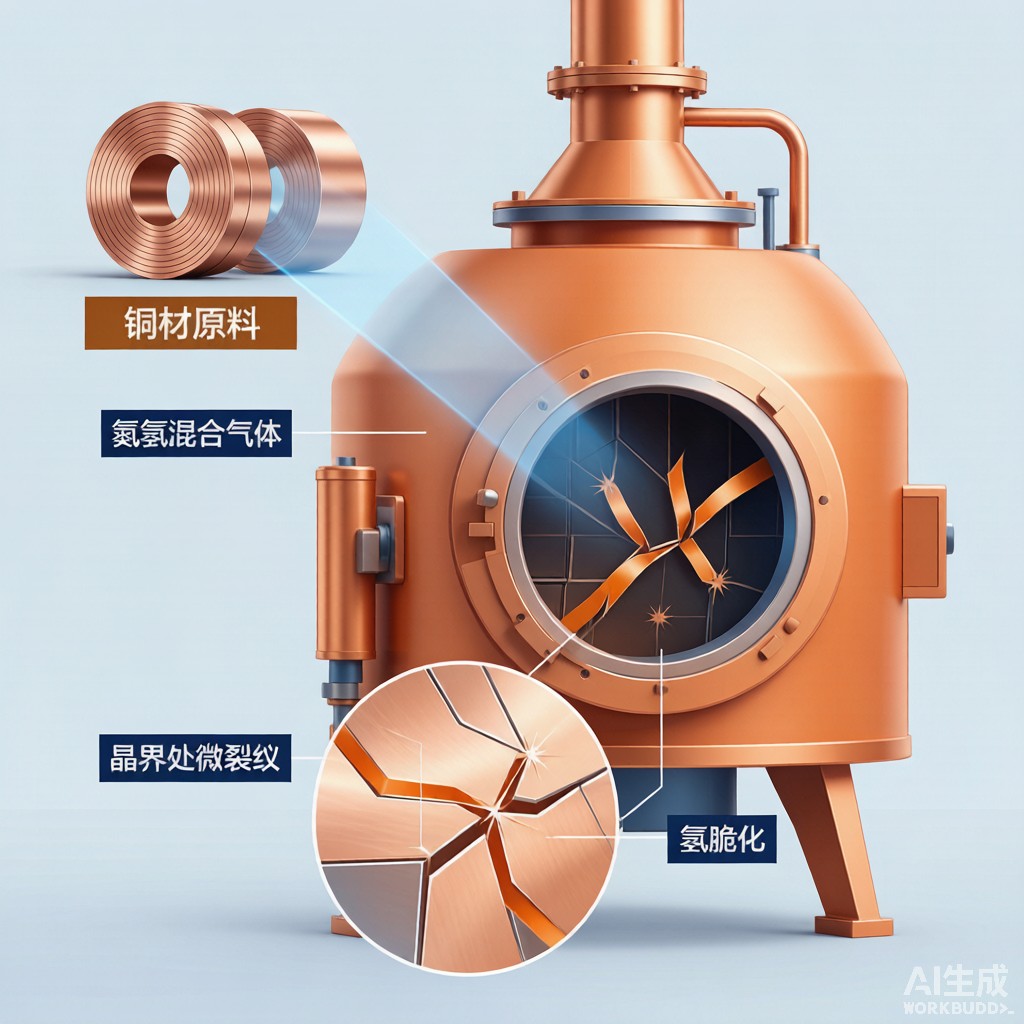
Unlike surface defects, hydrogen embrittlement creates subsurface damage that can persist through downstream processing. Once absorbed, hydrogen preferentially segregates to grain boundaries, voids, and inclusions, reducing cohesive strength and producing brittle fracture behavior even at modest strains. For SMT lead frame applications in automotive, industrial, and power electronics where reliability margins are narrow, controlling a
ealing atmosphere chemistry is as critical as controlling temperature and time.
Mechanism of Hydrogen Embrittlement in Copper Alloys
Hydrogen Absorption and Transport
Copper does not form a stable hydride under normal processing conditions, but it readily absorbs atomic hydrogen from the surrounding atmosphere, particularly at elevated temperatures. The hydrogen absorption rate follows a Sieverts-type law at low partial pressures and shifts to a linear dependence at higher partial pressures typical of industrial a
ealing atmospheres. At 600-700°C a
ealing temperatures, hydrogen solubility in copper reaches 5-10 ppm by weight — sufficient to alter mechanical behavior significantly.
Once absorbed, hydrogen migrates through the copper lattice via interstitial diffusion. The diffusion coefficient of hydrogen in copper at 600°C is approximately 5×10⁻⁶ cm²/s, meaning that a 1.5 mm thick copper strip a
ealed at 600°C for 60 minutes allows hydrogen to penetrate throughout the entire cross-section. The hydrogen then becomes trapped at microstructural defects — grain boundaries, a
ealing twins, oxide inclusions, microvoids — where its concentration can locally exceed 100 ppm.
Cuprous Oxide Film Rupture and Steam Embrittlement
The most damaging form of hydrogen embrittlement in copper strip a
ealed under reducing atmospheres is steam embrittlement, also known as the “hydrogen disease.” When hydrogen diffuses into copper containing dispersed cuprous oxide (Cu₂O) inclusions — present in electrolytic tough pitch (ETP, C11000) copper at typical concentrations of 100-500 ppm oxygen — it reacts with the oxide at elevated temperatures:
Cu₂O + H₂ → 2 Cu + H₂O (steam)
The water vapor generated by this reaction creates internal pressure at the original oxide inclusion sites, rupturing the copper matrix along grain boundaries. The steam condenses during cooling, leaving voids and brittle interfaces that fail under tensile or bending stress. This mechanism is particularly severe for ETP copper (C11000) compared to oxygen-free copper (C10100, OFHC) because ETP contains the distributed Cu₂O that drives the reaction.
Ductility Loss Measurement
The mechanical signature of hydrogen embrittlement is reduced ductility without corresponding change in hardness or yield strength. The most sensitive tests:
| Test Method | Standard | Hydrogen-Free Baseline | Hydrogen-Embrittled Reading | Detection Capability |
|---|---|---|---|---|
| Reverse Bend Test (RBT) | ASTM B577 | 10-15 bends to fracture | 2-5 bends to fracture | Surface + subsurface H |
| Erichsen Cup Test (IE) | ISO 20482 | 10.5-12.5 mm cup depth | 5-7 mm cup depth | Through-thickness H effect |
| Elongation at Fracture | ASTM E8 | 35-45% (a
ealed copper) |
10-20% | Bulk embrittlement |
| Slow Strain Rate Test | ASTM E1294 | Standard reduction-in-area | 30-60% reduction in RA | Cracking threshold detection |
A reverse bend test result that drops below 5 bends to fracture is a strong indicator of severe hydrogen pickup. Routine production QC should include RBT testing on at least one coil per furnace batch, with results tracked as a process capability metric.
Sources of Hydrogen in A
ealing Atmospheres
Reducing Atmospheres in Industrial Furnaces
Bell-type and continuous a
ealing furnaces for copper strip typically use one of three protective atmospheres:
| Atmosphere Type | Composition | H₂ Content | Dew Point | H Embrittlement Risk |
|---|---|---|---|---|
| Pure Dry Nitrogen | 99.99% N₂ | < 10 ppm | -60 to -70°C | Very Low (preferred) |
| NX Gas (N₂/H₂) | 95% N₂ / 5% H₂ | ~50,000 ppm | -40 to -50°C | Moderate-High (requires tight control) |
| Dissociated Ammonia (DA) | 75% H₂ / 25% N₂ | ~750,000 ppm | -30 to -40°C | Very High (legacy, being phased out) |
| Forming Gas (90/10) | 90% N₂ / 10% H₂ | 100,000 ppm | -50 to -60°C | High (requires -60°C dew point) |
The hydrogen embrittlement risk is a function of both H₂ partial pressure and dew point (water content). For NX or forming gas atmospheres, the critical control parameter is the dew point: each 10°C increase in dew point (i.e., wetter atmosphere) increases hydrogen pickup by approximately 2-3x at 700°C a
ealing temperature. The dew point must be maintained at -50°C or lower for SMT lead frame applications where ductility retention is critical.
Pre-A
ealing Hydrogen Sources
Even furnaces operating with high-purity nitrogen can produce embrittled strip if hydrogen is carried into the furnace by the strip itself:
| Source | Hydrogen Loading | Removal Strategy |
|---|---|---|
| Electrolytic plating (Sn, Ni, Ag, Au) | 5-50 ppm H in plating layer | Vacuum bake at 150°C / 4h before a
eal |
| Acid pickling (H₂SO₄, HCl) | 2-10 ppm H in surface layer | Rinse thoroughly + alkaline neutralization |
| Drawing lubricant residues | Hydrogenated lubricants release H at 300-500°C | Alkaline degrease before a
eal |
| Oil residue from cold rolling | Mineral oils crack to release H₂S, CH₄, H₂ | Vapor degrease + pre-burn-off at 400°C |
For ETP copper strip destined for SMT lead frame stamping, the upstream process chain must be designed to minimize hydrogen pickup at every step. Electrolytic plating should be performed after a
ealing if possible. If plating must precede a
ealing (e.g., for partial-finish stock), a vacuum stress-relief bake at 150-200°C for 2-4 hours prior to the high-temperature a
eal helps remove trapped hydrogen.
Atmosphere Control Best Practices
Dew Point Monitoring and Control
Continuous dew point monitoring at the furnace inlet, outlet, and ideally at multiple points along the work zone is essential. Recommended instrumentation:
Cooled Mirror Hygrometer: The industry standard for -80 to -20°C dew point measurement, accurate to ±1°C. Requires manual reading but provides traceable calibration.
Capacitive Polymer Sensor: Continuous measurement with ±2°C accuracy, suitable for -60 to -20°C range. Lower accuracy at very low dew points but excellent for process trending.
Aluminum Oxide Sensor: Best for extreme low dew points (-100 to -40°C), but slower response and more sensitive to contamination.
Dew point alarms should trigger at -45°C (warning) and -40°C (process shutdown for high-reliability product). For automotive-grade SMT lead frames, the engineering specification should require sustained -50°C or lower throughout the entire a
ealing cycle.
Atmosphere Flow and Distribution
Uniform atmosphere distribution within the a
ealing chamber is critical. Stagnant zones with depleted or stratified atmospheres allow localized hydrogen buildup that produces coil-to-coil variation in ductility. Best practices include:
Inlet Velocity: Maintain 0.05-0.15 m/s inlet gas velocity across the coil cross-section for adequate penetration between coil wraps.
Flow Direction: Counter-flow or radial-outlet configurations ensure that the freshest gas contacts the hottest strip first.
Recirculation: For energy efficiency, up to 70% of the spent atmosphere can be recirculated after moisture removal through desiccant dryers. The recirculated gas should be re-analyzed for H₂ and O₂ content before blending with fresh supply.
Leak Testing: Quarterly helium leak testing of the furnace shell identifies air ingress that introduces oxygen and moisture, defeating the protective atmosphere. Leak rates should be less than 0.5% of chamber volume per hour at operating pressure.
Quality Verification Protocols
In-Process Testing
For SMT lead frame copper strip production, the following in-process tests should be performed at every furnace batch:
| Test | Frequency | Acceptance Criterion | Purpose |
|---|---|---|---|
| Reverse Bend Test (RBT) | 1 per coil | ≥ 6 bends to fracture | Hydrogen embrittlement screening |
| Hardness (HV0.5) | 3 per coil | 40-65 HV (a
ealed temper) |
Verify full a
eal achieved |
| Grain Size (ASTM E112) | 1 per batch | 20-50 μm (ASTM 5-7) | Confirm a
eal uniformity |
| Conductivity (%IACS) | 1 per coil | ≥ 100% IACS | Purity and a
eal completeness |
| Surface Roughness (Ra) | 2 per coil | 0.3-0.8 μm | Stamping compatibility |
| Dew Point Log | Continuous | ≤ -50°C throughout cycle | Atmosphere control evidence |
Advanced Characterization
For high-reliability automotive AEC-Q100/Q104 qualified lead frame production, advanced hydrogen measurement should be performed quarterly or on process deviation:
Vacuum Extraction Mass Spectrometry: Hydrogen content measured to ±0.05 ppm by heating a sample in ultra-high vacuum and analyzing the evolved gas. Typical ETP copper has baseline hydrogen of 0.5-1.5 ppm; embrittled strip can exceed 5 ppm.
Carrier Gas Hot Extraction (LECO): Similar principle, hydrogen measured by thermal conductivity detector. Industrial standard for hydrogen analysis in metals.
Fractographic Analysis: Field-failed lead frames should undergo SEM fractography to identify intergranular facets characteristic of hydrogen-assisted cracking. Presence of “rock candy” or “cleavage-like” facets at grain boundaries indicates hydrogen embrittlement rather than overload fracture.
Alternative A
ealing Strategies
Vacuum A
ealing for Critical Applications
For SMT lead frames destined for the most reliability-demanding applications (automotive powertrain ECUs, aerospace avionics, medical implants), vacuum a
ealing eliminates hydrogen concerns entirely. Vacuum furnaces operating at 10⁻³ to 10⁻⁵ mbar provide an essentially hydrogen-free environment where steam embrittlement ca
ot occur.
The trade-offs of vacuum a
ealing are: higher equipment cost (3-5x vs gas-atmosphere furnaces), longer pump-down cycles (3-6 hours before starting), and slower cooling rates (no convective heat transfer in vacuum). However, for critical automotive-grade lead frames, the additional cost per piece is justified by the elimination of hydrogen embrittlement risk and the resulting improvement in field reliability.
Nitrogen-Only Atmosphere Optimization
For most commercial SMT lead frame applications, properly controlled pure nitrogen atmosphere provides adequate hydrogen protection at substantially lower cost than vacuum. The key is to maintain H₂ partial pressure in the atmosphere below 50 ppm and dew point below -50°C — specifications that modern nitrogen generators with PSA (Pressure Swing Adsorption) technology can reliably meet.
An emerging trend is the use of membrane nitrogen generators, which produce N₂ with < 10 ppm H₂ at dew points of -60°C or lower. These systems are particularly attractive for Southeast Asian copper stamping operations where reliable industrial hydrogen supply may be inconsistent and where on-site nitrogen generation reduces both cost and supply chain risk.
Conclusion
Hydrogen embrittlement in copper strip is a controllable failure mode that requires disciplined atmosphere management throughout the a
ealing process. The combination of low dew point (-50°C or lower), low hydrogen partial pressure (< 50 ppm), proper pre-a
eal cleaning to remove hydrogen-bearing residues, and verification testing by reverse bend test on every coil provides a robust quality assurance framework. For the most demanding SMT lead frame applications, vacuum a
ealing or oxygen-free copper substrate eliminates hydrogen concerns outright. By understanding the metallurgical mechanisms and implementing the engineering controls outlined in this article, copper strip manufacturers can deliver SMT lead frames with consistent ductility and field reliability — meeting the stringent qualification requirements of automotive, industrial, and power electronics customers.