Organic Solderability Preservative (OSP) has become the dominant PCB surface finish for consumer electronics SMT assembly in Asia, commanding an estimated 45–55% market share by surface area processed. Its appeal is straightforward: OSP provides a flat, coplanar pad surface ideal for fine-pitch components at roughly one-third the cost of ENIG. But this cost advantage comes with a critical operational constraint — OSP has a finite and environmentally sensitive solderability window that, if mismanaged, leads to non-wetting defects, head-in-pillow BGA failures, and costly rework.
This article provides a practical, technically grounded framework for managing OSP surface finish through the entire SMT assembly workflow — from incoming inspection through reflow soldering — with specific shelf life data, handling procedures, and process window parameters.
OSP Chemistry and the Solderability Clock
OSP coatings are water-based organic compounds — typically benzimidazole or substituted benzimidazole derivatives — that form a thin (0.2–0.5 μm) organometallic complex with the copper surface. This transparent film passivates the copper, preventing oxide formation during storage. During reflow soldering, the OSP layer decomposes thermally (onset temperature 180–220°C depending on formulation), exposing clean metallic copper for solder wetting.
The “solderability clock” starts the moment OSP is applied and is governed by three degradation mechanisms:
- Thermal degradation: Elevated storage temperatures accelerate OSP decomposition. Rate approximately doubles per 10°C increase (Arrhenius behavior).
- Oxidative degradation: Atmospheric oxygen slowly penetrates the OSP film, oxidizing underlying copper. Humidity catalyzes this process.
- Mechanical degradation: Handling, board flexing, and multiple thermal excursions (pre-bake, rework) physically disrupt the OSP layer.
Shelf Life: What the Data Shows
Industry-standard OSP shelf life is 6 months from date of manufacture when stored in sealed, humidity-controlled packaging at 15–30°C and <50% RH. However, real-world solderability studies paint a more nuanced picture:
| Storage Condition | Reliable Solderability Window | Solderability Test Method |
|---|---|---|
| Sealed + desiccant, 20°C, <40% RH | 9–12 months | Wetting balance (IEC 60068-2-54) |
| Sealed, 25–30°C, 50–60% RH | 4–6 months | Dip-and-look (IPC-J-STD-003) |
| Opened, ambient (28°C, 70% RH), SE Asia | 8–24 hours | Dip-and-look |
| Opened, nitrogen cabinet, <10% RH | 5–7 days | Wetting balance |
| After 1× reflow (double-sided assembly) | 2–4 hours (second side) | Production wetting test |
For Southeast Asian assembly operations where ambient humidity regularly exceeds 70%, the practical shelf life of opened OSP boards is dramatically shorter than datasheet values suggest. A PCB removed from vacuum packaging at 8:00 AM may show acceptable solderability at 10:00 AM but measurable wetting degradation by 4:00 PM the same day.
Incoming Inspection Protocol
OSP boards arriving at the SMT line should undergo three verification steps before being released for production:
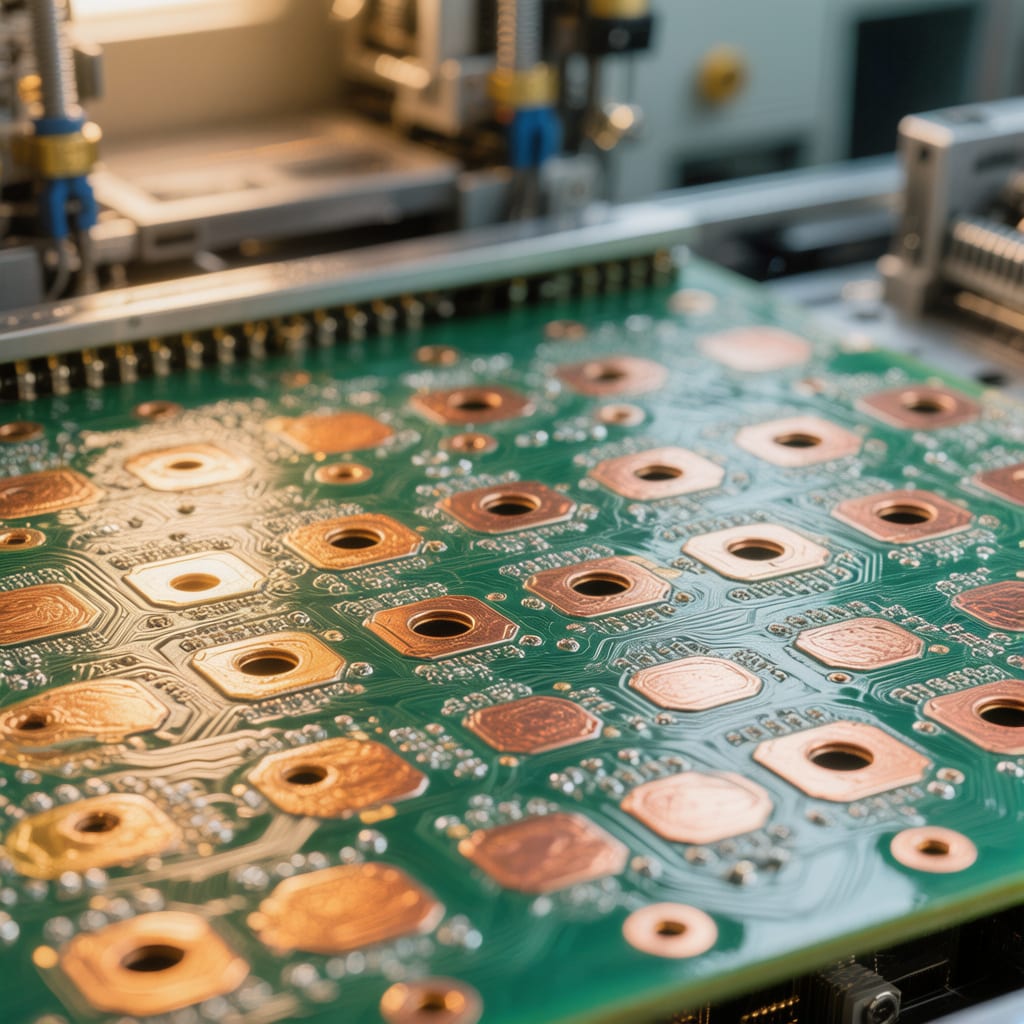
1. Visual inspection under 10× magnification: Look for color shift from uniform pale gold/tan to patchy brown or purple. Any visible copper discoloration indicates OSP breakdown and is grounds for rejection or immediate solderability testing.
2. Solderability test (IPC-J-STD-003, Test Method B): Dip a representative coupon in SAC305 solder at 255°C for 3 seconds. Accept if >95% of pad area shows complete wetting with bright, smooth solder coverage. Marginal wetting (85–95%) requires process adjustment (more active flux, nitrogen atmosphere). Below 85% wetting, boards should be rejected or stripped and re-coated.
3. Date code and humidity indicator verification: Check that the humidity indicator card (HIC) inside sealed packaging shows <30% RH at all indicator spots. Any triggered 30% or 40% indicators indicate compromised storage.
Handling Best Practices for Maximum Solderability
- Minimize bare-hand contact: Finger oils contain fatty acids that chemically attack the OSP layer. Use nitrile gloves and handle boards by edges only.
- First-in, first-out (FIFO) with opened-package time tracking: Label each opened package with date/time and consume within 8 hours in tropical ambient conditions or 24 hours in humidity-controlled (<45% RH) environments.
- Nitrogen storage for partially used packages: Return unused boards to nitrogen-purged dry cabinets (<10% RH) immediately. Do not reseal in original packaging without fresh desiccant.
- Pre-bake only when necessary: Baking OSP boards at 105–120°C for 2–4 hours can drive out moisture but also accelerates OSP degradation. Bake only when required for moisture-sensitive component compatibility (J-STD-033), and minimize bake duration.
- Double-sided assembly sequencing: Complete the lighter, lower-thermal-mass side first (typically the bottom side). The residual OSP on the second side will have degraded during the first reflow pass, so minimize the time between first and second reflow to under 4 hours.
Solder Paste and Reflow Considerations
OSP surfaces require moderately active flux chemistry. No-clean fluxes rated ROL0 (low activity) may not adequately remove aged OSP films, especially on boards approaching their shelf-life limit. ROL1 flux formulations provide a wider process window for OSP without requiring post-reflow cleaning.
For reflow profile optimization:
- Maintain peak temperature at 235–245°C (SAC305) — the upper end of the acceptable range helps ensure complete OSP decomposition.
- Time above liquidus (TAL): 60–90 seconds. Extended TAL compensates for OSP that decomposes more slowly due to age or thickness variation.
- Nitrogen atmosphere (O₂ < 1000 ppm) significantly improves wetting on aged OSP surfaces by preventing copper re-oxidation during the brief interval between OSP decomposition and solder melting. For OSP boards beyond 4 months of age, N₂ reflow is strongly recommended.
OSP remains the cost-performance leader for consumer and industrial SMT assembly, but its solderability window demands disciplined handling. For Southeast Asian manufacturers, the combination of high ambient humidity and supply chain transit times makes OSP shelf-life management a daily operational reality — not a datasheet footnote. The difference between 98% first-pass yield and 92% often traces back to how OSP boards were stored, handled, and sequenced through the SMT line.