Introduction
Moisture-sensitive SMT components are among the most fragile elements in modern electronics assembly. A single plastic-encapsulated IC exposed to ambient humidity beyond its rated floor life can suffer internal delamination, package cracking, or “popcorn” failure during reflow soldering. Combined with ESD risks, improper component handling accounts for a significant portion of SMT field failures. The industry standard for managing these risks is IPC/JEDEC J-STD-033, which defines moisture sensitivity levels (MSL), storage conditions, and bake-out procedures.
Why Moisture Sensitivity Matters
Modern IC packages use organic mold compounds that absorb moisture from the surrounding air. When a moisture-saturated package is subjected to rapid reflow heating (peak temperatures of 240-260°C for lead-free SAC alloys), the absorbed moisture expands rapidly as steam. The resulting internal pressure can crack the package, delaminate the die from the lead frame, or rupture wire bonds. These defects may not be visible externally but cause latent reliability failures in the field.
The severity of moisture damage depends on the package size, mold compound chemistry, and absorbed moisture content. Larger packages with thi
er geometries are more vulnerable. A 10×10 mm QFN can typically tolerate more moisture than a 25×25 mm BGA with the same mold compound.
Moisture Sensitivity Levels (MSL) per J-STD-020
JEDEC J-STD-020 classifies components into eight MSL categories based on their floor life under specific temperature and humidity conditions (30°C / 60% RH baseline):
- MSL 1 — Unlimited floor life at 30°C / 85% RH; no special handling required
- MSL 2 — 1-year floor life at 30°C / 60% RH
- MSL 2A — 4-week floor life at 30°C / 60% RH
- MSL 3 — 168 hours (1 week) floor life
- MSL 4 — 72 hours (3 days) floor life
- MSL 5 — 48 hours (2 days) floor life
- MSL 5A — 24 hours (1 day) floor life
- MSL 6 — Bake-out required before use; moisture-sensitive components that must be baked and reflowed within a defined time
For lead-free reflow, components are rated per J-STD-020 with peak package body temperatures up to 260°C. The same component may carry a different MSL rating for leaded (235°C) versus lead-free (260°C) processing, with lead-free ratings typically more conservative (shorter floor life).
Dry Cabinet Requirements
Components with MSL 2A through MSL 6 must be stored in dry cabinets that maintain humidity below 5% RH (typically 1-3% RH for ultra-sensitive devices). The cabinet must meet several critical requirements:
Humidity Control
- Maintained RH below 5%, verified by calibrated digital hygrometer
- Recovery time to target RH after door opening: less than 30 minutes
- Continuous data logging of humidity for traceability
- Alarm notification if humidity exceeds 10% RH for more than 1 hour
ESD Protection
- ESD-dissipative shelving (surface resistance 10⁶ to 10⁹ Ω/sq)
- Wrist strap co
ection points at cabinet access doors
- Common point ground bonded to facility ESD ground
- Ionizers optional but recommended for handling areas outside the cabinet
Physical Configuration
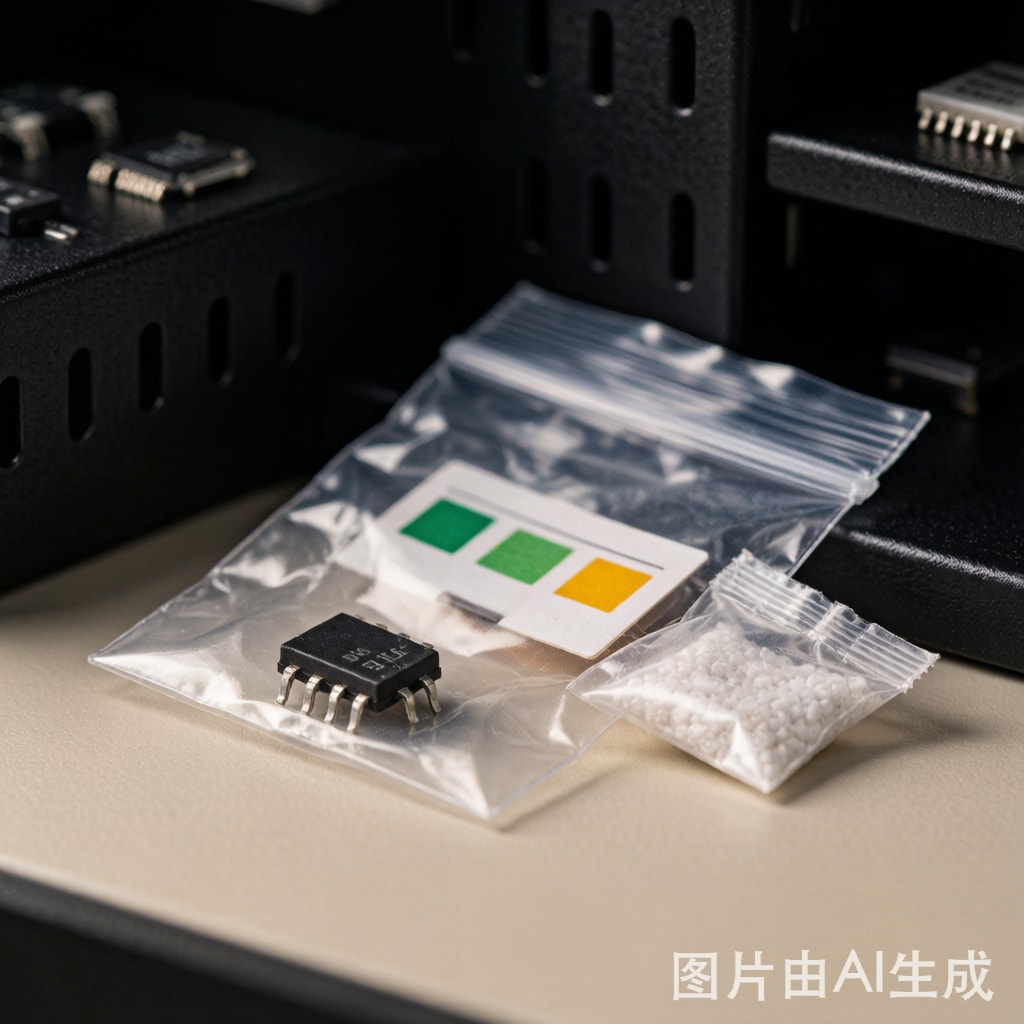
- Shelf loading: components stored in original sealed MBB (Moisture Barrier Bag) with desiccant and humidity indicator card until needed
- Opened MBB: contents transferred to dry cabinet with MBB re-sealed or discarded
- Identification: each storage location labeled with part number, MSL level, and bag opening date
Floor Life Tracking
Once a moisture barrier bag (MBB) is opened, the floor life clock starts. The component must be reflowed within the MSL-rated time or returned to dry storage. Best practices for floor life tracking include:
- MSL label: Each component reel or tray should carry a label indicating its MSL level, MBB opening date, and exposure expiration date
- Re-sealable dry storage: Components removed from the MBB for partial use should be re-sealed in a new MBB with fresh desiccant and a new humidity indicator card
- Exposure log: For Class 3 assemblies, maintain a database logging each component’s exposure time at the SMT line
- Pre-reflow check: Before mounting, verify the indicator card (typically blue at <10% RH, pink at >10% RH) confirms the MBB environment remained dry
Bake-Out Procedures
Components that exceed their floor life must be baked to remove absorbed moisture before reflow. J-STD-033 specifies bake-out conditions based on component thickness and package type:
Standard Bake Conditions
- Components ≤ 1.6 mm thick: 125°C for 24 hours
- Components 1.6-2.5 mm thick: 125°C for 48 hours
- Components > 2.5 mm thick: 125°C for 96 hours, or 150°C for 24 hours as a faster alternative
- Carrier tape and reel materials limit bake temperature to typically 40-50°C to prevent degradation
Bake-out must occur in a nitrogen-purged oven or a conventional oven with low humidity to prevent re-absorption during the bake. After bake-out, the component’s floor life clock resets, and it must be processed within the rated MSL time or returned to dry storage.
ESD Considerations During Handling
Beyond moisture, ESD damage is the second major handling risk for SMT components. Modern ICs with sub-100 nm process geometries can be damaged by electrostatic discharges as low as 30 V — well below the human perception threshold of 3,000 V. ESD-safe handling per ANSI/ESD S20.20 requires:
- Wrist straps with 1 MΩ resistor for all perso
el handling components
- ESD-safe work surfaces (10⁶ to 10⁹ Ω/sq) at every assembly station
- ESD-safe trays, totes, and carriers for component transport
- Continuous monitoring of grounding systems to detect failures
- Humidity control between 30-70% RH in handling areas to minimize triboelectric charging
Conclusion
Effective moisture and ESD control is fundamental to SMT assembly quality. Combining J-STD-033 moisture management with ANSI/ESD S20.20 ESD protocols prevents the two leading causes of latent component damage. Investing in proper dry cabinets, training, and traceability systems is far less expensive than the field failure costs of cracked packages, delaminated dies, or ESD-degraded devices discovered after deployment.