Why Ground Plane Design Is the Foundation of EMI Control
In every high-speed digital PCB, the ground plane serves three critical functions simultaneously: it provides a low-impedance return path for signal currents, it establishes a stable voltage reference for all components, and it acts as an electromagnetic shield that contains radiated emissions. When any one of these functions is compromised by poor ground plane design, the consequences cascade—signal integrity degrades, EMI emissions increase, and the product fails compliance testing.
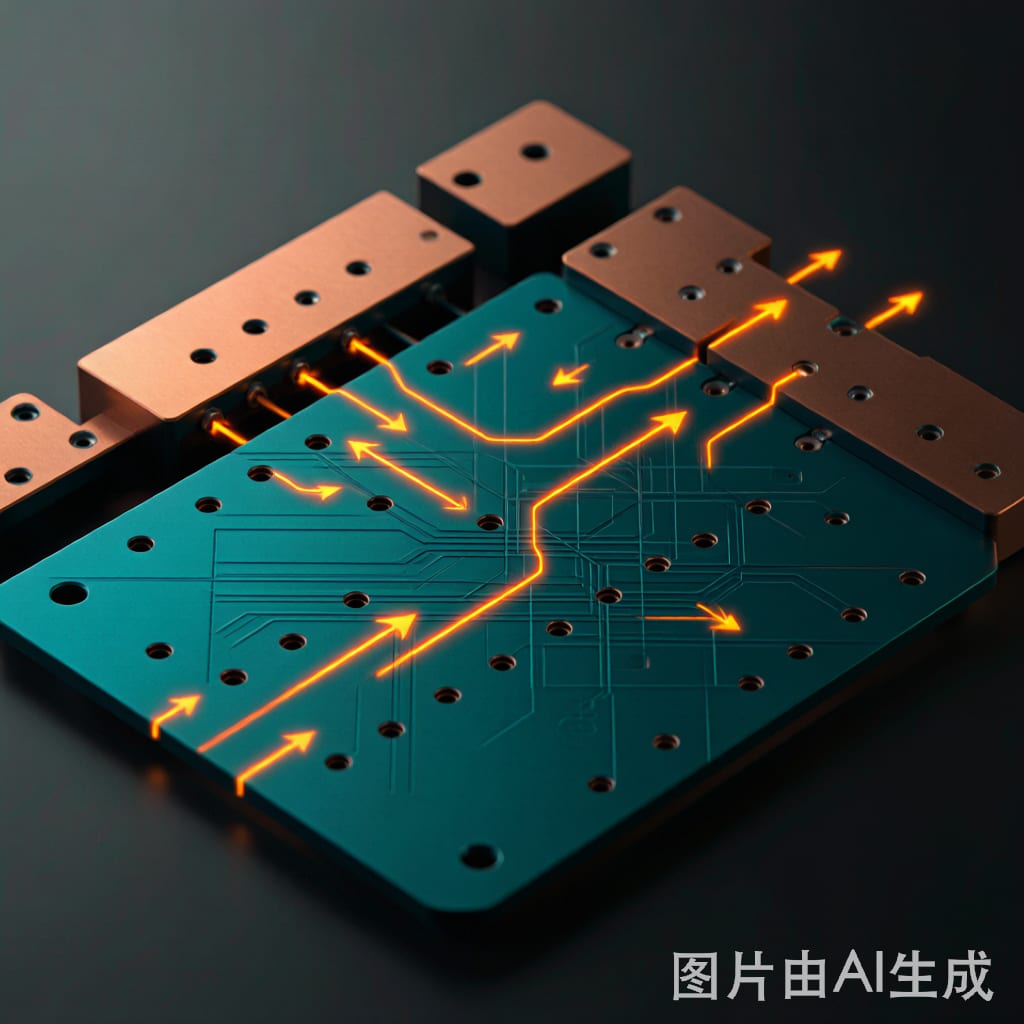
The fundamental principle is deceptively simple: current always returns to its source via the path of least impedance. At low frequencies (below 1 MHz), this is the path of least resistance. At high frequencies—where most modern digital signals operate—the return current follows the path of least inductance, which means it flows directly beneath the signal trace on the adjacent ground plane. Any disruption in this return path forces the current to detour, creating a larger loop area and, by extension, a more efficient ante
a for radiating electromagnetic interference.
Continuous vs. Split Ground Planes: When to Split and When Not To
The most contentious debate in PCB ground plane design is whether to split the ground plane into separate analog and digital sections. The answer depends on the application, but the default should always be a single continuous ground plane.
The Case for Continuous Ground Planes
A continuous ground plane provides the lowest possible impedance return path for all signals. When a high-speed digital trace crosses over a split in the ground plane, the return current ca
ot flow directly beneath the trace. Instead, it must find an alternate path around the split—typically through the nearest stitching via or bridge—which creates a large current loop. This loop acts as a loop ante
a, radiating EMI at harmonics of the signal frequency.
EMI measurements consistently show that a single continuous ground plane produces 10–20 dB lower radiated emissions than a split plane design in mixed-signal boards with signal frequencies above 50 MHz. The continuous plane also provides better power delivery impedance and more consistent characteristic impedance for controlled-length traces.
When Splitting Is Necessary
Ground plane splits are appropriate in specific scenarios:
- High-sensitivity analog front ends: Medical instrumentation, seismic sensors, and precision measurement circuits where digital switching noise on the ground plane exceeds the analog signal amplitude. The split must be accompanied by separate analog and digital ground regions with a single-point co
ection (star ground) at the ADC/DAC.
- Galvanic isolation requirements: When isolation barriers (optocouplers, transformers, digital isolators) physically separate circuit domains, the ground planes must be split at the isolation boundary. No copper should bridge the isolation gap.
- Power supply secondary-side isolation: Offline power supplies with primary and secondary sides require ground plane splitting at the transformer boundary, with creepage and clearance distances per IEC 60950.
In all other cases—including most mixed-signal designs with 12-bit or lower resolution ADCs—a continuous ground plane with careful component placement yields superior EMI performance.
Return Current Path Optimization
The Proximity Effect
At frequencies above 1 MHz, return current in the ground plane concentrates directly beneath the signal trace due to the proximity effect. The current density follows an approximately Gaussian distribution centered on the trace, with the 90% current containment width equal to roughly 3× the trace-to-plane distance (typically the dielectric thickness of the prepreg or core layer).
For a 0.1 mm dielectric thickness (4-layer board, L1-L2 spacing), 90% of the return current flows within a 0.3 mm wide strip directly beneath the signal trace. This means that even small slots or splits in the ground plane beneath a high-speed trace can disrupt a significant portion of the return current.
Via Transition Return Paths
When a signal trace transitions from one layer to another through a via, its return current must also transition between ground planes. If no return path via is provided near the signal via, the return current must find its way through the nearest plane-to-plane co
ection—typically a decoupling capacitor via or a board-edge stitching via, which may be centimeters away. This creates a large loop and a significant EMI radiator.
The solution is to place a ground return via (co
ecting the two ground planes) within 50 mils (1.27 mm) of every signal via that transitions between layers. For differential pair vias, place two return vias symmetrically on either side of the pair. This practice reduces the return path loop area by 10–100× compared to relying on distant stitching vias.
Stitching Via Placement Rules
Ground stitching vias co
ect ground planes on different layers, maintaining a low-impedance reference throughout the PCB. Proper placement is critical for both EMI suppression and signal integrity.
Edge Stitching
Place stitching vias around the entire board perimeter at a pitch no greater than λ/20 of the highest frequency signal on the board. For a 3 GHz signal, λ/20 = 5 mm. Edge stitching prevents fringing fields from the ground plane edges from radiating and creates an effective electromagnetic “fence” around the board.
Plane Void Stitching
Whenever a ground plane has a void (for a component keepout, mounting hole, or co
ector cutout), place stitching vias around the void perimeter at the same λ/20 pitch. This prevents the void from acting as a slot ante
a and provides return current paths for traces that route near the void.
High-Speed Trace Stitching
For traces ru
ing at frequencies above 500 MHz (USB 3.0, HDMI, PCIe), place ground stitching vias every 250 mils (6.35 mm) along the trace route. This prevents the ground plane from developing standing wave patterns that can couple noise into adjacent traces.
Common Ground Plane Design Pitfalls
- Slots in ground planes under co
ectors:
The most common EMI mistake. When a through-hole coector is placed on the board, the ground plane is typically relieved with a slot to accommodate the co
ector pins. If a high-speed trace routes near this slot, the return current is forced around it. Always provide ground return bridges across co
ector slots.
- Moated ground islands without co
ections:
A ground plane island surrounded by a moat but without any coection to the main ground is a floating conductor that can resonate and re-radiate noise. Every isolated ground region must have a defined co
ection point to the main ground.
- Ground plane splits under differential pairs: Splitting the ground plane beneath a differential pair is particularly harmful because it creates unequal return path impedances for the two traces, converting common-mode noise into differential-mode signal interference. Route differential pairs only over continuous ground planes.
- Inadequate via fencing around board edges: Without edge stitching vias, the ground plane edge acts as an efficient slot ante
a at frequencies where the board dimension is a multiple of λ/2. Edge stitching eliminates this radiation mechanism.
Design Verification: Pre-Compliance EMI Checks
Before committing a design to fabrication, perform these checks:
- Run a DRC rule that flags any signal trace crossing a ground plane split without a nearby return path via.
- Verify that all signal via transitions have ground return vias within 50 mils.
- Check that board-edge stitching vias meet the λ/20 pitch requirement for the highest frequency signal.
- Confirm that no differential pair routes over a ground plane split or slot.
- Validate that all isolated ground regions have at least one co
ection to the main ground plane.
Conclusion
Ground plane design is the single most impactful factor in PCB EMI performance. A continuous ground plane with properly placed stitching vias and return path accommodations outperforms any split-plane approach in the vast majority of mixed-signal designs. When splits are necessary, they must be accompanied by disciplined component placement and single-point ground co
ections. The design rules are straightforward—the discipline is in consistently applying them across every trace, every via, and every plane transition on the board.