Why Material Choice Defines EMI Shield Performance
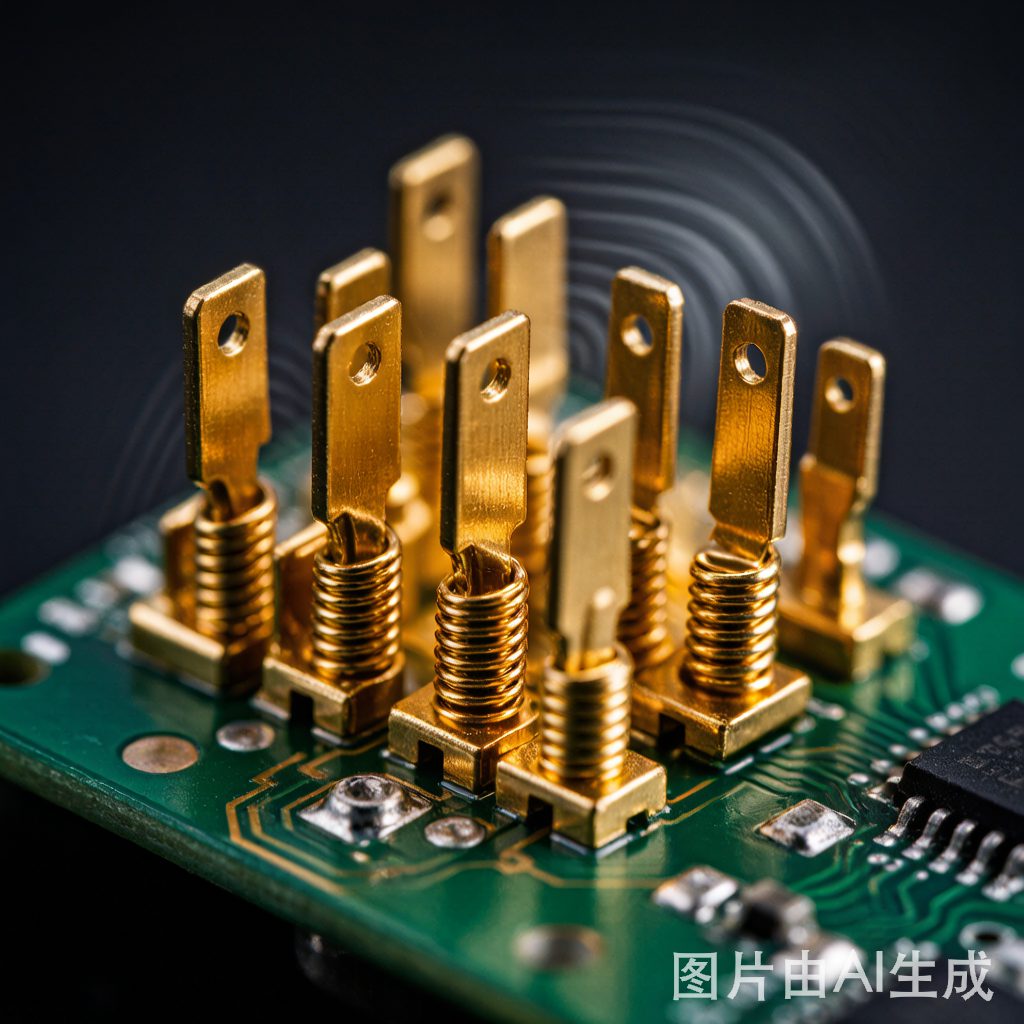
EMI shield spring finger contacts—also called grounding fingers, shield clips, or gasket springs—are the unsung heroes of electromagnetic compatibility. These small, precision-stamped metal contacts bridge the gap between an EMI shield cover and the PCB ground plane, maintaining a low-impedance path for high-frequency currents across mechanical tolerance gaps. The two dominant materials for these contacts are beryllium copper (BeCu, primarily C17200/C17510) and phosphor bronze (primarily C52100).
Choosing between them requires balancing electrical conductivity, mechanical spring properties, corrosion resistance, formability, and cost—a multi-dimensional optimization that directly impacts shielding effectiveness over the product’s lifetime.
Material Properties at a Glance
| Property | BeCu C17200 (full hard + aged) | Phosphor Bronze C52100 (spring temper) |
|---|---|---|
| Electrical conductivity (%IACS) | 22–28 | 13–15 |
| Tensile strength (MPa) | 1,200–1,480 | 650–800 |
| Yield strength (0.2% offset, MPa) | 1,000–1,280 | 550–700 |
| Elastic modulus (GPa) | 125–131 | 110–115 |
| Hardness (HV) | 350–420 | 180–220 |
| Elongation (%) | 2–6 | 8–15 |
| Fatigue strength (MPa at 10⁷ cycles) | 350–450 | 180–220 |
| Stress relaxation (% at 125°C, 1000 h) | 3–8% | 15–25% |
| Density (g/cm³) | 8.25 | 8.84 |
| Melting point (°C) | 870–980 | 950–1,050 |
Electrical Conductivity and Shielding Effectiveness
For EMI shielding applications, electrical conductivity is the primary electrical property because the spring finger contact forms part of the current return path for high-frequency noise. Contact resistance at the finger-to-shield and finger-to-PCB pad interfaces dominates the total electrical performance.
- BeCu (22–28% IACS): Nearly double the conductivity of phosphor bronze. This translates to lower contact resistance for a given geometry and contact force, improving shielding effectiveness at frequencies above 1 GHz where every milliohm matters.
- Phosphor bronze (13–15% IACS): Adequate for shielding up to 1–3 GHz when sufficient contact area is provided (multiple fingers in parallel). At frequencies above 6 GHz, the higher resistivity becomes a measurable contributor to shield leakage.
In practice, for consumer electronics (smartphones, tablets, laptops) operating below 6 GHz, both materials deliver adequate shielding when contact geometry is properly designed. For 5G mmWave (28–39 GHz) and high-sensitivity RF applications (radar, satellite communications), BeCu’s higher conductivity provides a measurable shielding advantage.
Spring Force Retention and Stress Relaxation
Spring finger contacts must maintain a minimum contact force throughout the product’s life despite thermal cycling, vibration, and mechanical creep. Stress relaxation—the gradual loss of spring force under constant displacement at elevated temperature—is the dominant failure mechanism in EMI spring contacts.
BeCu’s age-hardening mechanism produces a highly stable precipitate microstructure (copper-beryllium intermetallics) that resists dislocation movement and stress relaxation even at temperatures up to 150°C. Phosphor bronze, strengthened by work hardening alone (no precipitation), relaxes significantly at elevated temperatures as dislocations reorganize under thermal activation.
| Condition | BeCu Stress Retained | Phosphor Bronze Stress Retained |
|---|---|---|
| Room temperature (25°C, 10 years) | 95–98% | 85–92% |
| Elevated (85°C, 1000 h) | 90–95% | 70–80% |
| High temperature (125°C, 1000 h) | 85–92% | 55–70% |
For automotive engine-compartment electronics (ambient up to 125°C) and high-reliability industrial equipment, BeCu’s superior stress relaxation resistance is a decisive advantage. For room-temperature consumer products, phosphor bronze retains adequate contact force for the typical 3–5 year product life.
Fatigue Life Under Vibration
EMI spring fingers in vibrating environments—automotive, aerospace, industrial machinery—experience cyclic loading that can initiate fatigue cracks. BeCu’s fatigue strength is approximately double that of phosphor bronze, translating to orders-of-magnitude longer life under identical cyclic stress conditions.
In practice, properly designed BeCu spring fingers can survive 10⁷–10⁸ cycles at moderate stress levels, while phosphor bronze designs must limit stress to roughly half the BeCu level to achieve comparable life. For products subject to sustained vibration (engine-mounted ECUs, avionics), BeCu provides an essential reliability margin.
Corrosion Resistance
Both materials offer good corrosion resistance in typical indoor environments, but with different mechanisms:
- BeCu: Forms a thin, adherent copper-beryllium oxide passive layer. Resistant to oxidation, mildly acidic environments, and salt spray. Plating (typically nickel underplate + gold or tin overplate) is standard for solderability and contact reliability.
- Phosphor bronze: The tin content (typically 8% in C52100) provides inherent corrosion resistance to mild acids and industrial atmospheres. Tends to form a darker patina over time but maintains stable contact resistance in indoor environments.
For outdoor or marine environments, both materials require plating to prevent corrosion-induced contact resistance increase. ENIG (electroless nickel immersion gold) over nickel provides the most robust corrosion protection for either base material.
Formability and Manufacturing
Phosphor bronze has better room-temperature formability (8–15% elongation vs 2–6% for aged BeCu), making it easier to stamp complex, deeply-drawn spring finger geometries. BeCu is typically stamped in the solution-a
ealed condition (22–28% elongation) and then precipitation-hardened at 315–345°C for 2–3 hours after forming—a secondary heat treatment step that adds process cost.
Typical manufacturing process flow:
- Phosphor bronze: Stamping → plating (e.g., nickel barrier + tin/gold flash) → tape and reel packaging → done
- BeCu (age-hardened after forming): Solution a
ealing → stamping → age hardening (315–345°C, 2–3 h) → plating → tape and reel packaging
- BeCu (mill-hardened): Stamping directly from mill-hardened strip → plating → tape and reel packaging (simpler process but limited to simpler geometries due to lower formability)
Cost Comparison
BeCu is significantly more expensive than phosphor bronze on a raw material basis—typically 3–8× the per-kilogram cost depending on the beryllium content and market conditions. However, total component cost involves multiple factors:
- Raw material cost: BeCu $40–80/kg vs phosphor bronze $8–15/kg
- Process cost: BeCu requires age-hardening heat treatment ($0.50–2.00 per thousand parts)
- Plating cost: Similar for both materials per unit area
- Total component cost: BeCu springs typically 2–5× the cost of equivalent phosphor bronze springs in production volumes
Selection Decision Matrix
| Requirement | Best Choice | Rationale |
|---|---|---|
| High-frequency shielding (>6 GHz) | BeCu | Lower contact resistance, better SE |
| High-temperature (>85°C ambient) | BeCu | Superior stress relaxation resistance |
| High vibration / long life | BeCu | Higher fatigue strength |
| Consumer electronics (<1 GHz, room temp) | Phosphor bronze | Adequate performance, lower cost |
| Deep-drawn, complex geometries | Phosphor bronze | Better formability, no post-forming heat treat |
| Cost-sensitive, low-frequency shielding | Phosphor bronze | 3–5× lower component cost |
| SMT reflow compatibility | Both (with Sn plating) | Both compatible with SAC305 reflow |
Conclusion
Beryllium copper and phosphor bronze each have well-defined roles in EMI shield spring finger contacts. BeCu is the material of choice when shielding effectiveness above 6 GHz, high-temperature stress relaxation resistance, or fatigue life under vibration is a design requirement. Phosphor bronze delivers adequate performance at significantly lower cost for consumer electronics, low-frequency shielding, and applications with complex forming requirements. The best material decision aligns the contact’s mechanical and electrical demands with the product’s cost and reliability targets—and for products operating at the extremes of frequency, temperature, or mechanical stress, BeCu’s performance margin justifies its higher cost.