Why Component Packaging Format Matters in SMT Manufacturing
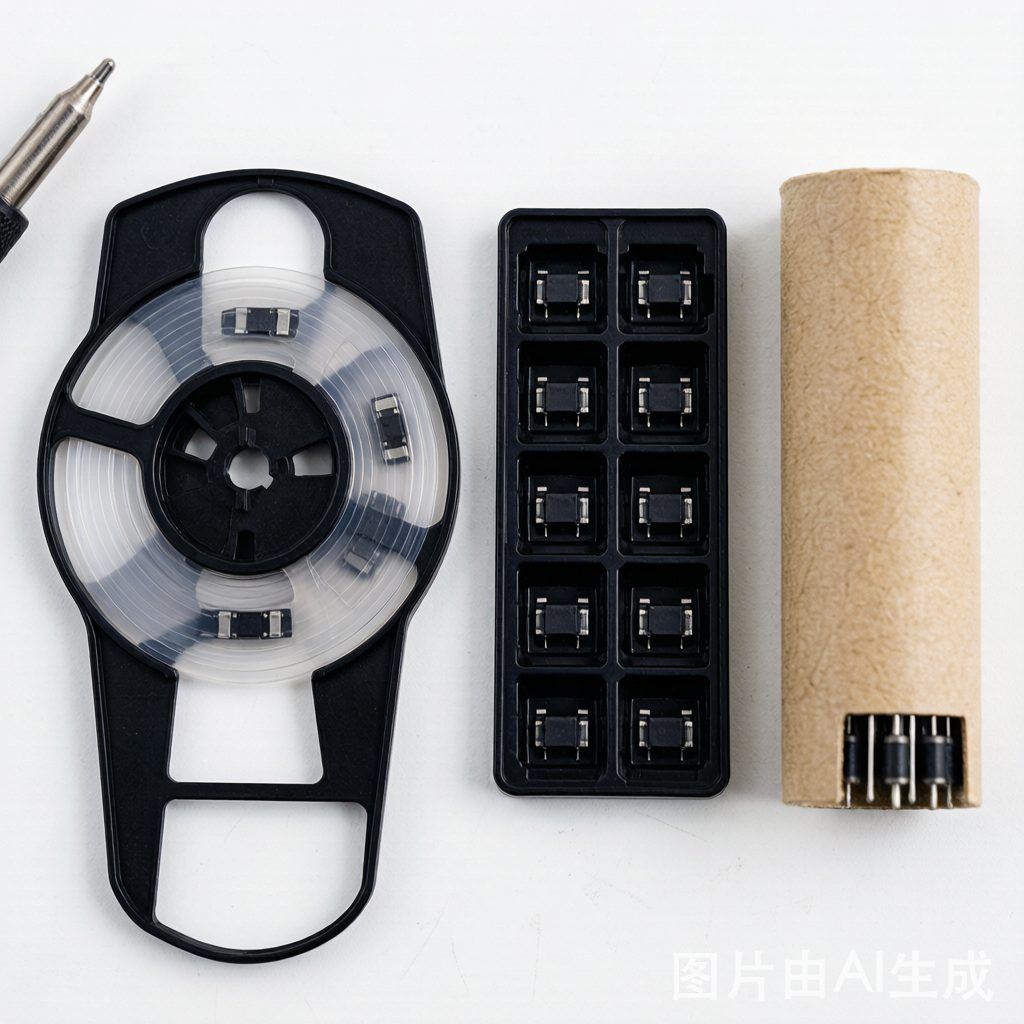
The choice of SMT component packaging format has a direct impact on production line efficiency, changeover time, inventory handling, and total assembly cost. While pick-and-place machines can work with multiple input formats, the wrong packaging choice creates bottlenecks, increases mis-pick rates, and adds labor cost that erodes the savings of high-volume SMT. Understanding the strengths and limitations of tape & reel, tray, and tube packaging is essential for both component procurement and SMT process engineering.
This guide provides a practical comparison of the three dominant SMT component packaging formats.
Tape and Reel: The Workhorse of High-Volume SMT
Tape and reel is by far the most common packaging format for SMT components, supporting the full range of automated pick-and-place machines from desktop units to high-speed production lines. Components are sealed in pockets formed between two carrier tapes: a top cover tape (heat-seal or pressure-sensitive adhesive) and a bottom embossed carrier tape (typically polystyrene or polycarbonate for passive components, or conductive PS for ESD-sensitive parts).
EIA-481 Carrier Tape Standards
The Electronic Industries Alliance EIA-481 standard (globally adopted as IEC 60286-3) defines the dimensional requirements for carrier tapes. Key parameters include:
- Width: 8 mm (most common for 0402 to 2512 chip components), 12 mm (for larger passives, small SOICs), 16 mm, 24 mm, 32 mm, 44 mm, 56 mm
- Pitch: Distance between component pocket centers—1 mm for 0201/0402, 2 mm for 0603, 4 mm for 0805, 8 mm for SOIC-8, 12 mm for SOIC-14
- Reel diameter: 178 mm (7″) for prototypes, 330 mm (13″) standard production, 381 mm (15″) for high-volume runs
- Component orientation: For polarized components (diodes, capacitors), standard EIA-481 specifies the cathode/anode orientation relative to the sprocket holes
Advantages of Tape and Reel
- Fully compatible with all major pick-and-place machines (Yamaha, Panasonic, Fuji, Juki, ASM)
- High component density per reel—5,000 to 50,000 components per 13″ reel depending on size
- Sealed cover tape protects against contamination and moisture (in conjunction with MBB bags and desiccant)
- Automated splice capability allows continuous production across multiple reels with minimal operator intervention
- Compatible with all major component counters and reel inventory systems
Limitations
- Higher per-component packaging cost amortized over many components; for low-volume runs, tape and reel setup fees can be $50–200 per unique part number
- Damage risk during high-G mechanical shock (dropping reels, mishandling)
- Component reorientation after tape opening (for polarized parts) is not possible
- Limited to component sizes that fit standard pocket dimensions; very large or irregularly shaped parts (large transformers, modules) require custom carriers
JEDEC Trays: Ideal for High-Value and Heat-Sensitive Components
JEDEC matrix trays (JEDEC MS-018, JEDEC MO-047) are rigid, typically injection-molded plastic carriers with a grid of pockets designed to hold components in precise positions for pick-and-place loading. Trays are the standard packaging format for ICs, BGAs, QFNs, and other high-value components where proper orientation, ESD protection, and mechanical handling are critical.
Standard Tray Dimensions
- Outer dimensions: 315.0 mm × 135.5 mm (12.4″ × 5.3″)—standard JEDEC tray size
- Stack height: 7.62 mm to 25.4 mm per tray, with anti-rotation features for stacking
- Pocket count: 50–250+ per tray depending on component size
- Anti-static options: Conductive (black) polystyrene for ESD-sensitive components; also available in carbon-filled dissipative materials
Advantages of JEDEC Trays
- Excellent mechanical protection for large, fragile, or expensive components (BGAs, FPGAs, ASICs)
- Easy visual inspection of all components before placement
- Compatible with tube-to-tray and tray-to-tray feeders as well as direct tray loading on modern pick-and-place machines
- Stackable for space-efficient storage; standardized dimensions fit automated tray handling systems
- Reusable through multiple production cycles, reducing per-component packaging cost for small-batch or prototype runs
Limitations
- Lower component density per unit volume compared to tape and reel
- Requires special tray feeders on pick-and-place machines (though most modern machines have integrated tray handling)
- Trays can accumulate static charge without proper anti-static treatment, risking ESD damage to ICs
- Higher initial tooling cost for custom pocket designs—typically $5,000–20,000 for unique component geometries
Tube Packaging: For Through-Hole and Axial Components
Tube packaging uses rigid plastic or cardboard tubes with end stops to hold components in axial orientation. While not as common in pure SMT production, tubes remain relevant for through-hole components (axial capacitors, axial diodes, axial resistors) and a few SMT components with axial lead configurations (some specialty LED packages, certain co
ector types).
Tube Standards
- I
er diameter
: 5 mm to 25 mm depending on component size - Length: Typically 480–520 mm
- Stopper Foam or plastic end stops prevent component loss during shipping and handling
- ESD protection: Conductive tubes or antistatic coating required for ESD-sensitive components
Advantages of Tubes
- Lowest per-component packaging cost for axial and through-hole components
- Easy manual component access for hand-assembly, repair, and prototype work
- Compatible with most through-hole insertion machines and radial lead component inserters
- Lightweight and compact for storage
Limitations for SMT
- Most pick-and-place machines ca
ot feed directly from tubes—requires manual loading into trays or specialty feeders
- Risk of component lead bending during tube loading/unloading
- Limited protection against mechanical shock and ESD
- Not suitable for high-volume SMT production
Moisture Sensitivity and Packaging Integration
For moisture-sensitive components (predominantly BGAs, QFNs, and other large ICs with plastic packages), the packaging format must integrate with JEDEC J-STD-033 moisture sensitivity level (MSL) handling requirements. Regardless of whether components ship in tape and reel or trays, they are typically vacuum-sealed in a moisture barrier bag (MBB) with desiccant and humidity indicator cards. After opening, components have a limited “floor life” before they must be baked dry and re-sealed or processed through reflow. We cover MSL handling and baking procedures in detail in our dedicated MSL guide.
Selection Guide: Choosing the Right Packaging Format
| Component Type | Recommended Format | Reason |
|---|---|---|
| Small chip components (0201–2512) | Tape and reel (8 mm) | High density, low cost, universal compatibility |
| SOIC, SOT, SOT-23, MSOP | Tape and reel (8–16 mm) | Standardized, all pick-and-place compatible |
| BGAs, QFNs, large ICs | JEDEC tray | Mechanical protection, visual inspection, MSL handling |
| LEDs, photodetectors | Tape and reel or tray | Both formats common; tray preferred for high-power LEDs |
| Co
ectors, sockets |
Tray or tube | Tray for high-pin-count; tube for simple pin headers |
| Axial components (through-hole) | Tube or ammo pack | Standard for axial lead; tape and reel for SMT axial |
| Prototype/low-volume runs | Cut tape or tray | Cut tape for small quantities of chip components; tray if reuse pla
ed |
| Modules, transformers, large passives | Custom tray | Standard trays don’t fit; custom pocket design required |
Cost Considerations
Packaging cost is a meaningful component of total component cost, especially for high-volume production. Typical relative costs:
- Tape and reel: $0.001–0.01 per component amortized for full reels; $50–200 setup fee per unique part number for smaller reel formats
- JEDEC tray: $0.05–0.50 per component for low volumes; trays reusable and amortized over multiple production runs
- Tube: $0.001–0.005 per component; minimal setup cost
For prototype and small-batch production (under 500 units), trays often have lower total packaging cost because they can be reused across multiple production runs. For high-volume production (10,000+ units), tape and reel becomes the most cost-effective format due to automation efficiency and reduced changeover time.
Conclusion
Selecting the right SMT component packaging format requires understanding the tradeoffs between automation efficiency, mechanical protection, ESD and moisture handling, and total cost. Tape and reel dominates high-volume passive and small IC production; JEDEC trays are the standard for high-value, moisture-sensitive, or mechanically delicate components; tubes remain relevant for through-hole and axial components. The best packaging decision aligns with the component’s physical characteristics, the production volume, the pick-and-place equipment in use, and the supply chain logistics of the overall manufacturing operation.