The Wire Bonding Transition: From Gold to Copper
Wire bonding remains the dominant die-to-package interco
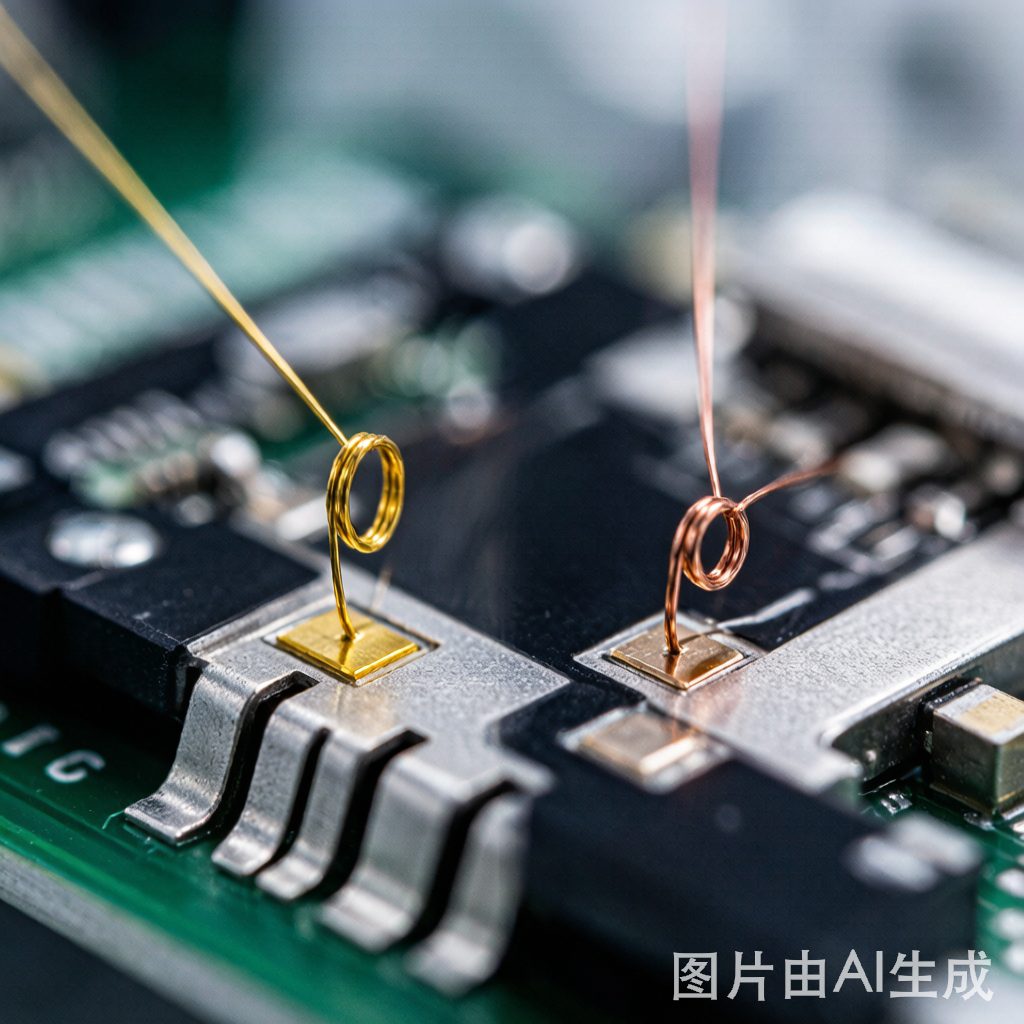
ection method in semiconductor manufacturing, used in over 90% of IC packages worldwide. For decades, gold (Au) wire was the unquestioned standard due to its excellent conductivity, corrosion resistance, and ease of bonding. However, the dramatic rise in gold prices since the early 2000s—from under $400/troy oz to over $2,000—triggered a major industry transition toward copper (Cu) wire bonding, and more recently toward palladium-coated copper (PCC) wire.
This comparison examines gold and copper wire bonding across the dimensions that matter most to packaging engineers and procurement teams in electronics manufacturing.
Material Cost Comparison
The cost differential between gold and copper wire is the primary driver of the technology transition. At current market prices:
- Gold wire (99.99% purity): Approximately $60–80 USD per gram; a 25 μm diameter, 1 mm long wire bond weighs approximately 3.4 μg, costing about $0.00020–0.00027 per bond
- Copper wire (99.99% purity): Approximately $0.009–0.012 USD per gram; same geometry wire bond costs approximately $0.000003 per bond—roughly 70–100× cheaper
- Palladium-coated copper (PCC) wire: 5–10× more expensive than bare copper wire, but still 10–15× cheaper than gold; PCC’s palladium skin provides oxidation resistance during bonding
For a device with 200 wire bonds produced in volumes of 10 million units/year, switching from gold to copper wire saves approximately $400,000–500,000 a
ually—a compelling business case.
Mechanical Properties
Copper wire has significantly different mechanical properties from gold, which impacts both bonding process parameters and long-term reliability:
| Property | Gold Wire | Copper Wire |
|---|---|---|
| Tensile strength | ~100 MPa | ~220 MPa |
| Elongation at break | 4–6% | 3–6% |
| Hardness (Vickers) | ~30 HV | ~60–80 HV |
| Elastic modulus | 79 GPa | 128 GPa |
| Electrical resistivity | 2.44 μΩ·cm | 1.72 μΩ·cm |
Copper’s higher hardness and elastic modulus mean it exerts significantly more force on bond pads during bonding (first bond/ball bond). This higher impact force can crack underlying low-k dielectric layers in advanced CMOS devices—a critical concern for sub-28nm nodes that required the development of optimized softer copper alloys and PCC wire.
Bonding Process Differences
Free Air Ball (FAB) Formation
In ball-wedge wire bonding, the wire tip is melted by electric flame-off (EFO) to form a free air ball before the first bond. Gold FAB formation is straightforward in open air. Copper oxidizes almost instantly at FAB temperatures (~1085°C melting point), so copper wire bonding requires forming gas (95% N₂ + 5% H₂) purging around the capillary tip to prevent ball oxidation. This adds process complexity and equipment cost.
Second Bond (Stitch/Wedge Bond)
Copper’s higher hardness makes stitch bond formation more sensitive to process parameter variation. Wider process windows are achievable with PCC wire due to the palladium skin’s lubricating effect during the stitch bond.
Looping Characteristics
Copper wire maintains tighter loop geometries due to its higher stiffness, which is advantageous for fine-pitch multi-tier stacked-die applications. Gold wire’s greater ductility allows more flexible looping geometries needed for some package styles.
Reliability Considerations
Corrosion Resistance
Gold’s noble metal nature makes it highly resistant to corrosion—gold wire bonds remain reliable even in harsh chemical environments. Copper wire, despite its lower cost, is more susceptible to:
- Oxidation: Copper forms CuO/Cu₂O in humid or contaminated atmospheres; molding compound chemistry must be carefully selected to minimize halide and ionic contamination that accelerates copper corrosion
- Chloride corrosion (HAST/UHAST testing): Chloride ions from epoxy mold compounds attack copper at the ball/pad interface; AuAl intermetallic problems in gold bonding are replaced by CuAl interface corrosion concerns in copper bonding
Intermetallic Formation
Au-Al (gold-aluminum) intermetallics have been extensively characterized; “purple plague” (Au₅Al₂) formation at high temperatures reduces bond strength but is manageable with standard gold wire processes. Cu-Al intermetallics form more slowly and are generally more mechanically stable—copper wire bonds often exhibit superior high-temperature storage (HTS) reliability compared to gold bonds on Al pads.
Humidity Sensitivity
Copper wire bonding packages require careful attention to molding compound moisture sensitivity level (MSL) and floor life. IPC/JEDEC MSL-3 or better is typically required for copper wire bonded packages to prevent delamination and corrosion during lead-free reflow.
Application Suitability Summary
- Choose copper wire bonding for: High-volume consumer electronics, automotive non-safety-critical ECUs, standard logic and memory packages, applications where cost reduction is paramount
- Choose gold wire bonding for: Medical implants, aerospace/defense, extreme-environment applications (>150°C junction temperature), packages with thin Al bond pads (<0.8 μm) where pad cratering risk from copper hardness is unacceptable
- Choose PCC wire for: Balanced performance and cost, fine-pitch advanced packages, automotive AEC-Q100 Grade 0/1 applications requiring improved corrosion resistance over bare copper
Conclusion
The transition from gold to copper wire bonding has delivered substantial cost savings across the semiconductor packaging industry. While copper introduces process complexity and new reliability considerations—particularly around corrosion and pad cratering—PCC wire and mature bonding equipment have resolved most barriers. For the vast majority of electronics manufacturing applications, copper or PCC wire is the technically sound and economically superior choice. Gold wire bonding retains relevance in the highest-reliability and extreme-environment niches where its noble metal properties remain irreplaceable.