As power densities rise in LED drivers, motor controllers, and RF amplifiers, the printed circuit board itself becomes part of the thermal path. Choosing the right thermally conductive PCB substrate can lower junction temperatures, extend component life, and reduce the need for bulky heatsinks. The three most common options are metal-core PCB, ceramic PCB, and advanced FR-4 laminates engineered for PCB heat dissipation.
Metal-Core PCB: Aluminum and Copper Bases
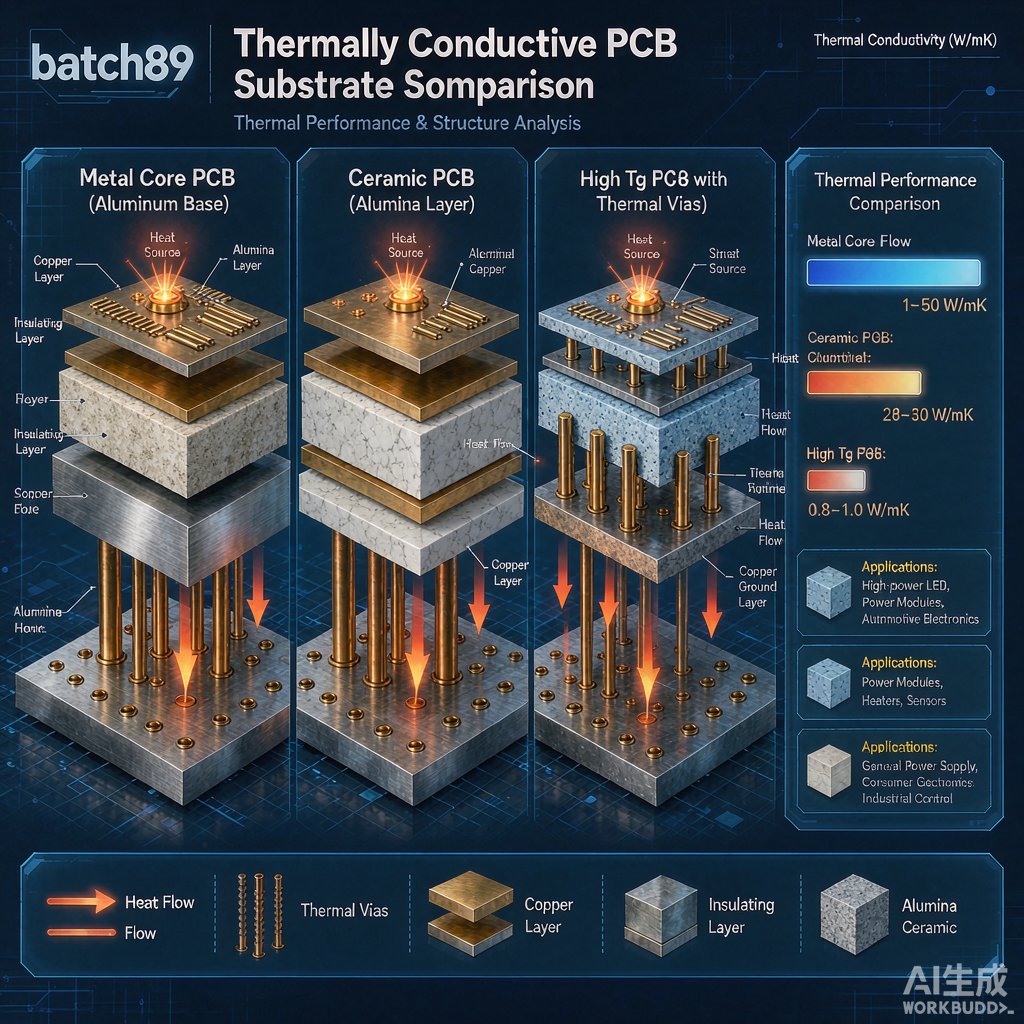
Metal-core PCB, also called insulated metal substrate, consists of a thin dielectric layer bonded to an aluminum or copper plate. Aluminum is the cost-effective choice for LED lighting and consumer power supplies, with in-plane thermal conductivity around 150–200 W/m·K. Copper-core variants offer roughly twice the conductivity but at higher weight and cost.
Dielectric Layer Matters
The thermal performance of metal-core PCB is often limited by the dielectric rather than the metal. Standard dielectrics offer 1–3 W/m·K, while high-performance ceramic-filled prepregs reach 8–12 W/m·K. A thicker dielectric improves electrical isolation but increases thermal resistance. Designers must trade off breakdown voltage requirements against thermal resistance.
Ceramic PCB: Alumina, AlN, and SiC Substrates
Ceramic PCBs use alumina, aluminum nitride, or silicon nitride as both substrate and insulator. Alumina is economical and widely used in power modules, with thermal conductivity around 24–30 W/m·K. Aluminum nitride jumps to 170–230 W/m·K and is preferred for high-brightness LEDs and wide-bandgap semiconductors. Silicon nitride adds mechanical toughness for automotive and aerospace modules.
CTE Matching with Silicon
One advantage of ceramic substrates is coefficient of thermal expansion closer to silicon than metal-core PCB. This reduces solder joint fatigue during thermal cycling. Direct-bond copper or active-metal-brazed copper layers provide high current handling and excellent reliability in harsh environments.
High-Tg FR-4 with Filler Additives
Conventional FR-4 has through-plane thermal conductivity near 0.3 W/m·K, which is poor for heat spreading. High-Tg FR-4 loaded with alumina, boron nitride, or other ceramic fillers can reach 1–3 W/m·K while retaining standard PCB fabrication processes. These materials are attractive when cost and board complexity matter more than ultimate thermal performance.
When FR-4 Is Enough
For low-to-moderate power devices with modest heat loads, thermally enhanced FR-4 plus well-placed thermal vias and copper planes can be sufficient. The key is to keep heat-spreading planes continuous and to use multiple plated vias under thermal pads to move heat to i
er or opposite-side copper layers.
Selection Matrix
Metal-core PCB suits high-volume LED and power supply designs where single-sided assembly and low cost dominate. Ceramic PCB fits high-reliability power modules, RF devices, and applications requiring CTE matching with chips. Thermally enhanced FR-4 is the pragmatic middle ground for multilayer boards with moderate heat loads and complex routing.
Design Practices
Regardless of substrate, maximize copper area co
ected to thermal vias, keep dielectric layers thin under hot components, and avoid solder mask over large thermal pads that could trap air. For metal-core boards, remember that plated through-holes are difficult or impossible, so plan for single-sided or riveted via constructions.
Conclusion
There is no single best thermally conductive PCB substrate. Metal-core, ceramic, and enhanced FR-4 each occupy a different point on the cost-performance-reliability spectrum. By matching the material to the application’s thermal budget, electrical complexity, and reliability targets, engineers can build more compact and durable electronics.