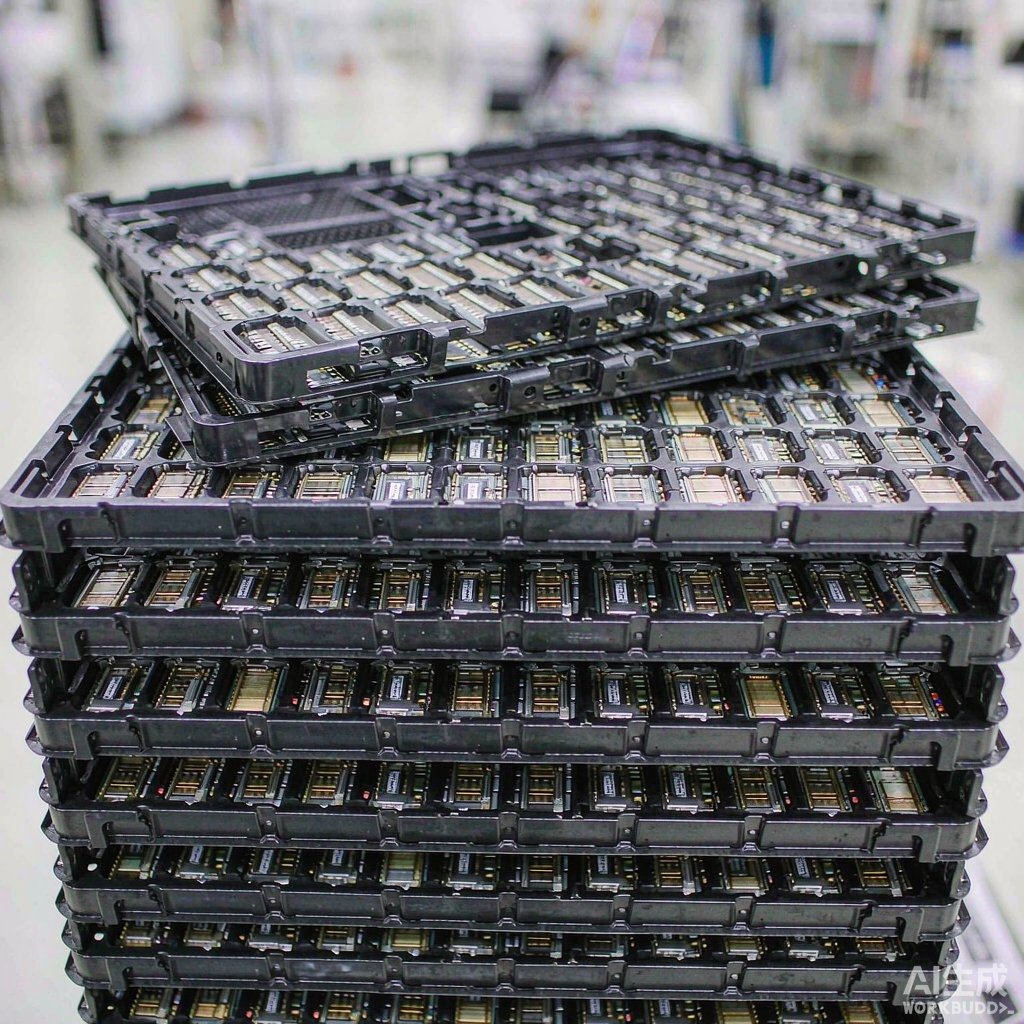
JEDEC trays are the quiet workhorses of SMT assembly: flat molded carriers with precision pockets that transport ICs from the molding house to the pick-and-place feeder. A tray that warps 0.5 mm over its span will jam in a feeder and stop a line; a tray that outgasses or sloughs particles contaminates bond pads. Most high-temperature trays are molded from polycarbonate (PC) pellets, and choosing that resin correctly is a materials decision with direct line-efficiency consequences.
What a JEDEC Tray Must Survive
- Thermal exposure: Trays loaded with freshly molded or cured packages see 125–175 °C for extended periods; trays used in solder-reflow-adjacent processes (bake-out, cure) see spikes beyond 200 °C.
- Dimensional precision: Standard 322 × 136 mm body with pocket positions toleranced to fractions of a millimeter, since vacuum nozzles and vision systems reference pocket coordinates.
- Flatness: A few tenths of a millimeter of warp across the tray is the usual acceptance band; beyond that, feeders mispick.
- Chemical and particle cleanliness: Compatibility with molding compounds, flux residues, IPA cleaning, and low particulate generation for cleanroom handling.
Material Options Compared
Polycarbonate (PC)
The standard for general and high-temperature trays. Unfilled PC offers HDT(B) around 130–140 °C, excellent dimensional stability, and toughness at low temperature. High-heat PC grades (siloxane or carbonate-blend chemistry) push HDT above 150 °C for curing and bake applications. PC also molds with a clean surface finish suited to vision inspection.
Polypropylene (PP)
Cheaper and used for low-temperature taping trays and interim packaging, but its ~100 °C heat deflection and higher CTE disqualify it from hot-process carriers.
PPS and PEEK
Engineering trays for extreme heat (reflow carriers, fixtures) reach 260 °C briefly, at several times the resin cost of PC. Choose them when the process truly demands it; for most JEDEC tray duty, high-heat PC is the economic optimum.
Specifying the PC Pellets
Melt Flow Rate
Tray walls run 0.8–1.2 mm over a 322 mm span — a thin-wall, large-area molding. Pellets with MFR of roughly 15–25 g/10 min (at 300 °C/1.2 kg) fill the geometry at practical injection pressures. Lower-MFR general-purpose PC leaves short shots at the tray corners; higher MFR trades away toughness slightly.
Heat Deflection and Aging
Specify HDT at 1.8 MPa rather than the more flattering 0.45 MPa number, and require post-aging dimensional data if trays see 150 °C continuously. Repeated thermal cycling is what reveals cheap blends: fillers and reground content raise long-term warp.
Optical and Appearance
Vision inspection of packaged parts benefits from low-haze, high-clarity PC in the pocket floor, while ESD grades are inherently darker. Some designs split the tray: conductive black base, clear PC lid-style carrier for optics-critical devices.
ESD Grades: Dissipative or Conductive?
IC handling standards (ANSI/ESD S20.20 and IEC 61340-5-1) define the targets:
- Static dissipative, 10⁶–10⁹ Ω surface resistance: Bleeds charge slowly, preventing CDM and HBM events on sensitive devices. This is the standard choice for JEDEC trays handling finished ICs.
- Conductive, < 10⁶ Ω: Used where rapid charge drain matters, e.g., trays in ionizer-rich or high-speed automation zones; risks fast discharge damage if grounding is intermittent.
Carbon-filled PC pellets achieve permanent ESD performance unaffected by humidity, unlike topical antistat coatings that wear off with washing. Confirm the surface resistance is specified after ISO-wipe or IPA-clean cycles, not just as-molded.
Molding and Design Notes
- Uniform wall thickness with generous corner radii controls warp on the wide, thin tray body; sink marks at pocket bosses are the usual cosmetic and flatness risk.
- Dry PC pellets to 0.02% moisture or hydrolysis weakens parts and shows as silver streaks on the pocket floor.
- Gate design matters: valve-gated hot ru
ers with balanced filling keep pocket-to-pocket dimensional scatter inside the few-hundredths-of-a-millimeter band vision systems expect.
- Post-mold a
ealing at modest temperature stabilizes trays destined for hot curing lines.
Reuse Economics
Quality PC trays survive 200–500 handling cycles with periodic IPA cleaning, versus single-use cardboard-plastic laminates. Track pocket wear at the lead contact points and retire trays when surface resistance drifts above 10⁹ Ω or flatness exceeds spec — a cheap flatness gauge on the line catches most feeder jams before they happen.
Conclusion
The right PC pellet for JEDEC trays balances thin-wall processability (MFR 15–25), heat resistance appropriate to the process temperature, permanent ESD control in the dissipative band, and molding cleanliness. Match the grade to the hottest process the tray will see — not the average one — and validate flatness and surface resistance over the full cleaning and cycling life. Lines that treat tray resin as a spec item, not a commodity, stop paying for feeder jams and mispicks.