Why PBT GF30 Dominates SMT Co
ectors and Relays
Polybutylene terephthalate with 30% glass fiber reinforcement, known as PBT GF30, is one of the most widely specified engineering plastics for surface-mount co
ector housings, relay bases, switch bodies, and sensor sockets. It offers an attractive balance of heat resistance, dimensional stability, electrical insulation, and cost that makes it a direct competitor to PA66 GF30 in many electronics applications.
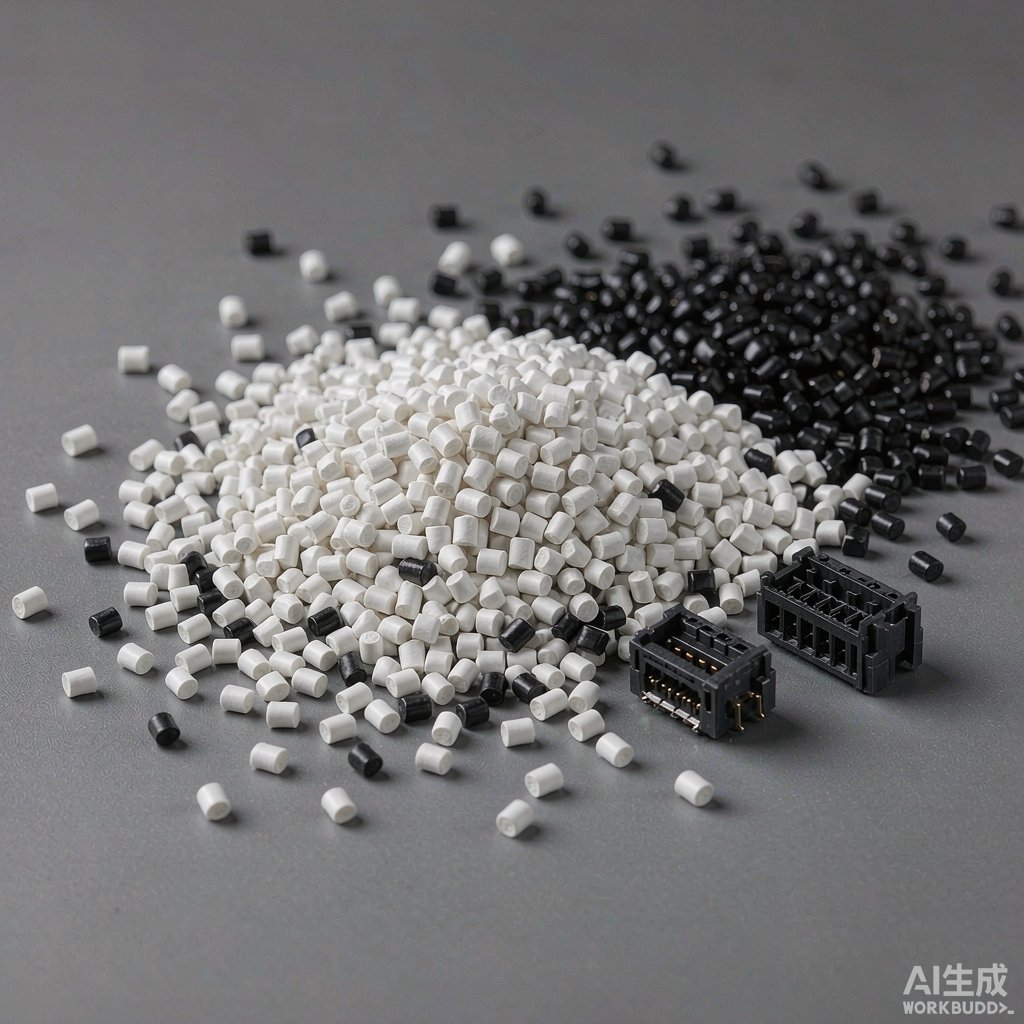
PBT is a semi-crystalline polyester with lower moisture absorption than polyamide, faster crystallization during molding, and excellent surface finish. These characteristics make PBT GF30 pellets particularly suitable for small, precision electronic parts with thin walls and tight pin-to-pin tolerances.
Key Material Properties
Mechanical Strength and Stiffness
The addition of 30% short glass fiber raises tensile strength to approximately 130 to 150 MPa and flexural modulus to 8 to 10 GPa. This stiffness keeps co
ector housings from deforming during pick-and-place, reflow soldering, and pin insertion. Creep resistance is also good, which is important for parts that must maintain contact force over years of thermal cycling.
Thermal Performance
PBT GF30 has a melting point near 220 to 230 degrees Celsius and a heat deflection temperature above 200 degrees Celsius at 1.8 MPa. It handles lead-free reflow peaks of 245 to 260 degrees Celsius for short durations without warping or blistering. Continuous operating temperature is typically rated from 120 to 140 degrees Celsius, depending on grade and reinforcement level.
Electrical Insulation
With a dielectric strength of 20 to 25 kV/mm, volume resistivity above 10¹&sup5; ohm·cm, and a comparative tracking index of 250 to 600 V, PBT GF30 provides reliable insulation between closely spaced terminals. It is available in natural, black, and color-coded grades for co
ector polarization and identification.
Moisture and Chemical Resistance
PBT absorbs significantly less moisture than PA66, typically below 0.1% under standard conditions. This reduces the risk of hydrolysis during reflow and minimizes dimensional changes in humid climates. PBT also resists common solvents, oils, and flux residues encountered in electronics assembly.
Molding Considerations
Drying
Before injection molding, PBT GF30 pellets must be dried to a moisture content below 0.02%. Typical drying conditions are 120 to 130 degrees Celsius for 3 to 4 hours. Inadequate drying causes hydrolytic degradation, surface defects, and reduced mechanical properties.
Melt and Mold Temperature
Melt temperatures range from 240 to 270 degrees Celsius, and mold temperatures from 60 to 90 degrees Celsius. Higher mold temperatures improve surface gloss and crystallinity but extend cycle time. For thin-wall co
ector housings, higher injection speeds and pressures help the glass-filled material fill intricate cavities.
Warpage and Shrinkage
Glass fiber reinforcement creates anisotropic shrinkage, with lower shrinkage along the flow direction than across it. Mold design should align fiber orientation with the direction requiring maximum dimensional stability. Gate location and wall thickness uniformity are critical for minimizing warpage in SMT parts that must sit flat on a PCB pad.
Flame Retardancy and Compliance
Many co
ector applications require UL94 V-0 flame retardancy. Halogen-free V-0 PBT GF30 grades are available for environmentally sensitive products. When specifying flame-retardant grades, confirm compatibility with reflow temperatures, as some additive systems can plate out on molds or degrade solder joint appearance.
Reliability in SMT Service
PBT GF30 co
ectors perform well through temperature cycling, vibration, and humidity testing. The material’s low moisture uptake helps maintain insulation resistance during biased humidity tests such as 85 degrees Celsius / 85% relative humidity. Relay bases molded from PBT GF30 also resist the heat generated by coil operation and contact arcing.
Selection Guidelines
Choose PBT GF30 for SMT co
ectors and relays when moisture resistance, dimensional precision, and good surface finish are priorities. Consider PA66 GF30 or LCP when higher temperature capability or ultra-thin walls are required. Always validate the selected grade with your actual reflow profile and end-use environmental testing.
PBT GF30 pellets continue to be a trusted material for high-volume electronics manufacturing. With proper drying, molding, and grade selection, they deliver reliable, cost-effective housings that survive the demands of modern SMT assembly.