When Air Cooling Reaches Its Limit
IGBT modules, SiC MOSFETs, and high-power rectifiers routinely dissipate hundreds to thousands of watts per package. At these power densities, air-cooled heat sinks become impractical due to size, weight, and acoustic noise. Liquid cold plates move heat away from the device baseplate through a circulating coolant, enabling thermal resistances below 0.05 K/W in well-designed systems.
Effective cold plate design is not simply about adding water cha
els. It requires balancing heat transfer coefficient, pressure drop, coolant chemistry, manufacturability, and reliability. This article summarizes the key engineering decisions for power electronics thermal management.
Cold Plate Cha
el Geometry
Parallel Cha
els vs. Pin-Fin Arrays
Parallel straight cha
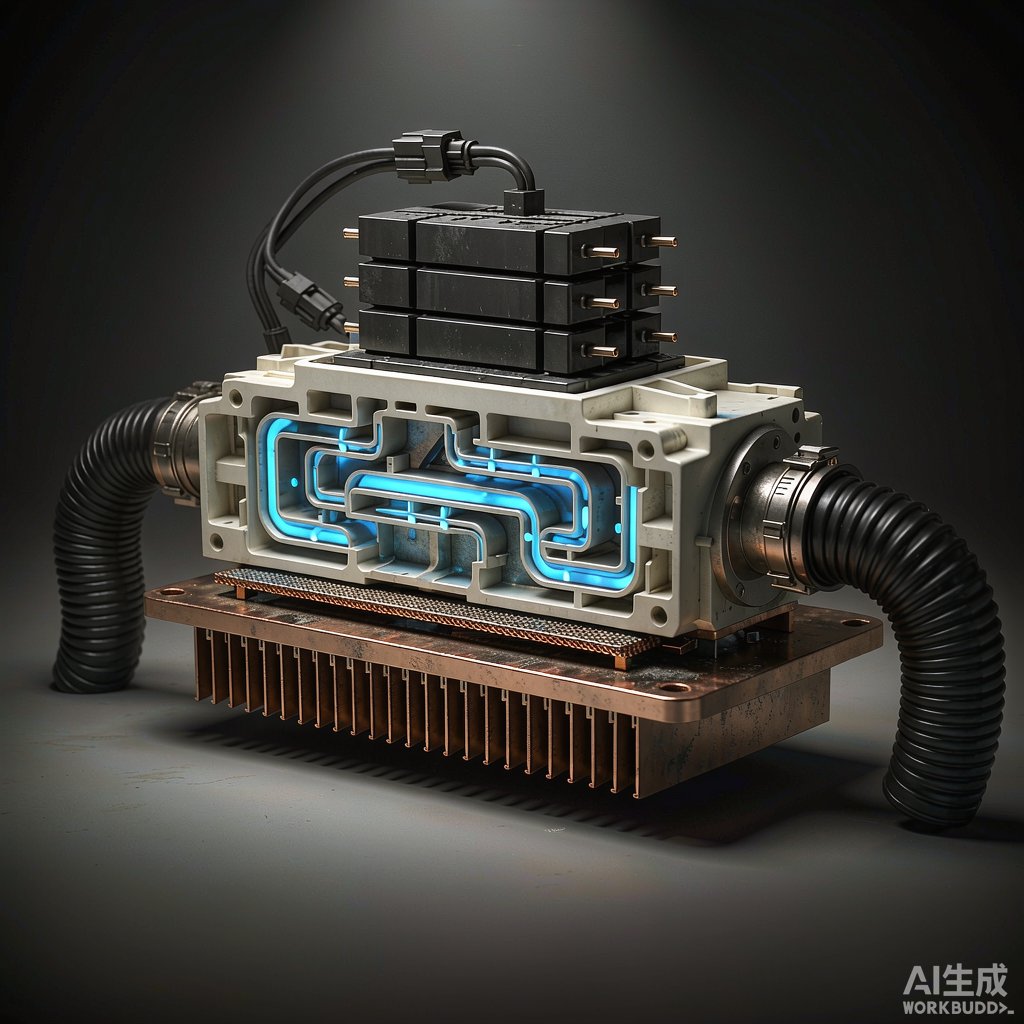
els are easy to machine and offer predictable flow. However, they create thick thermal boundary layers downstream, reducing heat transfer efficiency. Pin-fin arrays and interrupted fin structures turbulate the flow, break up boundary layers, and increase the heat transfer coefficient by 30–60% at the cost of higher pressure drop.
Cha
el Width and Aspect Ratio
For water-glycol coolants, cha
el hydraulic diameters of 1–3 mm provide a good compromise between heat transfer and pump power. Aspect ratios up to 4:1 increase surface area but raise tooling complexity. Additive manufacturing now allows conformal cooling cha
els that follow heat flux contours, reducing hot spots in IGBT modules with non-uniform power maps.
Material Selection
Aluminum Alloys
Aluminum 6061 and 6063 are popular for cold plates because of light weight, good thermal conductivity (~180 W/(m·K)), and excellent machinability. Anodizing is recommended to prevent galvanic corrosion when copper or nickel-plated inserts are used. Aluminum cold plates are common in automotive inverters and renewable-energy converters.
Copper and Copper-Tungsten
Copper offers nearly double the thermal conductivity of aluminum (~400 W/(m·K)) and is preferred when the cold plate doubles as a current-carrying busbar. For modules with very large silicon dies, copper-tungsten inserts match the CTE of ceramic substrates (AlN or Al2O3), reducing thermal fatigue during power cycling.
Coolant Selection and Reliability
Deionized water has the highest heat capacity and lowest viscosity but requires corrosion inhibitors and biocides. Propylene-glycol mixtures extend freeze protection to −40°C and are non-toxic, making them suitable for transportation applications. Engineers must verify compatibility with seals (EPDM, Viton, or silicone), aluminum passivation, and any copper brazed joints.
Thermal Interface and Mounting
Between the IGBT baseplate and cold plate surface, a thermal interface material (TIM) fills microscopic air gaps. Phase-change materials, graphite sheets, or thin-gap fillers with thermal conductivity above 4 W/(m·K) are common. Uniform bolt torque and a flatness spec of ±50 µm over the contact area prevent hot spots caused by poor contact.
Conclusion
Liquid cold plates unlock the next level of thermal management for IGBT and wide-bandgap power modules. By optimizing cha
el geometry, choosing compatible materials, and selecting the right coolant, engineers can keep junction temperatures within safe margins while minimizing pump power and system volume.