## Introduction
Gold plating on SMT co
ector contacts is the standard solution for low-contact-resistance, corrosion-free interfaces over years of service. Gold itself is expensive and soft, so the actual contact layer is a thin gold finish over a harder, cheaper underplate. Nickel is the dominant underplate because it provides a hard barrier that limits gold diffusion, blocks pore corrosion from the underlying copper alloy, and gives the contact surface the mechanical strength needed for repeated mating cycles.
The thickness of that nickel underplate is one of the most consequential design choices in the co
ector specification. Too thin, and porosity allows corrosion to creep through and contaminate the gold surface. Too thick, and the contact becomes brittle, hard to solder, and prone to stress cracking.
This article explains how nickel underplate thickness controls reliability in SMT co
ector contacts and provides practical thickness ranges by application.
## Why Gold Alone Is Not Enough
### Porosity in Thin Gold
Gold plating is rarely defect-free. At thicknesses below about 0.5 µm, the plating contains pores that expose the underlying metal to the atmosphere. In a coastal or humid Southeast Asian environment, chloride ions attack the exposed copper through those pores, forming copper chloride that creeps across the gold surface and raises contact resistance.
Thicker gold reduces porosity but raises cost dramatically. The standard compromise is a thin gold finish over a nickel underplate that blocks pore corrosion regardless of gold thickness.
### Diffusion Barrier Function
Copper atoms diffuse into gold at room temperature, and the rate accelerates at elevated temperatures. Without a barrier, the gold surface becomes a copper-gold alloy that tarnishes and increases contact resistance. Nickel serves as a diffusion barrier between the copper-alloy substrate and the gold finish.
## Nickel Underplate Functions
### Mechanical Support
Gold is soft, with a Vickers hardness of roughly 25 HV in the as-plated condition. By contrast, electrodeposited nickel is 150–400 HV depending on the plating bath. The hard nickel underplate supports the gold layer against wear during mating cycles, preventing the soft gold from being pushed aside and exposing the substrate.
### Solderability and Wire Bonding
For SMT co
ector contacts that are reflow-soldered to a PCB, the nickel underplate must be thick enough to survive multiple reflow passes without oxidation. For wire-bondable gold pads, the nickel thickness controls bond strength and the risk of nickel migration into the gold.
## Thickness Ranges by Application
### Telecom and Consumer Co
ectors
For USB, HDMI, RJ45, and similar consumer co
ectors, a typical specification is:
– Gold thickness: 0.05–0.10 µm (flash gold) for cost-sensitive consumer products
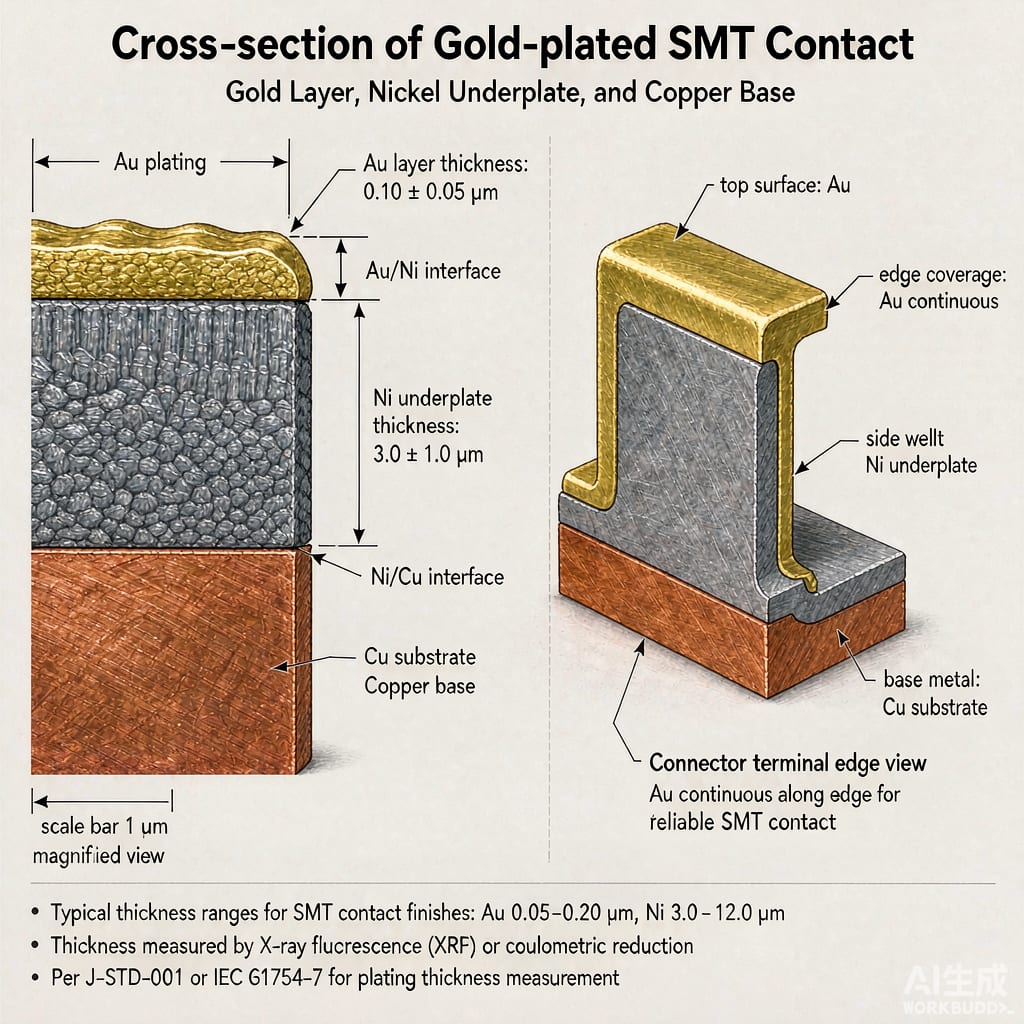
– Nickel underplate: 1.0–2.0 µm
At this combination, the nickel is thick enough to block porosity and provide mechanical support, but the entire plating system remains cost-effective for high-volume consumer manufacturing.
### Industrial and Automotive
Automotive, industrial, and outdoor co
ectors require longer service life and harsher environmental exposure. Typical specifications:
– Gold thickness: 0.25–0.80 µm
– Nickel underplate: 2.0–5.0 µm
The thicker nickel underplate protects against corrosion during extended service and at the higher operating temperatures seen in underhood and outdoor installations.
### Military and Aerospace
For mission-critical aerospace and military applications, gold thickness is often 1.0–2.5 µm with a nickel underplate of 5.0–10.0 µm. The cost is justified by decades of service life in extreme environments.
## Failure Modes Linked to Nickel Thickness
### Underplate Too Thin
If the nickel underplate is below about 1.0 µm, several failure modes appear:
– Pore corrosion reaches the copper substrate
– Gold diffusion through the underplate causes surface discoloration
– Reflow soldering dissolves the nickel and exposes copper to the solder pot
– Mechanical wear exposes base metal during mating
### Underplate Too Thick
If the nickel underplate is excessively thick, typically above 10 µm, the contact becomes brittle and prone to cracking under bending or impact. The plating also builds up internal stress that can cause the deposit to crack or peel during stamping or forming.
In SMT reflow soldering, very thick nickel underplates can develop nickel oxide or nickel-tin intermetallics at the solder interface, weakening the joint.
## Plating Process Control
### Sulfamate vs Watts Bath
Nickel sulfamate baths deposit low-stress nickel at high plating rates and are preferred for co
ector applications where the deposit must remain ductile. Watts nickel baths are cheaper but produce higher internal stress. For SMT co
ector contacts that undergo forming or stamping after plating, sulfamate nickel is the safer choice.
### Underplate Porosity Testing
Incoming inspection should verify the plating thickness and porosity using X-ray fluorescence (XRF) for thickness and a nitric acid spot test or ferroxyl indicator for porosity. For high-reliability applications, ASTM B733 and AMS-QQ-N-290 specify plating thickness, hardness, and porosity limits.
### Gold Layer Verification
Gold thickness is also measured by XRF, with verification at multiple points on each part. Hard gold (ASTM B488 Type I, Grade C) is preferred over soft gold for contacts because it resists wear better.
## SMT-Specific Considerations
### Co-Planarity and Solder Joint Reliability
The gold and nickel plating system adds about 1–10 µm to the contact thickness. For fine-pitch SMT leads, this thickness can affect co-planarity and therefore the solder joint formation during reflow. Designers should specify the plating thickness before finalizing lead geometry.
### Gold Embrittlement
Gold dissolves rapidly into tin-based solders, and if the gold layer is too thick, the dissolved gold forms brittle Au-Sn intermetallics that weaken the solder joint. The rule of thumb is to keep gold thickness below about 5 µin (0.13 µm) on SMT lead surfaces, or to tin-lead solder-plate those surfaces instead. For co
ector contacts that mate with pins rather than solder, thicker gold is fine.
### Storage and Reel Life
Pre-plated SMT co
ector reels should be stored in nitrogen-purged packaging to prevent nickel oxidation before reflow. Once removed from packaging, the recommended floor life before reflow is typically 6 months for tin-lead finishes and 12 months for gold-nickel finishes when stored below 30 °C and 60% relative humidity.
## Conclusion
The nickel underplate is the unsung hero of gold-plated SMT co
ector reliability. A well-chosen thickness, typically 1–5 µm depending on the application environment, blocks pore corrosion, supports the gold layer mechanically, and survives reflow soldering without compromising the joint. Specifying both gold and nickel thickness, the plating bath type, and the porosity acceptance limits gives co
ector manufacturers the information they need to deliver consistent field performance.