Introduction to CuNiSiCr Alloy Strip for SMT Applications
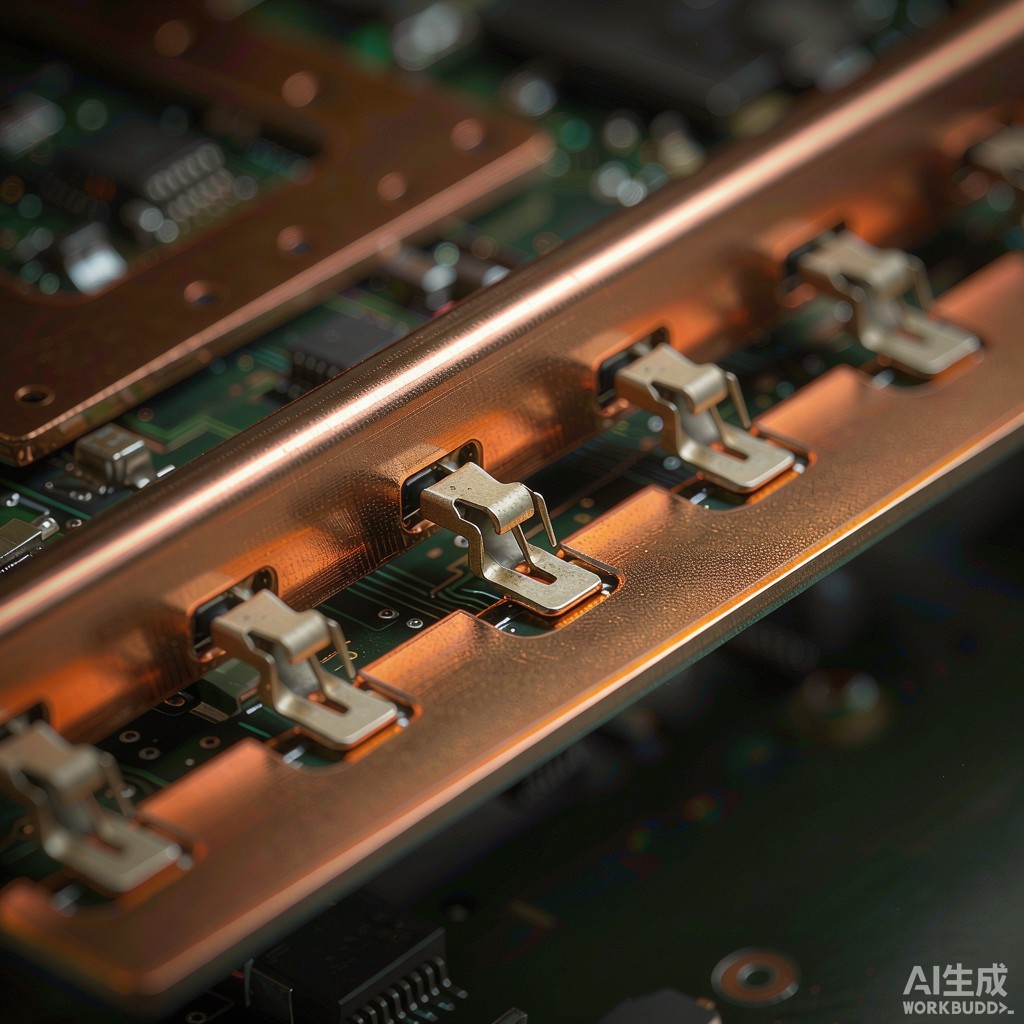
As surface-mount technology (SMT) continues to push toward miniaturization and higher pin densities, the mechanical and electrical demands on spring contacts have intensified dramatically. Traditional materials like brass (C2600/C2680) and phosphor bronze (C5191/C5210) have served the industry well for decades, but emerging applications in automotive electronics, 5G infrastructure, and medical devices require materials that can sustain higher temperatures, greater contact forces, and millions of mechanical cycles without degradation. Enter CuNiSiCr—a precipitation-hardenable copper alloy that is rapidly gaining traction among SMT co
ector and socket manufacturers worldwide.
CuNiSiCr alloy strip combines the excellent electrical conductivity of copper with the high strength and thermal stability provided by nickel, silicon, and chromium additions. Unlike conventional age-hardenable alloys such as CuBe2 (beryllium copper), CuNiSiCr contains no toxic beryllium, making it safer to process and increasingly preferred by OEMs with strict environmental compliance requirements. This article examines the metallurgical properties, performance advantages, and selection considerations for CuNiSiCr alloy strip in SMT spring contact applications.
Metallurgical Composition and Key Properties
The nominal composition of CuNiSiCr alloy strip typically falls within the range of 1.8–3.0% nickel, 0.4–1.0% silicon, and 0.1–0.8% chromium, with the balance being copper and trace elements. The alloy achieves its remarkable combination of strength and conductivity through a precipitation-hardening mechanism: after solution treatment and cold rolling, a controlled aging process causes nanoscale Ni₂Si precipitates to form within the copper matrix, dramatically increasing yield strength while maintaining respectable electrical conductivity.
In the fully aged (hard) temper commonly supplied for SMT strip applications, CuNiSiCr exhibits a tensile strength of 750–950 MPa, a yield strength of 700–850 MPa, and an electrical conductivity of 40–55% IACS. These figures place it competitively between high-conductivity, low-strength alloys like pure copper and C19400, and ultra-high-strength materials like CuBe2 or CuTi. For SMT spring contacts, this balance is often ideal: the material must exert sufficient contact normal force (typically 0.5–2.0 N per contact) over the lifetime of the product, yet it ca
ot introduce excessive electrical resistance that would compromise signal integrity or cause localized heating.
Performance Advantages Over Traditional Alloys
Superior Stress Relaxation Resistance
One of the most critical failure mechanisms in SMT spring contacts is stress relaxation—the gradual loss of contact force when the material is held under constant strain at elevated temperature. In automotive under-hood applications, co
ector operating temperatures can reach 125–150 °C continuously, with transient excursions to 175 °C during soldering or thermal cycling. Brass and phosphor bronze suffer significant stress relaxation at these temperatures, with force retention falling below 60% after 1,000 hours at 150 °C. CuNiSiCr, by contrast, typically retains 75–85% of its initial contact force under identical conditions, providing a substantially wider design margin and longer service life.
Excellent Formability and Bendability
Despite its high strength, properly processed CuNiSiCr strip exhibits outstanding formability. The material can be stamped into complex contact geometries with bend radii as small as 0.5× material thickness without cracking, enabling the tight packaging densities required by modern SMT co
ectors. This formability stems from the fine grain structure achieved through controlled thermomechanical processing, which distributes deformation uniformly rather than concentrating it at grain boundaries. For manufacturers transitioning from CuBe2, CuNiSiCr often runs on existing tooling with minimal adjustment, reducing capital expenditure and accelerating time-to-market.
Thermal Stability and Reflow Compatibility
SMT components must survive lead-free reflow soldering profiles with peak temperatures of 245–260 °C. Many precipitation-hardened alloys over-age during reflow, losing strength and spring characteristics. CuNiSiCr offers superior thermal stability because its Ni₂Si precipitates coarsen only minimally at reflow temperatures. Mechanical testing of contacts before and after three simulated reflow cycles typically shows less than 5% degradation in spring force, compared to 15–25% for some competing alloys. This stability is especially valuable for press-fit and compliant pin applications where the spring member must maintain dimensional precision after board assembly.
Surface Finish and Plating Considerations
Raw CuNiSiCr strip has moderate corrosion resistance due to its nickel content, but for SMT contacts it is almost always supplied with a surface finish. The most common options include:
- Tin plating (matte or bright): Cost-effective, solderable, and widely used for general-purpose signal co
ectors. Typical thickness 3–10 µm.
- Selective gold over nickel: Applied to mating surfaces for low-contact-resistance, high-wear-resistance applications. Nickel underlayer 1.5–3.0 µm, gold 0.8–1.5 µm.
- Silver plating: Preferred for high-current power co
ectors where minimizing contact resistance is paramount. Requires anti-tarnish treatment for shelf-life stability.
The silicon content in CuNiSiCr can occasionally complicate plating adhesion if surface oxides are not properly removed prior to plating. Reputable strip suppliers employ alkaline cleaning followed by mild acid activation to ensure a pristine surface for subsequent electroplating. When specifying plated CuNiSiCr strip, it is prudent to request adhesion testing per ASTM B571 or ISO 2819 to verify that the plating meets peel and thermal-shock requirements.
Selection Criteria and Design Guidelines
When evaluating whether CuNiSiCr is the right material for a given SMT spring contact design, engineers should consider the following decision matrix:
Choose CuNiSiCr when:
- Operating temperatures exceed 100 °C continuously or 150 °C intermittently.
- Contact normal force must remain stable over >10 years of service life.
- Beryllium-free material is required for RoHS, REACH, or corporate sustainability compliance.
- The design requires high-strength material with good formability for complex stamped geometries.
Consider alternatives when:
- Electrical conductivity >60% IACS is mandatory (e.g., high-current bus bars), in which case C19400 or C11000 may be preferable despite lower strength.
- Ultra-high strength (>1000 MPa) is required in very small cross-sections, where CuBe2 or CuNiSn may still be necessary.
- Cost sensitivity is extreme and operating conditions are mild; brass may offer adequate performance at lower material cost.
Conclusion
CuNiSiCr alloy strip represents a compelling advancement in contact material technology for SMT applications. Its combination of high strength, excellent stress relaxation resistance, thermal stability, and beryllium-free composition addresses many of the limitations inherent to legacy copper alloys. As co
ector pitches shrink, current densities rise, and operating temperatures climb across automotive, telecommunications, and industrial markets, CuNiSiCr is positioned to become the material of choice for demanding spring contact designs. Engineers specifying materials for next-generation SMT co
ectors should evaluate CuNiSiCr strip alongside established alternatives, using the performance data and selection guidelines presented here to make informed, application-specific decisions.