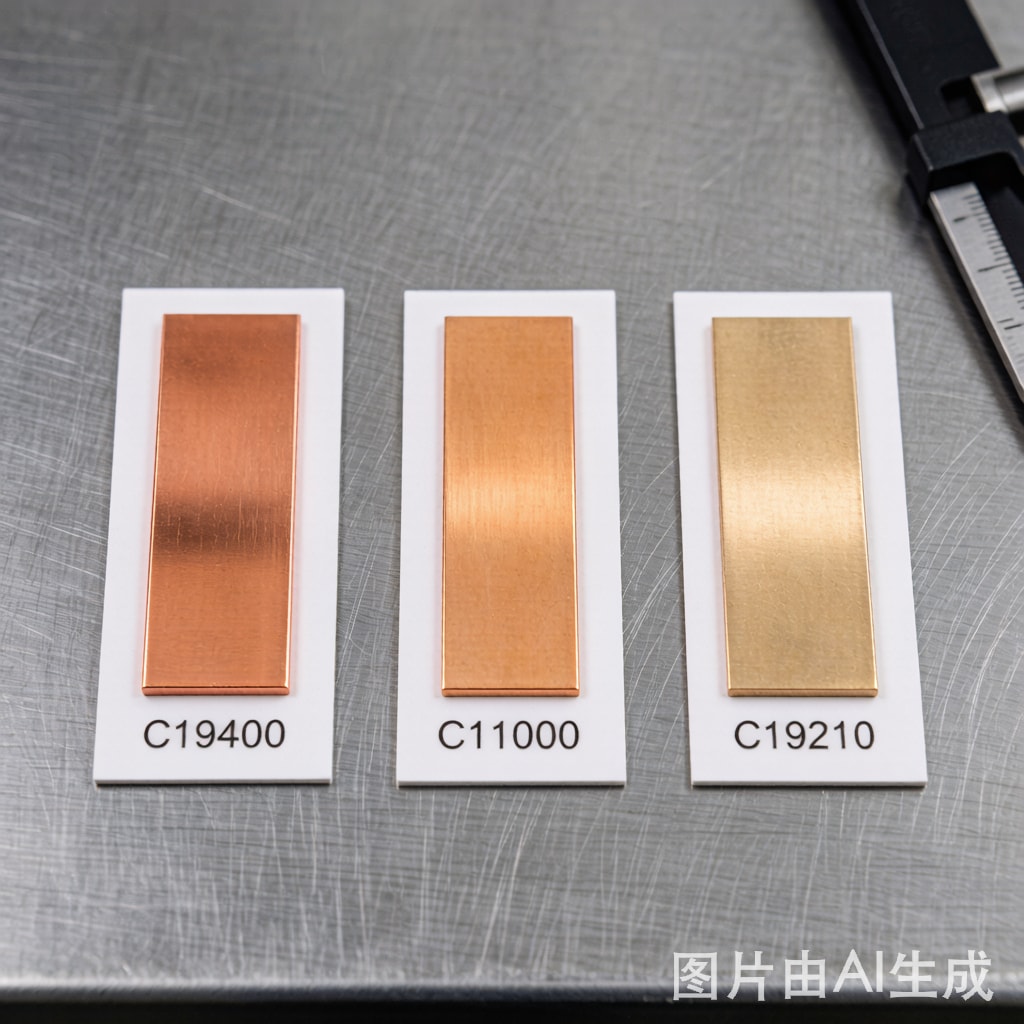
When an SMT lead frame design calls for a copper strip, the choice of alloy grade is rarely a simple “use the standard”. The three most commonly specified alloys in Southeast Asian electronics manufacturing — C11000 (ETP copper), C19400 (Cu-Fe-P), and C19210 (Cu-Fe-P-Ag) — span a wide range of mechanical strength, electrical conductivity, and cost. Selecting the right grade balances performance requirements against material cost premiums that can reach 30–60% over commodity copper.
Alloy Composition and UNS Designations
All three alloys conform to the Unified Numbering System (UNS) for copper and copper alloys, with the following nominal compositions:
| UNS Designation | Common Name | Composition |
|---|---|---|
| C11000 | ETP (Electrolytic Tough Pitch) | 99.9% Cu min, 0.02–0.04% O |
| C19400 | High-Copper, Fe-P | 97.5% Cu, 2.35% Fe, 0.03% P, 0.1% Zn |
| C19210 | High-Copper, Fe-P-Ag | 97.5% Cu, 0.85% Fe, 0.03% P, 0.1% Ag, balance Cu |
The 0.02–0.04% oxygen content in C11000 is the key metallurgical feature distinguishing it from the deoxidized C19400 and C19210 grades. The residual oxygen exists as Cu₂O particles distributed through the copper matrix, and these particles interact with hydrogen in ways that strongly affect high-temperature processing.
Mechanical Properties: Hardness and Formability
For SMT lead frame applications, the most relevant mechanical properties are yield strength (resistance to permanent deformation), tensile strength, and elongation (formability indicator).
| Property (H04 temper, 0.25 mm thick) | C11000 | C19400 | C19210 |
|---|---|---|---|
| Tensile strength (MPa) | 350–400 | 450–500 | 420–470 |
| Yield strength 0.2% offset (MPa) | 280–330 | 380–430 | 360–410 |
| Elongation (%) | 10–15 | 8–12 | 10–14 |
| Vickers hardness (HV 0.5) | 100–115 | 125–140 | 115–130 |
| Electrical conductivity (% IACS) | 100–101 | 60–70 | 80–85 |
| Thermal conductivity (W/m·K) | 390 | 260 | 320 |
The iron and phosphorus additions in C19400 and C19210 create iron-phosphide precipitates that strengthen the alloy through precipitation hardening. This delivers 30–40% higher yield strength compared to C11000 at the same temper. For lead frames requiring tight dimensional control after stamping, the higher strength of C19400 translates to better springback consistency and less part-to-part variation in fine-pitch geometries.
Electrical and Thermal Conductivity Trade-Offs
Alloying elements that strengthen copper invariably reduce its electrical and thermal conductivity. The relationship is governed by the Matthiessen-Nordheim rule — each atomic percent of solute adds resistance approximately linearly at low concentrations.
C11000 at 100% IACS sets the benchmark. C19400’s 2.35% iron drops conductivity to 60–70% IACS. C19210 with 0.85% iron and 0.1% silver achieves 80–85% IACS — a useful middle ground.
For power electronics lead frames where the copper strip carries significant current and dissipates heat from the die, the conductivity difference matters. A C19400 lead frame operating at 30 A continuous current will run approximately 15°C hotter than an equivalent C19210 lead frame. For thermal-sensitive applications (high-brightness LED, power MOSFET, IGBT modules), this difference can push junction temperatures past rated limits.
Hydrogen Embrittlement: The C11000 Vulnerability
C11000’s residual oxygen content creates a critical vulnerability: hydrogen embrittlement during high-temperature processing. At temperatures above 400°C in a hydrogen-containing atmosphere, hydrogen diffuses into the copper and reacts with the dispersed Cu₂O particles:
Cu₂O + H₂ → 2Cu + H₂O (steam)
The water vapor generated at internal Cu₂O sites creates high local pressure, leading to micro-voiding, grain boundary cracking, and dramatic loss of ductility. For lead frames that are subsequently exposed to hydrogen-containing atmospheres (such as H₂/N₂ bright a
ealing, hydrogen-rich reflow atmospheres, or reducing gas sintering), C11000 is unsuitable.
C19400 and C19210 are deoxidized — oxygen content is held below 0.005% — and are immune to hydrogen embrittlement. This single property is the primary reason that the global lead frame market has shifted to C19400 and C19210 even though they cost more per kilogram than C11000.
Formability and Stamping Performance
Lead frame production involves high-speed progressive die stamping at 200–1,200 strokes per minute. Tooling cost is amortized over millions of strokes, so any alloy feature that reduces tool wear has high leverage on production economics.
- C11000: Excellent formability, low tool wear. Draw depth up to 1.5× material thickness achievable without intermediate a
eal. Limitation: requires immediate plating after stamping due to rapid oxide formation in storage.
- C19400: Good formability in H04 temper. Draw depth limited to 1.2× thickness without intermediate a
eal. Slightly higher tool wear than C11000 due to higher hardness. Springback 8–12% higher than C11000, requiring stamping tool compensation.
- C19210: Best formability among the three at equivalent strength level. Draw depth up to 1.4× thickness. Tool wear comparable to C11000. Springback between C11000 and C19400. Most forgiving for complex lead frame geometries.
Cost Analysis (2026 Southeast Asia Pricing)
Approximate cost per kilogram for 0.25 mm strip in H04 temper, 1-to
e minimum order:
| Alloy | USD/kg | Premium vs C11000 | A
ual Volume Tier |
|---|---|---|---|
| C11000 ETP | $9.50–11.00 | Baseline (1.0×) | >100,000 to
es globally |
| C19210 | $12.50–14.50 | 1.3× | 10,000–30,000 to
es |
| C19400 | $13.00–15.50 | 1.35× | 50,000–100,000 to
es |
| C19400 (special temper) | $15.00–18.00 | 1.5× | 5,000–15,000 to
es |
| C7025 (Cu-Ni-Si, high-strength) | $22.00–28.00 | 2.2× | 1,000–5,000 to
es |
For an SMT lead frame consuming 50 to
es of copper strip a
ually, the cost difference between C11000 and C19400 is approximately $175,000–$200,000 per year. This is significant, but pales against the cost of a single field failure traced to hydrogen embrittlement cracking in a C11000 part exposed to a hydrogen-containing reflow atmosphere.
Plating Compatibility and Solderability
All three alloys accept standard lead frame plating (Ni, Ni-Pd-Au, Ag) with appropriate process control. The differences are in surface preparation requirements:
- C11000: Requires pre-plating pickling (5–10% sulfuric acid) to remove the native oxide layer. Pickling generates copper-bearing waste that requires treatment.
- C19400 / C19210: Cleaner surface post-a
eal, often acceptable for direct plating without pickling. Reduces waste treatment cost and shortens the plating line by 1–2 process steps.
For Sn-based lead-free solder attach, all three alloys provide adequate wetting with ROL0/ROL1 flux chemistries. Solder joint reliability in thermal cycling is approximately equivalent across the three alloys, provided the stamping-induced work hardening is properly stress-relieved by post-stamp a
eal where required.
Selection Decision Matrix
Choose C11000 when:
- No subsequent high-temperature processing in hydrogen atmosphere
- Maximum electrical/thermal conductivity is required (e.g., high-current busbars)
- Cost is the primary driver and formability dominates over strength
- Plating line already includes robust pickling capability
Choose C19400 when:
- High mechanical strength is required (fine-pitch, tight springback tolerance)
- Lead frame will be exposed to hydrogen during processing (H₂/N₂ a
eal, hydrogen reflow)
- High volume production benefits from the largest global supply base
- Application is QFN, DFN, or fine-pitch QFP lead frames
Choose C19210 when:
- Balance of conductivity (80% IACS) and strength is required
- Complex lead frame geometry demands maximum formability at moderate strength
- Power electronics application where 80% IACS is acceptable but C11000’s embrittlement risk is not
- Premium reliability is specified (automotive AEC-Q100, medical devices)
For the bulk of SMT lead frame production in Southeast Asia — consumer IC packages, standard QFP and SOIC lead frames, automotive power modules — C19400 has become the de facto industry standard, capturing an estimated 60–70% of new lead frame designs. C19210 occupies a meaningful but smaller share in higher-conductivity and more complex applications. C11000 retains its position in non-heat-treated busbars, motor windings, and applications where the cost premium of deoxidized grades ca
ot be justified.